
William Ernest Burke
Pre-WSC Background
William Ernest Burke was born on February 2, 1901, to Edmund Joseph Burke and Mary Kirk Burke in Wilbur, Lincoln County, Washington. Wilbur is located about an hour from Spokane, nestled in the center of wheat country. From the late 1800s to the mid-1900s, Wilbur was home to “Dane Town.” In its heyday, several thousand people lived in Wilbur, a quarter of them being first- and second-generation Danes. According to U.S. Census records, Edmund Burke was a grain merchant/dealer and was the son of Irish immigrants. He was fourteen years older than Mary Burke. The Lafollette Cemetery in Lincoln County, Washington, has two headstones with the name “Baby Burke” engraved on them. However, it is unknown when they were born and died. William Burke appears to be the only child of Edmund and Mary to survive infancy.
By 1910, Mary and her son lived independently in Bellingham, Washington. It is unknown if Edmund was officially separated from his family, as he worked as a farmer in Almira in Lincoln County. The family reunited at some point, and William attended Lewis and Clark High School in Spokane, where he graduated in 1919. Burke was noted to be a star basketball player while at Lewis and Clark. The 1920 U.S. Census records reveal that Burke lived with his father, and no occupation was listed.
WSC Experience
Burke attended WSC from 1919 to 1923. According to an article published in the Spokane Chronicle after his graduation, while at WSC, Burke continued to play basketball and won three letters in the sport. His basketball team was known as the “Cougar Five.” Burke also participated in football, although it is unclear if he was a starter. However, an article in The Evergreen published on April 11, 1921, shows he was hard at work with spring football training under Coach Welch.
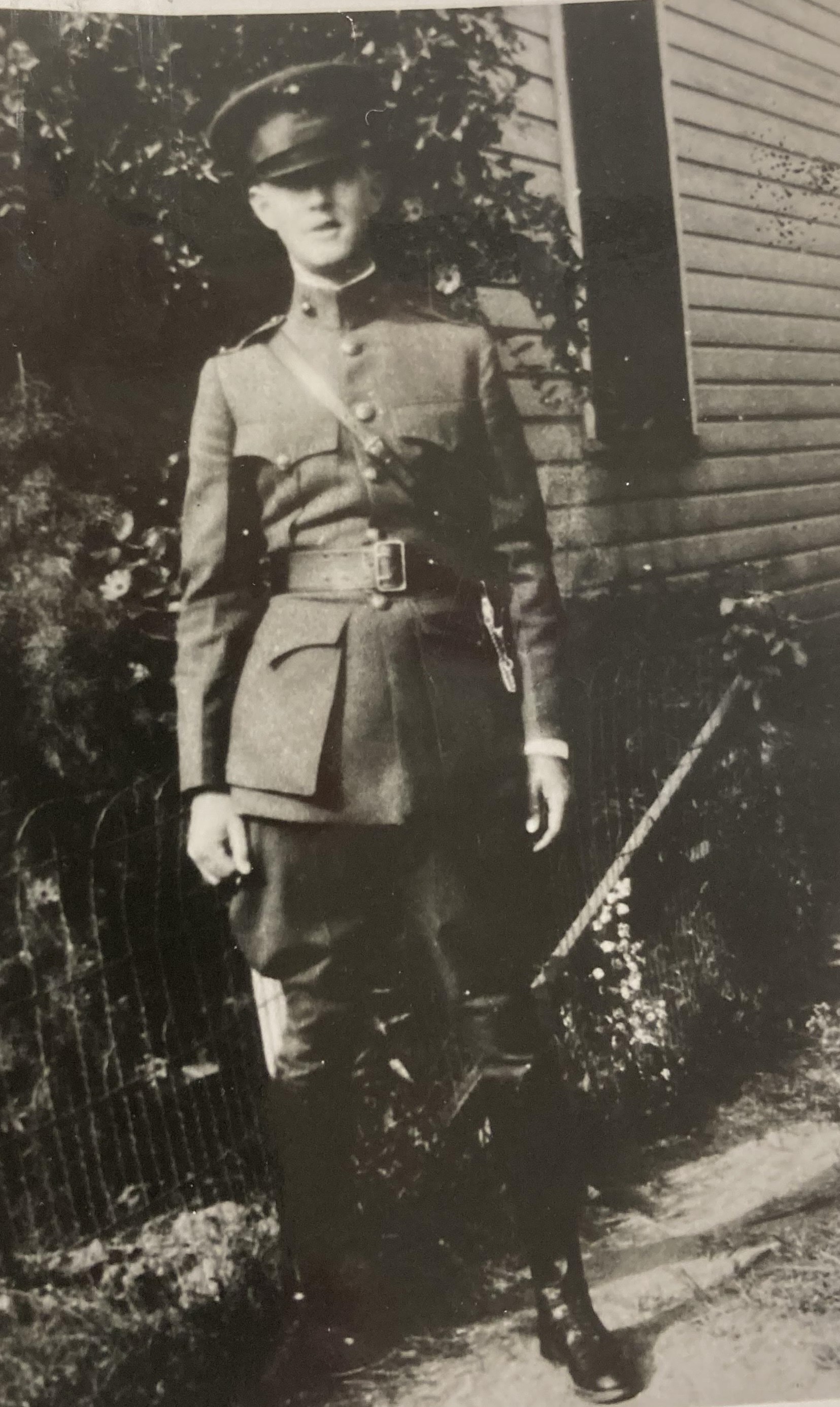
Burke was also a Major in the Reserve Officers Training Corp. (ROTC) while at WSC, where he won his commission as a second lieutenant following graduation. He was a member of the Automotive Trades Association and participated on the committee on dancing for a dance at Whitehead’s. The purpose of the Automotive Trades Association was to bring together socially all people interested in the automotive business and trade. Burke graduated from WSC in 1923 with a Bachelor’s in Agriculture.
Wartime Service and Death
Following his graduation from WSC, Second Lieutenant Burke joined the Marines and did his initial training in Quantico, Virginia. His mother noted after his death that she spent five months with him when he entered the Marine Corps at Quantico and that Captain Barnaby, Burke’s first Captain, said then that “Ernest would make a fine officer.”
Burke married Margaret Chase Easton, the daughter of a factory worker from Providence, Rhode Island, in January 1929 and took a honeymoon trip to New York. The couple would have three children together: Nicholas, born in December 1934; Meredith, born in 1937; and Crane, born in 1939. Burke and Margaret were sent to Nicaragua shortly after their marriage, where he served in the Panama Canal Zone. Burke returned to Quantico sometime in 1934 but left in January 1935 for winter maneuvers in southern waters. In February 1935, his parents received word that he had been promoted to Captain. Burke was Captain of the First Battalion of the Fourth Marines.
The First Battalion was activated initially in April 1911 as the 1st Battalion, 4th Marine Regiment. The battalion first saw combat action in November 1916 in the Dominican Republic, where it was charged with bringing “stability to the troubled island republic.” From February 1927 to November 1941, the battalion served in Shanghai and earned the title “China Marines.” Their duty in China was to protect the lives and property of American citizens in the International Settlement of Shanghai. The International Settlement originated in the Opium War of 1842 when Great Britain forced the Chinese to grant full trading privileges and the right of residence in Shanghai. By the time Burke arrived in 1935, the city had a population of over three million and was the leading port of China.
As captain of the First Battalion of the Fourth Marines serving in Shanghai from April 1935 to June 1938, he was among the officers commended by the commander of the Asiatic fleet for their performance in safeguarding American interests in the International Settlement during the Second Sino-Japanese War. This conflict, lasting from 1937 to 1945, was one of the most destructive conflicts of World War II. It marked the culmination of growing Japanese aggression toward China since the first Sino-Japanese War (1894-1895). By the end of World War II, 20 million Chinese would be dead, and 480,000 Japanese soldiers killed on Chinese soil. Despite their proximity to such brutality, the Fourth was exposed to the danger of small arms fire, stray shells, and bombs. By December 1937, Japan was in full control of the surrounding territory, and the 4th Marines became the sole protector of American interests in Shanghai following the departure of the 2nd Marine Brigade on February 17, 1938. Burke himself was sent to Washington, D.C., in 1938.
Japan, with its jurisdiction of territory adjacent to the city now assured, began a campaign to undermine the position of the Western powers in the International Settlement. While tensions soared between the Japanese and the American military in Shanghai, it was not until the fall of 1941 that Washington finally consented to the withdrawal of the 4th Marines. The era of the “China Marines” ended with the departure of the 4th Marines to the Philippines.
During World War II, Burke, now a Colonel, had been retired (Active) due to a valvular heart condition and was sent stateside. He was stationed in Washington, DC, where he was officer in charge of the procurement division at Marine Corps headquarters. He died suddenly at Bethesda Naval Hospital on November 12, 1944, of heart failure.
Postwar Legacy
Burke was buried at Arlington National Cemetery. His mother was devastated by the loss of her only son and, in a letter to E.O. Holland, stated that his death had “made me very unfit to write letters or do anything else properly.” However, she did note how pleased she was to be able to travel to his funeral service in Arlington. Interestingly, there is no communication between Burke’s widow, Margaret, E.O. Holland, or anyone else at WSC. Burke’s mother, Mary, could also not locate a photo of her son in his military uniform. She stated that there was one, but it was packed away.
Burke’s wife, Margaret, would go on to marry Winsor Harlow. Harlow was in the U.S. Air Force during World War II and the Korean War and retired after 30 years of service as lieutenant colonel command pilot. Margaret died in February 1986. Burke’s son Nicholas served in Vietnam as a Major in the United States Marine Corps. He had a son named Billy, likely named in honor of the grandfather he never knew. Burke’s youngest child, Crane, died at age 42 in a tragic sailing accident. His body was never found.
Burke is memorialized on the WSU Veteran’s Memorial.