
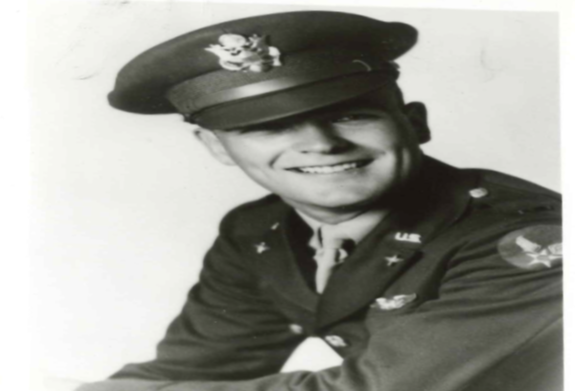
Walter Francis Chapin, Jr.
Pre-WSC Background
The Community of Post Falls, Idaho is mid-way point between its larger neighbors of Spokane in the west, and Coeur d’Alene in the East. Named after Frederick Post, a German immigrant that opened a lumber mill on land he purchased from Andrew Seltice, chief of the Coeur d’Alene tribe. Today the size of the city would leave people that lived there a century ago slack jawed. The explosive growth of its neighboring cities and the beautiful landscape has made the city home to a population of more than 27,000. But in the 1930’s and 1940’s the population grew from about 500 inhabitants to nearly 850. This is the Post Falls that Walter Francis Chapin Jr. grew up in, the community that molded him. He loved music, and one gets a sense from the sources that he had a flair, and good taste, in the dramatic. It is not altogether surprising that when this small-town Idahoan with an artist’s heart was called to war to protect his country, he did it in style, flying what is considered by many to be the most beautiful fighter plane produced during the war, The P-51 Mustang.
Walter F. Chapin Sr. was the son of a French immigrant, and Elizabeth M. Chapin grew up in New York. The 1930 census shows that their first daughter was born in 1918 and took her mother’s name, Elizabeth. On March 9, 1922, Walter F. Chapin Jr. was born, followed two years later by the third and final member of the Chapin clan, daughter Helen. The family lived at 86 Henry Street in a home valued at $3,700 in Post Falls, Idaho. Walter Sr. was a pharmacist and owned his own drug store in town while their children attended Post Falls high school. By 1940 the family’s circumstances had not changed much. Walter Sr. now listed his occupation as a “druggist” at a “retail drug store,” perhaps opting to sell his own business and take up working for a retailer.
WSC Experience
After graduating from Post Falls High School, Walter, Jr. enrolled at Whitworth College in Spokane. Walter Jr. was a busy boy in 1938 – 1940 performing in school activities, planning events, starring in local plays, performing his music at various functions, and ever the dutiful son, returning home to see family on breaks on vacations from school. On October 10, 1938, he was cast to play the lead role of Christopher Columbus in local church play. He continued his musical and artistic streak at Whitworth on the front page of the October 29, 1939 issue of the Spokesman-Review newspaper out of Spokane “inaugurating a daily flag ceremony at Whitworth, students fathered for the first flag-raising ceremony Tuesday when the Stars and Stripes were raised to the top of the new 65-foot long flag pole. Walter Chapin, Post Falls, is the bugler.” In November of 1939 he was one of nine students in charge of decorating the Isabella Room at the Davenport Hotel for Whitworth College’s 49th anniversary homecoming. I would be remiss in not pointing out that Walter was in a band called “The Whitmaniacs” at Whitworth college, and that the Whitmaniacs performed for their dormitory’s Open House event on March 16, 1940. Naturally, Walter was slated to perform a trumpet solo for the crowd in attendance. On April 2, 1940, Walter Jr. is listed among three Whitworth students’ home for Spring vacation. At the end of 1940 Walter decided what he wanted to do with his life and transferred from Whitworth College to enroll at in the music and education programs at Washington State College in Pullman, Washington. Walter made a lot of great decisions in his short life up to 1941, but it was his decision to transfer to Washington State College that proved to be his best choice, not because he would be a Cougar for the rest of his life, but because that is where he met Lois.
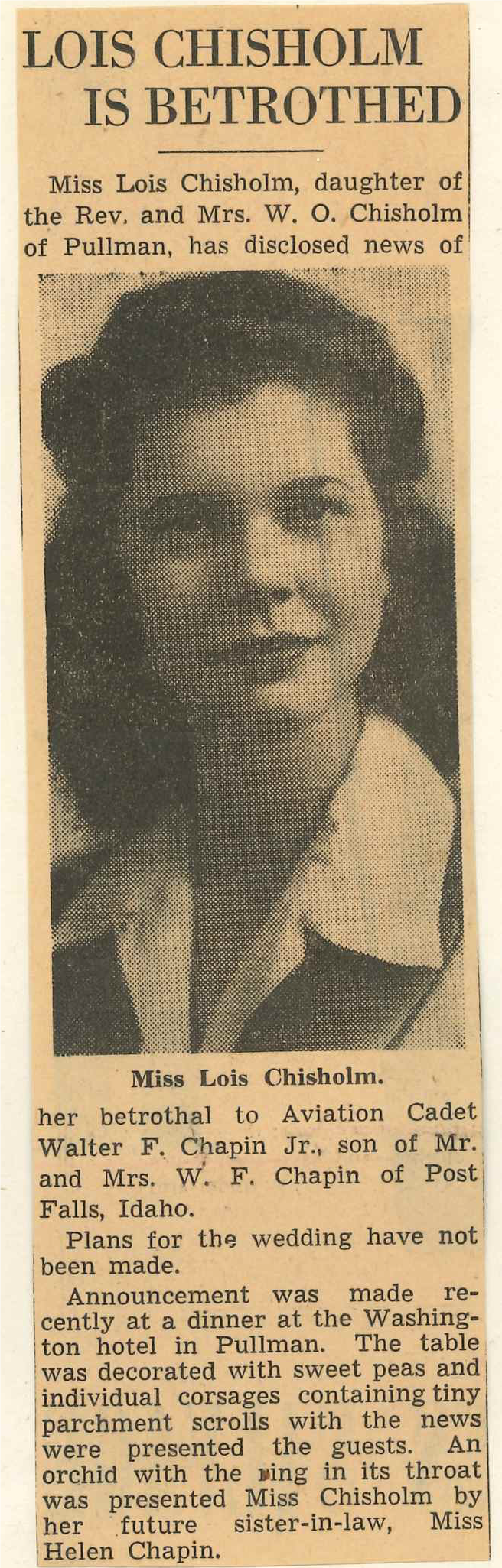
Lois Chisholm was in the music program at Washington State College when Walter arrived from Whitworth. She was the daughter of Reverend and Mrs. W.O. Chisholm of Pullman. It was at this exact moment, however, that the world outside threatened to encroach on Walter and Lois’s budding relationship. Walter and Lois courted from 1942 and 1943, through the Pearl Harbor attacks and a declaration of war between the United States and the Empire of Japan, with a declaration of war coming from Nazi Germany just four days after Pearl Harbor. Walter enlisted in the United States Army Air Corps on March 24, 1943, during his senior year at WSC and then finally asked Lois to be his wife. The Pullman community was atwitter when local newspapers announced, “LOIS CHISHOLM IS BETROTHED” in late 1943. “Miss Lois Chisholm . . . has disclosed news of her betrothal to Aviation Cadet Walter F. Chapin Jr. . . . of Post Falls, Idaho. Plans for the wedding have not yet been made,” the papers continued “The bride-to-be was a graduate from Pullman high school and is a sophomore in the department of music at Washington State College. But by the time the newspapers got to printing their stories, Walter was already going through his training to become a fighter pilot in the Army Air Corps.
Wartime Service and Death
In a letter sent to WSC President E.O. Holland, Walter Sr., a man after this historian’s own heart, wrote a detailed list of Walter’s trainings, complete with citations and footnote references for accuracy. Walter received his primary flight training at King City, California and basic training at Chico, California. He then continued to his advanced training at Luke Field, in Arizona where he earned his wings on January 7, 1944. Just in time for him to run home and get married. And if there was any doubt that the two artistically inclined music students would put on a good show at the wedding, that was dispelled quickly. The Spokane Chronicle provides a vivid description of the January 20, 1944, wedding:
Miss Lois Margaret Chisholm . . . and flight officer with the Army Air Force . . . were united in marriage this Thursday evening in an impressive double-ring ceremony reformed at the United Presbyterian church by the bride’s father, retired pastor of the local church. The service was read by candlelight at eight o’clock in the presence of a large fathering of relatives and friends. Organ music was played as the guests were being seated by miss Jane Loren, student at the State College of Washington, who accompanied Mr. Edwin Jungck, W.S.C student and friend of the Chisholm family, as he sang ‘O Promise Me’ and ‘the Lord’s Prayer.’ To the strains of the wedding march from Lohengrin, played by miss Loren, the wedding procession entered the church and formed at the chancel where they were met by Rev. John Haupt, pastor of the church who assisted with the service.
Walter’s baby sister Helen was the Maid of Honor waiting alongside her brother at the end of wedding aisle when Lois appeared at the far end, arm clasped with her father’s and looking radiant in “her wedding gown of white slipper satin and full-length veil. The gown was fashioned on Princess lines with a yoke of seed pearls long pointed sleeves and a long train. Her veil was held with a coronet of seed pearls, and she carried a bouquet of deep-red roses. As the traditional something old and borrowed she carried a lace handkerchief belonging to Mrs. M. Louise Campbell.” But the article is quick to point out that the happy couple did not have long together, as Walter was leaving the following Saturday for Tallahassee, Florida to complete more training specific to the machine he would be flying in Europe, the P-51 Mustang. Lois accompanied him in Tallahassee while he completed his training and returned to her studies when he deployed for Europe in July of 1944.
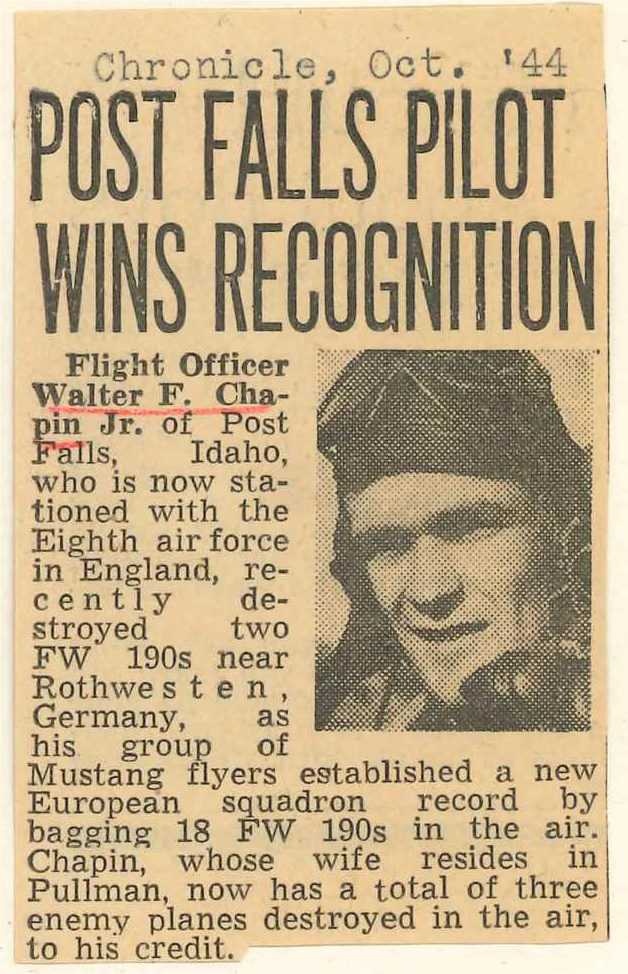
Walter was promoted to the rank of F/O, or Flight Officer, and assigned to the 376th Fighter Squadron of the 361 Fighter Group of the Eighth Air Force. The 361st was assigned the famed P-47 Thunderbolt fighter planes, but the 376th Squadron was assigned the newest model of the P-51D. The P-51D could carry extra fuel tanks on its wings, with top-of-class speed, maneuverability, and outstanding armament, it was a dangerous fighter that was capable of escorting long range heavy bombers deep into the heart of Germany where they could finally target its most vital logistical operations (factories, railroad depots, airfields, vehicle parks, etc.). Upon his arrival in England Walter was stationed at Bottisham airfield until the 361st was reassigned to Little Walden Airfield on September 26, 1944. Walter quickly made a name for himself as a fighter pilot. Newspapers back home eagerly followed the exploits of their native son as he toured the skies of the European theater. “In his last letter to his parents F/O Chapin said that he had flown over nearly every large city in Germany and had been over Berlin and Leipzig on the day that he wrote the letter.” His duties varied depending on necessity, and the unique capabilities of the P-51 made it suitable to all types of missions. “He was engaged in strafing, dive-bombing, escorting bombers and supporting advancing forces in France he said in his letters.” But perhaps what he was best known for, and the actions that won him the air medal, was his dog-fighting talents. “A recent news release from the Eighth Air Force Fighter Station in England stated: ‘Flight Officer Walter F. Chapin Jr., of Post Falls, Idaho, destroyed two FW 190’s recently near Rothwesten, Germany,” extolled the Pullman Herald. “His squadron established a new European Theater of Operations squadron record by bagging 18 FW 190’s (Focke-Wulf 190 German fighter planes) in the air. Three additional aircraft were destroyed on the ground.” Walter and his wing mates had just finished escorting their bombers to their run on Rothwesten when, in his words, a “gaggle” of FW 190’s descended from the clouds and began firing at the bombers. They then dove into a lower level of cloud cover when Chapin and the P-51’s gave chase. “I singled out one of them” recalled Walter, “and followed him for about 120 miles, finally getting him into combat at about 500 feet. I got on his tail, have him a short burst and he bailed out, his plane winging into the ground.” Walter then broke off contact and searched for a new target, laying eyes on another FW 190, and pursuing once more. “He tried every trick in the book, but I finally got him too.” Wrote Walter. “Chapin’s latest victories give him a total of three enemy aircraft destroyed in aerial combat. He flies a P-51 Mustang named ‘Angel Puss.’” Another newspaper claims the name of his plane was the “Sugar Puss,” but this researcher could not find a record of a P-51 with that name, however “Angel Puss,” does have a record in the database (Number: 44-13888). These incredible feats were the events of October 10, 1944. Unfortunately, October 11, 1944, came.
The Angel Puss, or Sugar Puss, was not the plane that Flight Officer Chapin was flying on October 11, 1944. For whatever reason, perhaps his plane was damaged or needed repairs after his successful dogfights the day before. But his plane was not ready that day. Walter jumped into the cockpit of another P-51 (Number: 42-106802) called “Blue Eyes.” He took off from Little Walden but there was a structural failure in one of the aircraft’s systems when trying to land. The plane crashed at Little Walden, killing him instantly. Flight Officer Chapin engaged in 17 combat missions over enemy territory in just his last 34 days of service. These missions included patrols of the Siegfried Line and of airborne attacks in the Ruhr Valley with targets including Dusseldorf, Stuttgart, Magdeburg, Mannheim, Hamburg, and Rothwesten, wrote Walter’s father in his well-cited letter to E.O. Holland. He won his first dogfight in the skies over Magdeburg, shooting down an ME 109 (Messerschmidt 109 fighter plane) before his two-plane day over Rothwesten.
Postwar Legacy
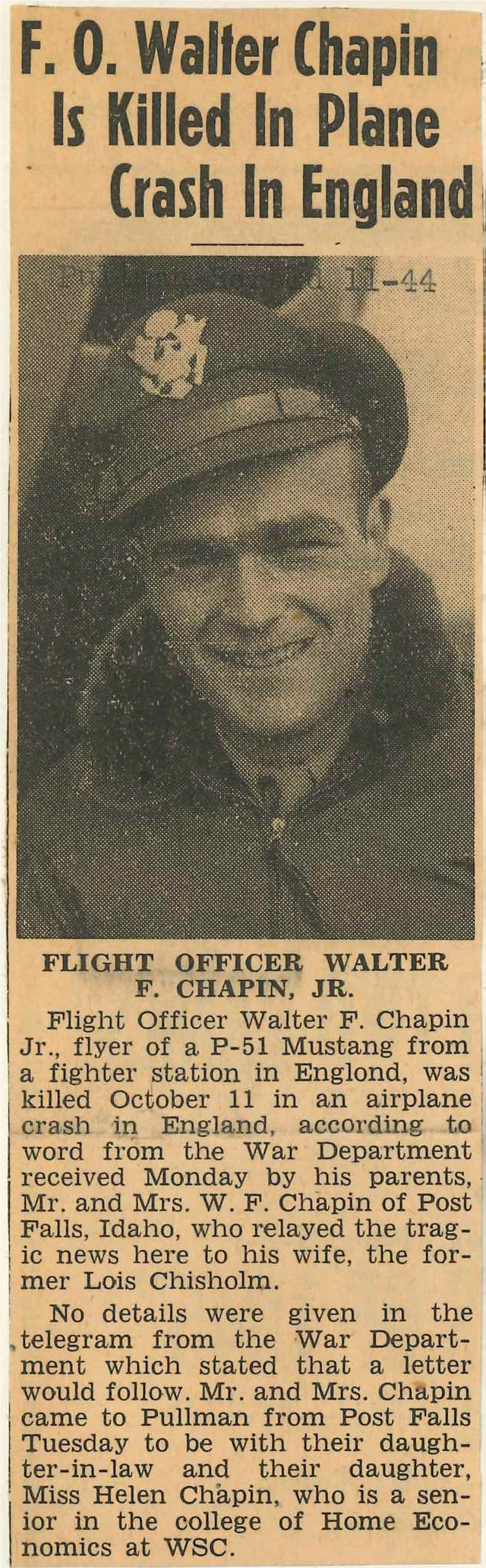
The community and Walter’s family were left bereft by his loss. Newspapers covered his story every step of the way. At Washington State College, Dr. E.O. Holland sought to ensure that all WSC men that died in the war were properly honored. He and the college administration put together pamphlets, Brochures, plaques, and poems to the fallen soldiers. He corresponded regularly with parents and sent each of them a framed poem fitted to hold a picture of their lost loved ones. In one letter to the Chapin parents, Dr. Holland wrote ““I knew Walter since he attended the State College of Washington from 1940 – 1943. He weas a splendid college citizen and a young man of character, capacity, and promise. . . I am proud that I knew Walter F. Chapin Jr.” The Chapin family was moved by the efforts of the college to honor their war dead, a cause the current Fallen Cougars Project seeks to carry on. The Chapin’s wrote to Dr. Holland in May of 1945 “Dear Mr. Holland, We deeply appreciate the certificate recently sent from Washington State College paying tribute to our son, F.O. Walter F. Chapin Jr. who gave his life in the service of our county last October 11th. We also thank you and the faculty for your fine personal tribute to Walter.”
Walter was memorialized and laid to rest next to his brothers in arms at the Cambridge American Cemetery and Memorial in Coton, South Cambridgeshire, England in Plot F, Row 7, Grave 33. On June 10, 1945, the Spokesman-Review reported that Walter had been awarded the Air Medal for his valor in the face of the enemy in the skies over Nazi occupied Europe. Lois attended the medal ceremony and accepted the honor on behalf of her Fallen Husband. Walter is also memorialized at his Alma Mater, today called Washington State University. It is the place where he met the love of his life, got married, and joined the military. The place where he sang, played his trumpet, and pursued his goal to teach music to future generations. And today it is the place where his name is emblazoned in gold letters alongside the names of more than two-hundred of his fellow Fallen Cougars who gave their lives in service to their country, and to whose families we can never fully repay.