
Stephen Forest Daniel
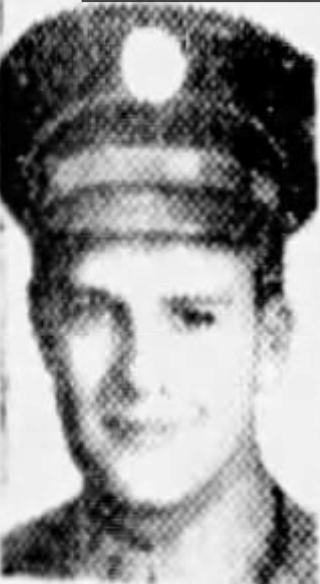
Pre-WSC Background
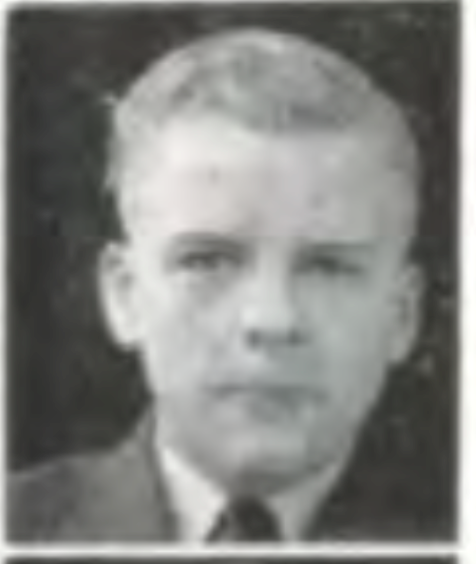
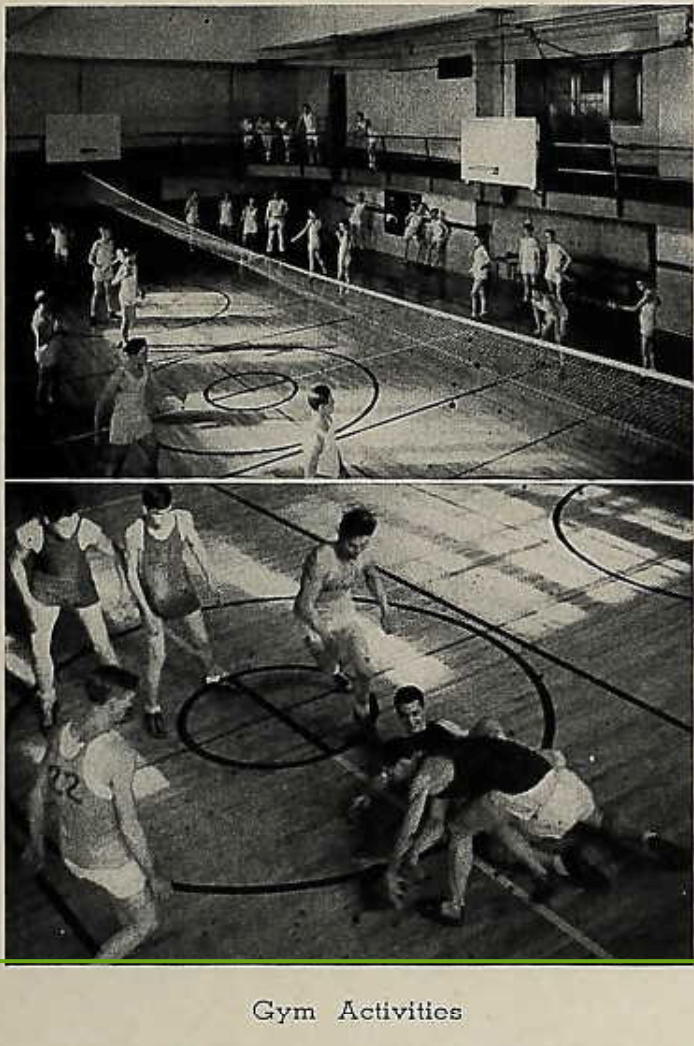
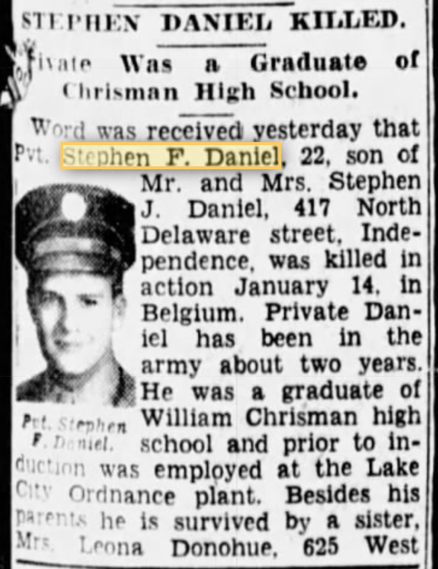
Stephen Forest Daniel was born 7th of June 1922 in Jackson County, Missouri. The second child, and only son, of parents Stephen John Daniel and Berenice Fannie Daniel (nee Boothe), Stephen was born in Independence, Missouri, in a suburb that is now a part of Kansas City. Stephen was named after his father and maternal grandfather. His family, on both sides, were multi-generation Missourians, relocating to Missouri in the early 18th century from Virginia and Indiana. Stephen’s older sister, Mary Leona, was born in 1921, a year after his parents were married. The siblings grew up in Independence, moving infrequently and enjoying a fulfilling and stable childhood. While few records remain of Stephen’s early life, he does appear often in his high school yearbook, where he displayed an early affinity for sports. In his senior year at Williams Crisman High School, Stephen achieved a score of 975 in his school’s annual gym letter test, being outscored by only one person. Stephen also played basketball in his school's noon league. His team, the “South Siders,” won the AA league, and in the same semester, Stephen individually won a class aerial darts tournament, competing in the school final. After high school, Stephen worked for a brief time at the Lake City Ordinance Plant (established by Remington Arms in 1941), testing and developing small-caliber ammunition for the US Army. Around the end of 1942 and the beginning of 1943, Stephen enlisted in the Army.
WSC Experience
As a part of enlisting in the United States Army, Stephen tested into the Army Specialized Training Program (ASTP). ASTP was a nationally funded program that sought to produce specialty-trained infantrymen for the war effort on a reduced timeline. Although the program advertised itself as a pipeline leading to Officer Candidate School, the primary goal of the program was to incentivize potential specialists. More than 200 schools from across the United States participated in the program, allowing young, enlisted men to attend their college programs for one or two years as student-soldiers.
While at Washington State College, Stephen partook in the Basic Engineering program. His records indicate that he studied basic physics, engineering, military science, mathematics, and chemistry during his first year. Stephen attended Washington State College between 1943 and 1944. While there, the Army Specialized Training Unit #3929 served as active participants in campus life. The majority of the ASTP were housed in WSC fraternities, which had been closed at the end of the 1942 academic year due to declining enrolments. Alpha Tau Omega, Alpha Gamma Rho, and Sigma Phi Epsilon were selected to host the engineers. Stephen may have resided here during his time at WSC, or in the former women’s dormitories, such as Duncan Dunn and Community Hall. Many soldiers participated in intramural activities and academic clubs, helping to sustain these programs during wartime. At the end of Stephen’s third academic term, in March 1944, the ASTP program was abruptly dismantled in response to the escalating need for frontline infantrymen. Active students were then sent to basic training and subsequently deployed to Europe. “Company B” of WSC’s ASTP Engineers was fully liquidated, and Stephen and his classmates were sent to Camp Roberts for basic training.
Wartime Service and Death
A majority of boys still in the Army Specialized Training Program at the time of its closure in March 1944 were eventually assigned as reinforcements to Army infantry divisions which had been depleted in Europe. From Washington State College, around 230 of the 667 men who were assigned to Unit #3923 were assigned to the 11th Armored Infantry Division of the US 3rd Army. Stephen served in A Company of the 21st Armored Infantry Battalion.
Stephen would have attended basic training at Camp Roberts and Camp Cooke in California, before moving on to Fort Benning (now Fort Moore) and then to England, ultimately deploying to the front in France. The 21st Armored Infantry Battalion was created out of the 55th Armored Infantry Regiment in the Fall of 1943. The Battalion was activated at Camp Polk, in Louisiana, before relocating to Camp Cooke, where Stephen would have joined them after completing basic training. The Battalion arrived in Barneville, France, in December 1943, before pushing East throughout the winter and spring into Belgium. Stephen fought at the Battle of the Bulge in 1944 and by January 1945 had reached Chegnone. Stephen was killed in battle at the very end of the Battle of the Bulge, on January 14th in Belgium. At the time, his company was clearing the woods east of Noville of German forces. It is unknown how exactly Stephen was killed. Today he is buried in Luxembourg American Cemetery. He received the Purple Heart for his sacrifice.
Postwar Legacy
As is the case with many veterans, Stephen’s legacy speaks more through his absence in the historical record than his presence. In the years after his death, Stephen’s sister Mary Leona also perished of an unknown cause, and in the wake of this tragedy, his parents separated. Stephen’s father remarried in 1956. Neither of Stephen’s parents had more children, and by all accounts, their direct family line ends with Stephen J Daniel’s death in 1969. Despite this, and despite the general lack of information surrounding Stephen’s lived experiences, today more than 21 families actively claim him as a distant relative across shared genealogy databases, and in his absence, these families continue to dispute his registered information. In this way, Stephen’s memory, though lost to history in many ways, still plays an active role in the lives of his extended family in the 21st century.
In an academic setting, Stephen played an important role in the development of this project. It is through the discrepancies in his file that researchers for the Fallen Cougar Project began to unpack the depth of military training programs that were birthed on Washington State College’s campus in the Second World War. This prompted us to the sheer number of young men who passed through the Palouse on their way to war, largely undocumented in the memory of our own community institutions. Stephen’s life, or moreover, his pressing absence, triggered this reexamination and so, in this way, the regrouping of information about WSC veterans who passed through ASTP, ASTrP, and War Training programs is a key part of Stephen’s individual legacy.