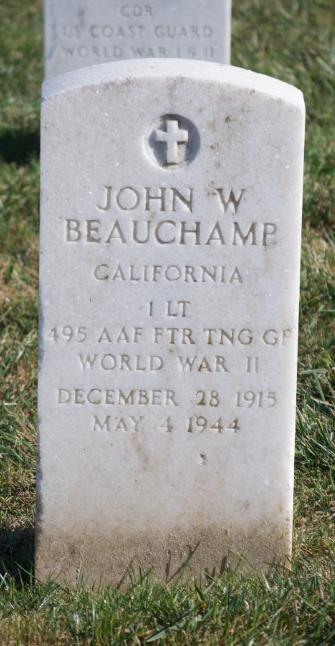
John Woodrow Beauchamp
Pre-WSC Background
In 1861 Thomas Baker, a lawyer and former colonel in the Ohio state militia moved out west to try his fortunes looking for gold in California. Baker settled on a small piece of flat land hugging the Kern River. Before long the area became a popular stop along the way to California gold country, and travelers referred to Thomas Baker’s little piece of land as Baker’s Field. By 1920 the area had a population of almost 20,000 and became the seat of the newly established Kern County. By 1930 the population continued to grow, climbing over 25,000. Unlike many cities established due to the gold rush that quickly folded or shrank after its end, Bakersfield continued its ascent. While 25,000 may be a paltry number compared to modern day Bakersfield, which boasts a population of nearly 350,000, it was quite a large town by the standards of the day. It was in Bakersfield in the 1920s and 1930s that John Woodrow Beauchamp was born and raised. John did not have an easy life as a young man born into what appears, from his mother’s letters, a poor family caught in the grips of the depression. But John was a fighter from an early age, a young man of talent and ambition but with a kind heart and a soft spot for animals that brought him to Washington State College.
While it is possible that this is a series of typos in the 1920 census, it seems very unlikely. It appears that John W. Beauchamp’s given name at birth was John Woodrow Beacham. The son of Charles M. Beacham and Olive Beacham, he was born in 1915. Charles lists his occupation as “real estate” and was in his own employ. Charles and Olive had four children. David was the eldest at seven years old in 1920, John was four years old, Phillip was two years old and baby Alice was just five months old at the time Charles filled out the census. Unfortunately it was the only census they would all get to take part in as a family. In a letter to Washington State College President E.O. Holland written in 1944, Olive explained that John “was such a sincere, good son and very studious. His father died when he was five, his stepfather when he was seventeen.” The death of John’s father at such a young age and while the country was in such economic despair could not have been easy. Olive remarried after Charles’s sad passing to one Vernon J. Nicholson. It is in the 1930 census that the name “Beauchamp” takes the place of Beachem for the children.
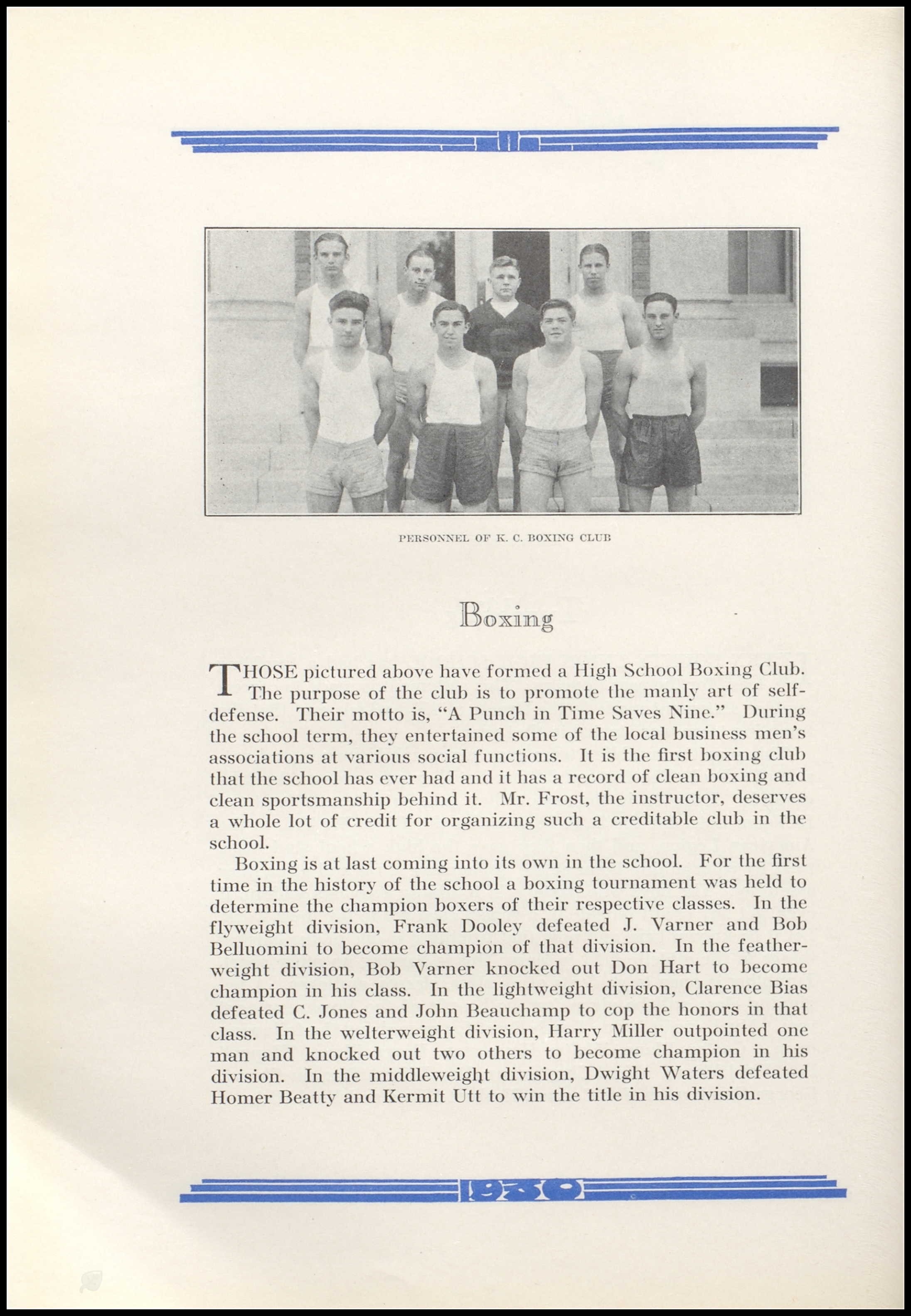
Vernon also seemed to be a good man. He and Olive had a son of their own, named after the father of his half-brothers and sisters, Charles, and his own father, Vernon. Little Charles Vernon Nicholson was just ten months old at the 1930 census. Vernon worked as an electrician, specifying that he was a contractor, which paid well enough to keep the family home at 1000 Wilkins Street, not something guaranteed in the Great Depression. John only had three years with his stepfather before he, too, passed away. But they were formative years for John. He attended Kern County Union High School, home of “The Drillers,” a reference to the oil-rich lands and profession ubiquitous in the area. He was a member of the Boxing Club, and it appears he was not a half-bad pugilist, making his way to the championship fight for the lightweight division in his class. John was not a traditional high school student, however. His mother told E.O. Holland that “he still wanted to go to college and with the help of us all and hard work out in the oil field all summer he managed to go. He earned all his spending money and paid for his own clothes from twelve.” At the age of twelve, he was also “working in a dairy,” and that is when he “entered high school at twelve years and one month. Graduated high school at fifteen years and five months.” His work at the dairy proved to be most impactful on his life. Olive reports that “His work at the dairy decided what he wanted as he loved . . . animals in general.” The young man who lost his father at the age of five, lost his stepfather at seventeen, enrolled in school at the age of twelve, graduated at the age of fifteen, earned money for the family, and paid for his own clothes also somehow saved up enough money to follow his passion in life, to care for sick and injured animals. This passion drove him to attend Bakersfield Junior College after high school.
WSC Experience
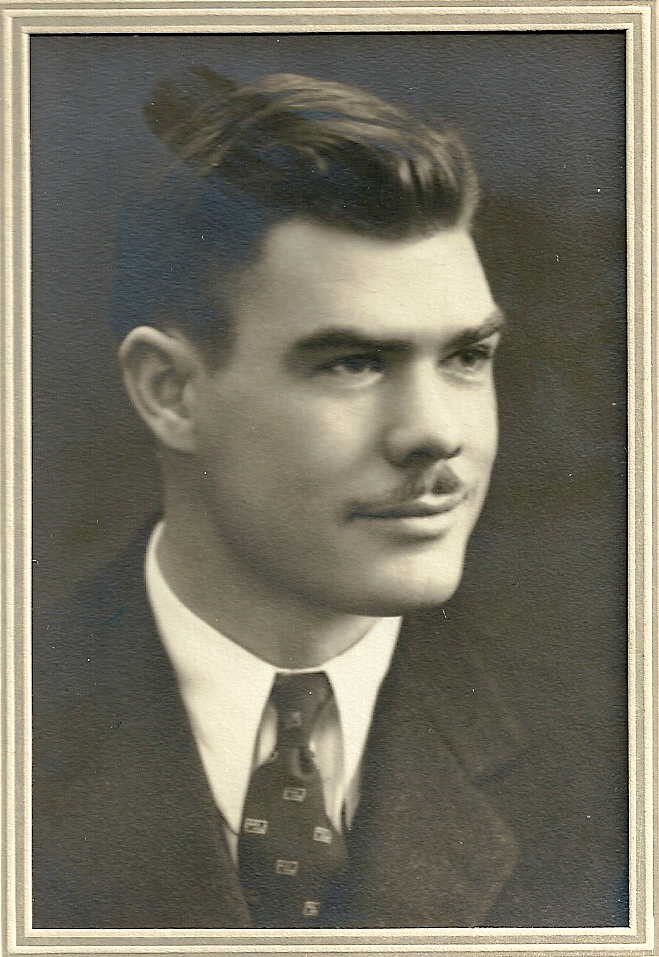
John Beauchamp enrolled in Junior College and according to newspaper articles produced after his death he graduated from Bakersfield Junior College with both athletic and scholastic honors. With that level of education completed, he looked for Veterinary Medicine programs to continue pursuing his dream of being a veterinarian. He found one such program at Washington State College, and in 1935 he left his native state of California bound for the Pacific Northwest and Pullman, Washington. John settled in nicely in the College Community in Pullman. He had grown into quite the handsome young man, with dark hair he wore slightly long on top and parted on the side, with a slick Hollywood-esque mustache and a strong jaw line, he is easy to pick out of the senior class yearbook where he is featured on page 85. He joined the Junior American Veterinary Medical Association (A.V.M.A) and is listed in the yearbook for that as well. John graduated from WSC in the class of 1939 with a Bachelor of Science and a Doctor of Veterinary Medicine (D.VM). John was remembered well by faculty and administration. College President Holland sent the Beauchamp family a framed poem in honor of her son after John’s sacrifice and in the accompanying letter wrote “You may consider this memorial a sincere expression of the deep regret with which this news was received by all of his many friends on the campus and among the alumni of the State College. During his years here, your son made an excellent record; you may be sure that we are very proud to have him as an alumnus.”
After completing his degrees at Washington State College John returned home to California and opened his own veterinary clinic, the scrappy kid had achieved his dream by the age of 26. The Spokesman-Review newspaper out of Spokane wrote that John opened his first practice in Redding, California, after graduation, but he may have also had a practice in Taft, California. In her letter, John’s mother recalled her son’s businesses, stating “He was in business for himself when he was called to the colors and was getting along fine and planning on being in business again when he was free.”
Postwar Legacy
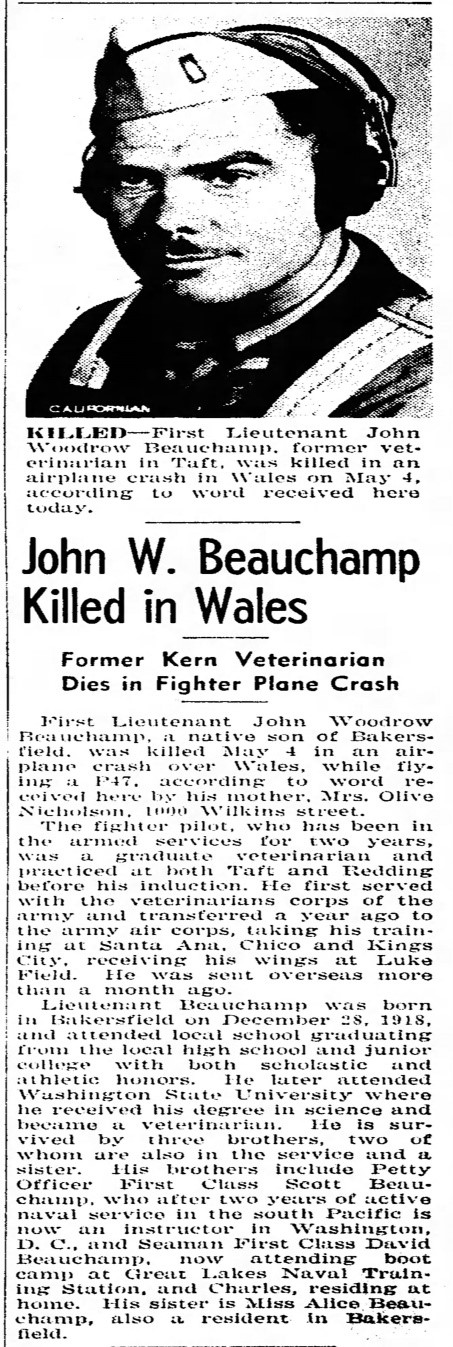
News of John’s death left the Beauchamp-Nicholson family and the community bereft. Numerous articles appeared in newspapers with photographs of John and descriptions of his life’s journey and its tragic end. What must have made it even more difficult for his mother, Olive, was that she had two more sons in the war. She wrote to E.O. Holland “There is two other brothers David and Scott Beauchamp in the Navy. Scott has been in six years and seen a lot of action but is now stationed at Washington D.C. as an instructor as chief fire controlman.” Losing one son was bad enough, but the idea that her two other sons were in mortal danger must have been unbearable, and brings to mind the famous Bixby letter penned by Abraham Lincoln (though authorship is controversial) to a mother that lost five sons fighting for the Union in the Civil War, especially the final passage:
I pray that our Heavenly Father may assuage the anguish of your bereavement, and leave you only the cherished memory of the loved and lost, and the solemn pride that must be yours to have laid so costly a sacrifice upon the alter of freedom.
Fortunately, no other Beauchamp or Nicholson boys were killed in the war, but they most certainly laid a heavy price upon the alter of freedom in the loss of their son and brother.
Dr. Holland and the administration at WSC set about making sure that no student that lost their life fighting for the United States during the war was forgotten, and that their families knew that WSC appreciated them. The WSC administration produced brochures, plaques, pamphlets, and other pieces to memorialize the students that had fallen in service. Dr. Holland also engaged in correspondence with the family members. Exchanging letters, and providing them with framed poems, and later an ornate frame to place a picture of their lost loved one in and to cherish in the family. It was in the process of this original form of the Fallen Cougars Project that Olive and Dr. Holland wrote the previously cited letters to one another. At the conclusion of Olive’s letter, she expresses how important Dr. Holland’s actions and the aforementioned letter regarding the memorial had been for her “I want to tell you if you had not wrote and told me about that memorial I would have never got it but it was finally related for me and is appreciated as he did like his college days and friends and teachers. Gratefully yours, Olive D. Nicholson.” It is with this in mind that the current iteration of the Fallen Cougars Project tries to live up to the legacy left by Dr. Holland.
John Woodrow Beauchamp was laid to rest at the Golden Gate National Cemetery in San Bruno, San Mateo County, California, Plot C, #633. All the newspapers, letters, poems, remembrances and other memorials, and the tireless efforts of WSC archivists have helped to keep John’s memory alive to this day. But perhaps the biggest memorial can be found on the campus of his Alma Mater, now called Washington State University in Pullman, Washington. His name is emblazoned in golden letters on the lovely World War II memorial, alongside the names of all his fellow Cougars who gave their lives in defense of their country and in opposition to the vilest tyranny.