
Donald Calvin Black
Pre-WSC Background
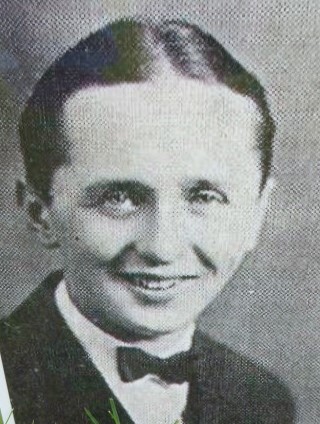
Donald Calvin Black was born in tiny Independence, Kansas on December 13, 1909. Even by Fallen Cougars standards, Independence Township was a tiny town with less than 100 inhabitants in the first decade of the twentieth century. Donald was the eldest child of Calvin J. Black and Ida Mae Black. According to the 1910 census the Blacks lived at 118 W. Cylanmer Street in Independence Township. Calvin worked as an agent for a life insurance company and Ida Mae managed the household and looked after little Donald. Perhaps the family grew weary of the vast expanses of flat land in middle-America, but whatever the reason, by 1920 they had moved all the way to very different terrain in the heart of Washington State. In the beautiful, forested mountain ranges of Chelan County there was once a small town called Canyon, Washington just outside the city of Wenatchee. Calvin took a job as a lineman for a telephone company, no doubt working to connect the cities in such rugged terrain was incredibly hard work. The family had adopted a daughter, the 16-year-old Gwendolyn Chase, at some point in the intervening years. Donald was just ten and he had welcomed his baby sister, the eight-year-old Dalores E. Black, to the family in 1912. The family lived on Washington Avenue in Canyon and the children attended the local school in Wenatchee. It was Wenatchee that Donald considered home and that he worked in for most of his life, subtracting a stint at college of course, and it is another Washington town that lost one of its native sons in World War II.
WSC Experience
By 1930 the family lived on 721 Palouse Street in Wenatchee. Calvin was working as a fruit inspector for a fruit market, and Calvin’s father, Andrew R. Black, had moved into the home at the age of 82. But Donald was no longer living at home. After he graduated from Wenatchee high school, he decided he wanted to continue his education. He applied to and was accepted at Washington State College, moving to Pullman Washington, and enrolling in the freshman class of 1929. There is surprisingly little information about Donald’s time at Washington State college. The College Registrar notes that he majored in Civil Engineering, perhaps watching his father work as a lineman when he was young inspired the young Donald to follow in his footsteps. He also may have been in the national guard in his time on campus, but this researcher could not find any more documentation to substantiate this other than a brief listing in a single secondary source. We do know that by 1932 he was in the Sigma Phi Epsilon fraternity as he is listed in the “Juniors” section of the fraternity’s yearbook page. Donald must have been quite the intellect, as his final year on campus is recorded as 1932. He moved back home to Wenatchee in 1933 and that is where he fell in love with one Elizabeth Vandivort.
Whether the two knew one another before 1933 is difficult to say, though it is likely that they did. The marriage license shows that Elizabeth was born and raised in Wenatchee, and likely would have attended school with Donald. The 23-year-old Donald and 21-year-old Elizabeth were married on April 25, 1933, in Wenatchee with the Minister Stanley L. Logan performing the ceremony in front of Donald’s parents and Elizabeth’s father, Arthur Vandivort and mother, Anna C. Vandivort.
Donald and Elizabeth wasted no time in starting a family together, in 1934 they had their only son, little Lyle V. Black. Donald put his Washington State College education to work and took a job with Chelan County. In 1938 the Spokesman-Review newspaper out of Spokane, Washington reported that “Don Black who has been acting Chelan County Engineer, today emerged with the complete robes of office, as the permanent engineer. His appointment confirmed by the county commissioners.” Donald was a busy man once he took the reins as Chelan County’s permanent engineer. On May 29, 1938, he appeared two times in the same edition of the Spokesman-Review. The first was for a road project through the Entiat Valley. The project was received a preliminary budget approval of $45,000 – $50,000 and “County Engineer Donald Black says he expects to have the new road laid out inside of the next two or three weeks. It will start west of the C.A. Harris & Son mill at Ardenvoir and continue up the Entiat Valley as far as the funds provided will allow.” Some columns later it was revealed that Donald had submitted an idea for a project that would turn a riverbank into a tourist camp for transient fruit workers and convert the current location into a public park. In June of 1938 Donald attended a convention of the Washington State Association of County Engineers in Centralia. A.B. Humason of Grant County was elected President of the Association for the coming year, and “Donald C. Black, Chelan County, was elected Secretary-Treasurer.” By 1940 Donald, Elizabeth, and little Lyle lived at 119 Highland Drive in Wenatchee. Donald listed his official job title as Civil Engineer for County Highways, averaging 50-hour work weeks and bringing in $2,100 per year. The Black family had built a lovely young family and made good lives for themselves in the communities that raised them, but by 1940 global events were conspiring to drag the United States into war and threaten families like theirs all over the country.
Wartime Service and Death
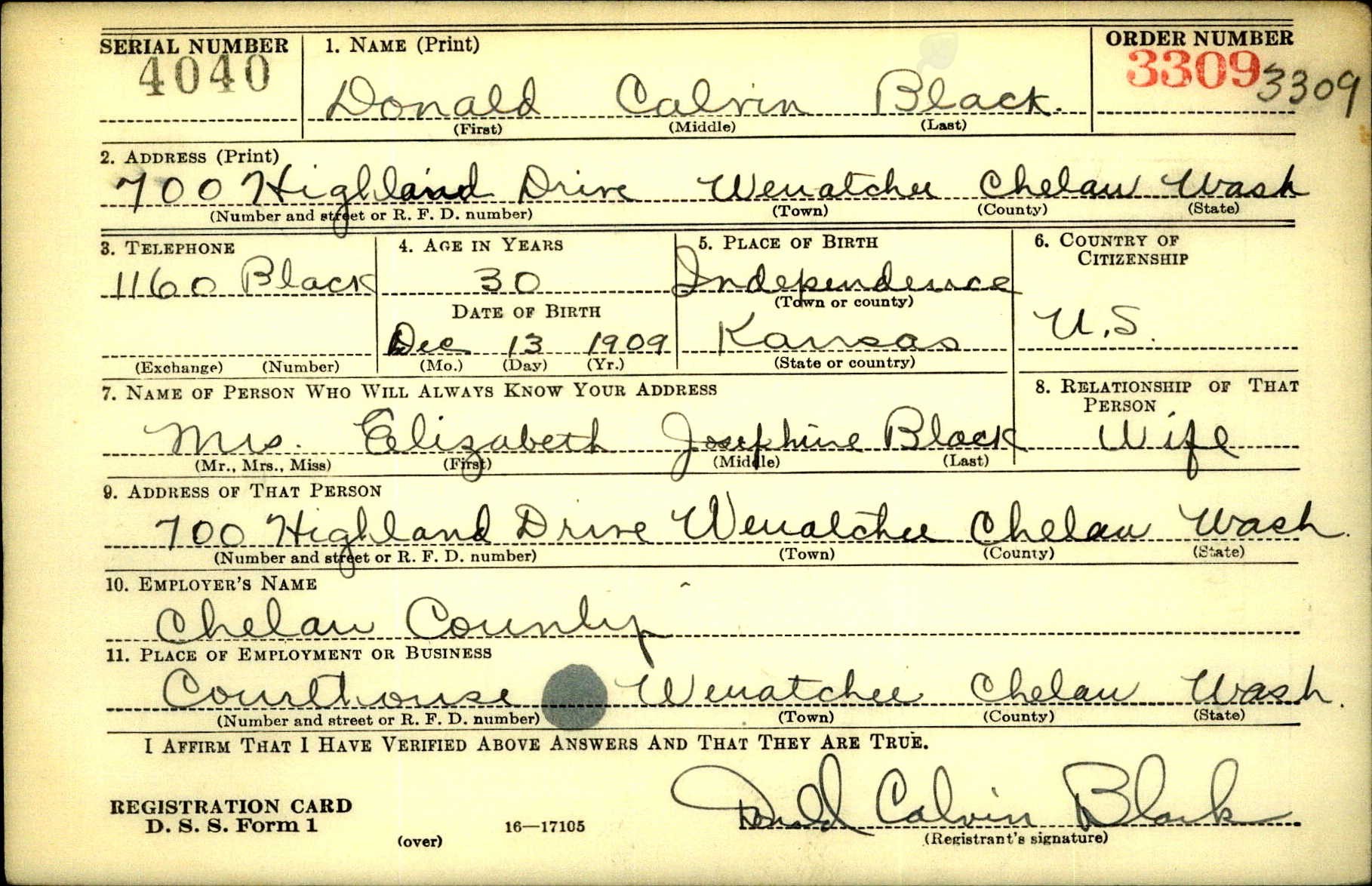
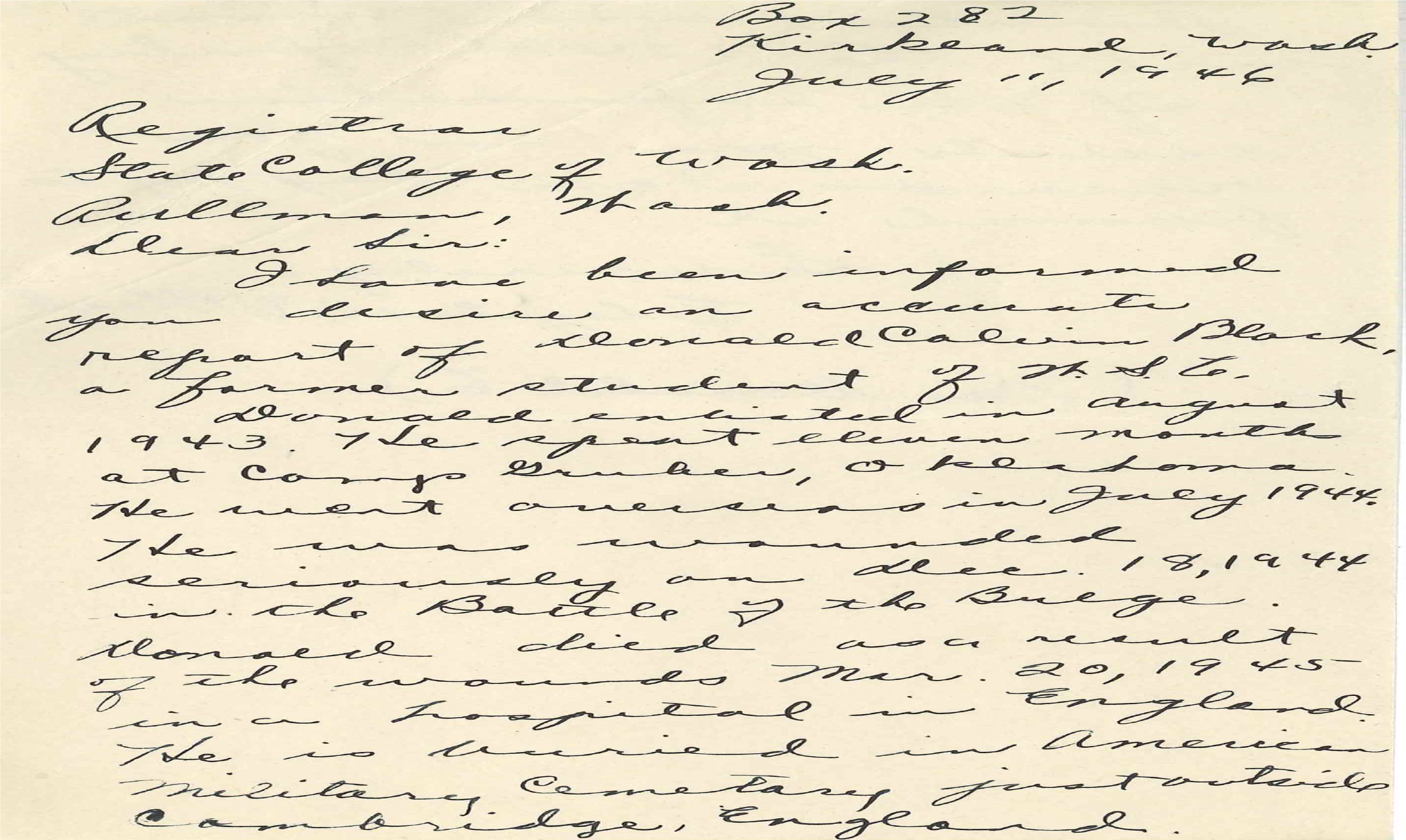
World War II in Europe had been raging since Nazi Germany invaded Poland on September 1, 1939. The fascist government, under the leadership of Austrian-born dictator Adolf Hitler, waged war throughout Europe. They conquered both Denmark and Norway in April of 1940, followed by Belgium, the Netherlands, and tiny Luxembourg in May of that same year. Most astonishingly the Germans managed to conquer France in just 39 days and snapping up North Africa from the French and British in the process. They followed up those light-speed victories with a massive aerial campaign against the United Kingdom. In 1941 the Germans turned their military aims to the east, conquering Yugoslavia and Greece in April before betraying and invading the colossal Soviet Union on June 22, 1941. They then made a mistake one of the most famous mistakes in military history. Largely to appease their Japanese allies and to satisfy Hitler’s ideological fanaticism, but also with an eye to destabilizing American politics, Germany then declared war on the United States on December 11, 1941. The United States was in desperate need of manpower, especially intelligent and brave young men to fill the ranks of the United States Army. It just so happens that the United States had many such men, several hundred of which had attended Washington State College. Why Donald was not put into an engineer company remains a mystery, whether it was the Army’s decision or Donald’s is equally unknown. On July 20, 1943, Donald travelled to Spokane, Washington and enlisted in the United States Army. He was given service number 39467800, measured in at 5’10 inches tall and 192 pounds with gray eyes and black hair. Unfortunately, Donald has the fewest sources of any Fallen Cougar I have profiled in Washington State University Archives, Manuscripts, and Special Collections materials. All there is for Donald is a letter written by Elizabeth on July 11, 1946, in which she gives a one-paragraph summary of Donald’s time in the military. She writes that Donald “spent eleven months at Camp Gruber, Oklahoma. He went overseas in July 1944.” She signed the letter “Mrs. Donald B”.
Donald was assigned the rank of Private in the infantry and was assigned to the 334th Infantry Regiment of the 84th Infantry Division. The 84th is often referred to as the “Lincoln Division” or the “Railsplitter Division” a title dating back, according to lore, the nineteenth century. It is believed that the division traves its lineage back to the Illinois militia company that future President Abraham Lincoln served in during the Black Hawk war of 1832. President Lincoln’s famed prior profession as a rail-splitter for the railroad fit quite nicely for an infantry regiment that was often first into the fray. Donald and the 84th landed in Normandy, France in early November of 1944. The Germans were attempting to regroup after near-constant allied attacks left them reeling. The 84th was moved to the city of Gulpen, in the Netherlands from November 5th to November 12th, positioning itself for “Operation Clipper”, a major allied offensive into the Roer Valley. On November 18, 1944, Donald and the Railsplitters assaulted Geilenkirchen, Germany to start off the campaign. Geilenkirchen fell the next day and the 84th pushed on to take two more towns by November 29th, battling against stiff German resistance every step of the way as the temperatures began to drop and the Germans prepared a massive winter offensive. The Germans launched their enormous offensive on December 16. Donald and the 84th were tasked with seizing the cities of Wurm and Mullendorf to stem the German advance through Belgium. In vicious fighting in the snow and frigid temperatures, Donald and his men threw the Germans out of Wurm and Mullendorf on the 18th of December 1944. It was likely in the capture of these towns that Donald collapsed was hit in the lower body by shrapnel from an exploding artillery shell. Somehow the men of the 84th managed to pull Donald out of the fight, and despite the severity of his wounds get him to safety behind the lines.
Donald had been in the United States Army for one year and five months when he was admitted to a hospital in England sometime in December 1944. Medical records classify his injury types as varied and severe. The worst of which appears to be a puncture to the lower intestine, but the list of injuries includes fragments in his foot and possibly his eye. The surgeons performed an enterorrhaphy or sewing up a wound to the intestine. Against all odds, somehow Donald survived the surgery, but his injuries were many and severe. Despite the heroic actions of his own units’ medics, and the work of his surgeons in England, he had gone without proper medical treatment in the field for too long, succumbing to his wounds on March 20, 1945.
Postwar Legacy
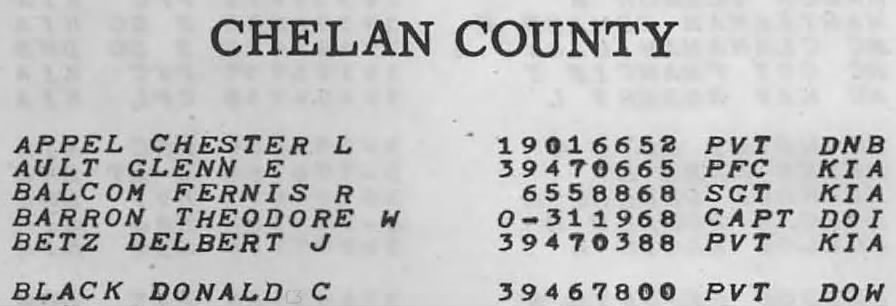
Donald’s death left his family and community in mourning. The 35-year-old civil engineer had given up a very good and comfortable life with his family to fight the tyranny and oppression of the Nazi regime and lost his life doing it. The Spokesman-Review ran and article with the names of the fallen from the east side of the cascades. “Inland Empire Honored Dead: Eastern Washington Counties Mourn War Heroes” read the article, with a list of counties in Eastern Washington coupled with the names of every fallen soldier beneath it. Donald is listed among the 61 heroes of Chelan County. In Elizabeth Black’s letter to Washington State College she wrote that Donald “is buried in an American military cemetery just outside Cambridge, England.” That is the Cambridge American Cemetery and Memorial in South Cambridgeshire, England. He was laid to rest in Plot D, Row 1, Grave 20, alongside his fallen brothers in arms.
President of Washington State College, E.O. Holland embarked on a project to ensure that every Washington State College student that lost his life in the war would be remembered. To that end he allocated funds to create pamphlets, brochures, and other remembrances for each fallen cougar. He also kept in touch with the families, sending them framed poems about their loved ones and proving each family with another frame designed for a photograph of the fallen. The current iteration of the Fallen Cougars Project is an attempt to carry on the legacy that Dr. Holland started. But perhaps the most lasting memorial to Donald Black and his Cougar brothers can be found on the main campus of his alma mater, today called Washington State University in Pullman, Washington. The Donald C. Black is emblazoned in gold letters on the World War II memorial there, alongside all those from WSC that made the ultimate sacrifice in defense of their country, and in opposition to the vilest tyranny.