
Cecil Richard Welchko
Pre-WSC Background
On October 31, 1936 in Oakland, California the Washington State College football team, under the leadership of the legendary Babe Hollingberry, were locked in a furious struggle with the Golden Bears from the University of California, Berkeley. The undefeated Cougars saw their perfect record slipping from their grasp as the California squad scored a touchdown late in the third quarter, but missed the extra point to make the score 13 – 7. Down six points with one quarter to go, the Cougars rallied, marching down the field and punching in the go-ahead score with just minutes remaining. The boys from Pullman, now up 14 – 13, were stunned by some quick offense from the Golden Bears that ate up chunks of the field and put their backs up against their own endzone with mere seconds left to play. The Cal quarterback took the snap and threw a dart to a seemingly open receiver when the pass was “intercepted by a substitute Cougar halfback named Cecil Welchko.” Welchko weaved his way through California defenders before “planting the ball on his own 33-yard stripe as the game ends.” “Wotta game!” Read the Oakland Tribune. What a game indeed. The Cougars pulled victory from the jaws of defeat and for one Halloween night in 1936, Cecil Richard Welchko was king of the Palouse. The fourth string sophomore halfback that was only in the game because “scythe-like blocking sen[t] nearly a dozen boys on both teams to the sidelines.” Welchko saved the Cougars undefeated season in front of 35,000 hostile fans. But it was not the last time the kid from Bonners Ferry, Idaho was asked to play the savior, and it was not the last time that he proved himself willing, and able, to step up in dire times.
The nineteenth century Pacific Northwest was a place where people settled to extract natural resources needed to feed the industrialized and more populace urban centers back east. The history of Cecil Welchko’s hometown, Bonners Ferry, is no different. The ancestral home of the Kootenai Native American tribe, the region is bisected by the Kootenai River, a major tributary of the mighty Columbia River. European and American settlers first established a trading post and a small ferry at the river junction in 1863 in order to trade with and provide transportation to gold prospectors on their way to Canada. When rumors that the Kootenai Valley also rested on top of gold deposits reached prospectors in other western territories like California, they flocked to the region. The rumors proved true, and several profitable mines were constructed in the valley throughout the 1860’s and 70’s, the first permanent settlements in the area. In order to house the miners and facilitate the transportation of citizens and their precious metal, a small town (to use the term loosely) was constructed on stilts. The stilts elevated the mining hamlet over the river, and allowed for the construction of a dock for use by steamships transporting workers to mines in the north and connecting Bonners Ferry to trading hubs back east. Officially established as a town in 1893, the people of Bonners Ferry had to adapt their economic strategy as the gold mines ran empty. The townspeople, apparently undaunted by their shifting fortunes, redoubled their efforts into logging and agriculture. They built levees and dams that helped turn the Kootenai Valley into prime farmland where the soil was replenished every year when the Kootenai river flooded, earning it the nickname “The Nile of the North.” By the end of the nineteenth century the Great Northern Railway connected Bonners Ferry to the wider regional economy with ease and secured its place as an agriculture and lumber town. In later years the small town was involved in, or at least adjacent to, several well-known historical events. The Kootenai tribe, under the leadership of Amy Cutsack Trice, famously declared war on the United States in 1974, threatening to call in the American Indian Movement that had taken over Wounded Knee, North Dakota the previous year. The bold action lead to their federal recognition as well as the expansion and guarantee of sovereignty over their reservation lands. Also, the famous, or infamous, Ruby Ridge standoff between federal law enforcement agencies and an Idaho family occurred just eight miles south of town in 1992. But it is not the local events that matter as much in this story, but rather a local man. This is the community that shaped Cecil Welchko and prepared him to take part in, and endure, some of the most important and brutal events of the twentieth century. The kid from the little lumber town was a born leader that became a star athlete, a dedicated soldier that became a prisoner of war, and a Washington State Cougar that lost his life in service to his country. Cecil Welchko’s life was as impressive and dignified as his death was tragic and senseless.
Cecil Welchko From Iowa to Idaho: Early Years
Emma Harvey was born on March 22, 1884 in Marshalltown, Iowa. At the age of 25 she married Charles Welchko, a second-generation German immigrant, and moved to Iowa Falls, Iowa. Between 1909 and 1912 they had three children, a daughter, Avonell Welchko, and two sons, Lawrence Leo Welchko, and Charles Welchko. After an uncharacteristically long break between children, they had their fourth child,
Cecil, in 1915. According to the 1920 Census the family lived in Iowa Falls along with two “roomers,” from Tennessee, one of which was employed by the local railroad. Unfortunately for the Welchko clan, Charles died just one month after filling out the census in January of 1920. He was laid to rest in his hometown of Tucson, Arizona. Emma remarried four months later. This was not uncharacteristic for the time period as the United States in the 1930’s was not a time for women to raise a family by themselves. Work opportunities were bad enough given the great depression, not to mention that work was largely unavailable for women even when the economy was not in crisis, least of all women with four children. Quick courtships followed by marriage was the expected social norm for women in Emma’s position, not a deviation from it. She married A.B. Ashby and moved to Bonners Ferry, where they set down roots to raise their family. Mr. Ashby was born Allen C. Ashby in London, England. He entered the railroad business at a young age, becoming an agent for the Great Northern Railroad, a career which brought him to Bonners Ferry. He was considered a “pioneer,” and an upstanding member of the community.
By all accounts Cecil grew up in a loving home which helped him excel in school and especially in sports. He attended Bonners Ferry high school where his athletic prowess and leadership abilities were recognized by his peers. The Spokane chronicle in 1935 wrote that the Bonners Ferry high school basketball team was honoring its letterman, Welchko among them, and noted that “The vote for honorary captain of the team . . . was tied between David Pace and Cecil Welchko.” But it was his time at Washington State College where he truly shined as a respected leader, a talented athlete, and something of a character among his peers.
WSC Experience
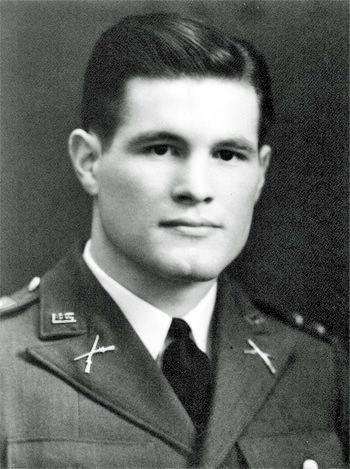
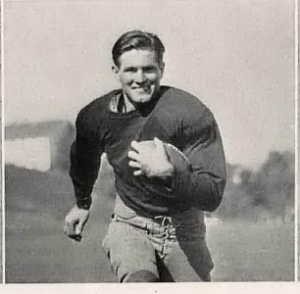
Welchko committed to Washington State College in Pullman, Washington and arrived on campus in 1936. He signed up for the United States Army and entered WSC’s ROTC (Reserve Officer Training Corp) program, which dovetailed nicely with his position on the college’s sharpshooter’s team. He grew into a tall and shockingly handsome young man. He was 6 feet tall, square jawed, broad shouldered, weighed 175 pounds, with jet black hair parted on the side and combed back, he would not have looked out of place in a Clark Gable movie. He also made the football roster his freshman year as a halfback, or “right wing” as they were called in Babe Hollingberry’s Wing-T offense. The game of football was drastically different in the 1930’s from the one that graces our televisions screens today. Quarterbacks were largely an afterthought, typically just another option to run the ball. Teams routinely used four players in the offensive backfield, a quarterback, two halfbacks, and a fullback. The right wing was typically the faster and more agile of the two halfbacks, and throwing the ball was a rarity. For example, the pass that Cecil Welchko intercepted to end the game against California was only the second pass thrown by California in that whole game. Welchko piled up accolades in all of these endeavors while working toward a degree in business administration.
His performance on the football field drew the most media coverage. In 1936 he caught a 16-yard touchdown pass against Oregon State in a losing effort. By 1937 his reputation as a character and leader on the team was making newspapers as well. The Spokesman Review in Spokane wrote that “Piano-legged Hal Smith and left-handed Cecil Welchko, the wild man from Bonners Ferry, are the only two letterman halfbacks to return” for the 1937 season. In his more prominent role as a returning halfback in 1937, the Spokesman Review further noted that “Cecil Welchko who, like Smith, came along strong at the end of last season, is figured to be a strong bet. Welchko is a rangy boy with abundant speed. He is a cagey pass catcher as well as being a good southpaw thrower.” The Spokane chronicle also picked up on Welchko’s reputation as a wild man, or a cagey player, when they wrote “Cecil Welchko, [or] ‘Bird Dog’ Welchko to his teammates, is afraid Idaho will score on W.S.C while he’s a member of the team . . . The Vandals haven’t scored on the Pullman gang since Cecil joined the team.” The less colorful language of sports writers today would probably simply refer to Cecil as a player with a “high motor.” But the sports-writing styles of the era reveal a more nuanced personality in Cecil. Dogged, determined, and scrappy, the Bonners Ferry “wild man” or the WSC “Bird Dog,” he was clearly believed to be a dedicated player and a hard-worker with a bit of an eccentric side, qualities which endeared him to those around him.
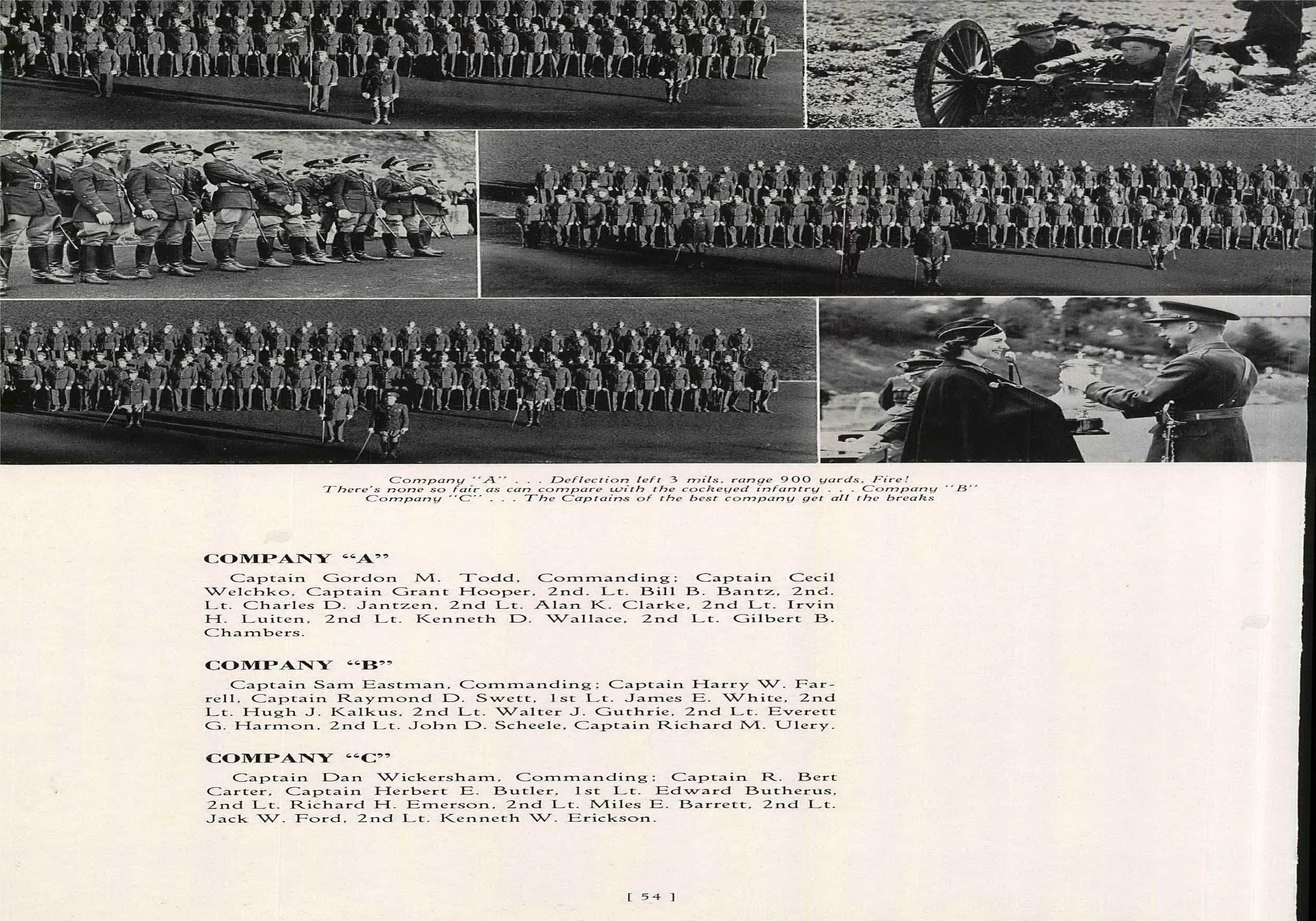
Cecil excelled off the gridiron as well. He was made commanding officer of “Company A” in ROTC. He was a member of the “prize combat squad,” which he led to victory in the ROTC summer training camp at Fort George Wright.
Wartime Service and Death
Upon graduation from WSC, the ROTC standout received a commission as a 2nd lieutenant in the United States Army in 1940 and was assigned to serve under General Douglas MacArthur in the 31st Infantry Regiment, part of the newly activated Philippine Division. The Philippine Division was comprised of the 31st infantry, two regiments of Philippine Scouts, and support artillery. Cecil once again showed promise as a leader in the Philippines and was promoted to the rank of Captain, placing him in charge of, once again, Company A, but this time it was a real company in the United States Army.
The Philippines was technically an independent nation in 1940, even more technically, however, it was not, and instead is most easily considered a quasi-independent colonial holding of the United States. The islands were of vital strategic importance in the Pacific, something Philippines Commonwealth, the United States, and the Empire of Japan knew quite well. The islands were rich in tin, rubber, and oil, and provided the optimal location to launch attacks on other important targets in the Pacific like the Dutch East Indies (modern day Indonesia) and Australia. The surprise attack on the American Pacific Fleet at Pearl Harbor on December 7, 1941 is well known. However, the impact of the attack on Pearl Harbor distracts from the broader campaign throughout the Pacific that, when viewed in its entirety, constitutes the largest military campaign in history. Between December 7th and December 10th, 1941, the Japanese empire attacked or invaded British colonies of Malaya, Singapore, and Hong Kong as well as the United States naval bases on Wake Island, Guam, the Philippines, and more. They opened a battlefront that was 6,000 miles wide north-to-south. Their intent was to seize the resource-rich territories and islands and fortify them against counter-attacks. When the attack came in the Philippines, Cecil Welchko and his 31st infantry were on the frontlines of a war they did not know was coming.
When the Japanese Imperial Army made landfall at Lingayen Gulf and Lamon Bay; they had already annihilated American airpower on the islands and chased off American naval forces. On December 23, 1941, General McArthur announced that “WPO-3 is in Effect.” (War Plan Orange - 3) This plan was a general withdrawal of all American and Filipino forces to the Bataan Peninsula and the small island fortress of Corregidor. However, the Japanese advance was moving much faster than anyone could have anticipated. The poorly trained and supplied American and Filipino soldiers, almost 100,000 strong, in forward positions were no match for the battle-hardened Japanese army with overwhelming naval and air superiority. It was ordered that the 31st infantry would move from the Zambales coast into the peninsula and quickly construct defensive fortifications to the best of their abilities. Their orders were simple and seemingly impossible: slow down the Japanese advance at all costs. The 31st was reinforced by some elements of the 41st division on December 28, and they dug in. Just like that Halloween night in 1936, Cecil Welchko found himself backed up against his own endzone by a rapidly advancing enemy. Once again, Welchko and his team came up with some fourth-quarter heroics.
The 31st infantry and the rest of the Filipino and American soldiers managed to turn a desperate retreat into a tactical withdrawal while turning the Bataan Peninsula into a 15-mile-wide rolling gun-battle. Instead of a quick victory over a disoriented enemy, the Japanese advance slowed to a crawl before stopping completely. While the Japanese waited for reinforcements and resupply, many American and Filipino military personnel, including General MacArthur, managed to retreat to Corregidor fortress. Over the next three months the Japanese tried again and again to crack the defenses but could not break through. The American and Filipino soldiers held out despite being outgunned, surrounded, cut-off from supplies, starving, and rife with illness. A poem written by war correspondent and Idaho native Frank Hewlett summed up the mindset of the soldiers on the Bataan Peninsula in those dreary months:
We’re the Battling Bastards of Bataan;
No mama, no papa, no Uncle Sam.
No aunts, no uncles, no cousins, no nieces,
No pills, no planes, no artillery pieces.
And nobody gives a damn.
Under such withering fire and in the complete absence of support of any kind, the defenders eventually retreated to Corregidor Fortress and held out as long as they could. Finally surrendering on May 6, 1942. It was the largest surrender of American forces in the history of the United States, comprising some 12,000 American, Cecil Welchko among them, and 65,000 Filipinos. While it may be easy to see this as a clear defeat, it is much more complicated. Filipino and American forces had severely hampered Japanese plans for the Pacific, they forced the Japanese to commit thousands more soldiers and precious resources to capturing the islands than they had anticipated, and provided the American public with much-needed good news in the aftermath of Pearl Harbor.
In the aftermath of the fall of Corregidor American and Filipino POW’s were subjected to what is now known as the Bataan Death March. The POW’s that had just finished a 3-month battle, were malnourished, dehydrated, and sick with a dozen different diseases, were forced to march more than 60 miles over brutal terrain in extreme heat and humidity. Those that fell behind were killed by Japanese soldiers escorting them to the POW camps. Thousands of Filipinos and hundreds of Americans died on the march, but Cecil Welchko managed to survive and was interred at POW Camp 2, Cabanatuan 1 2 3, Nueva Province in Luzon, Philippines. The news that the former star halfback had been taken captive hit WSC and the surrounding area like a bombshell.
Local newspapers ran numerous headlines about Cecil’s possible death or capture. Some reprinted letters sent to Cecil’s mother, referred to as Mrs. A.B. Ashby or Emma Welchko Ashby. One such article titled “Cecil Welchko Is Prisoner, Belief,” the U.S. War Department apologized for not having more information on her son but that “the war department will consider the persons serving in the Philippine Islands as ‘missing in action’ from the date of the surrender of Corregidor, May 7, 1942,” before promising to keep Emma informed if any news of her son became available. The intervening months must have been agony, but on December 12, 1942 another paper ran the headline “CAPTAIN WELCHKO IS WAR PRISONER.” The paper informed their readers that “Mrs. A.B. Ashby received a telegram from the war department Thursday evening informing her that her son, Captain Cecil R. Welchko, was a prisoner of the Japanese,” and thankfully he had not died on Bataan or Corregidor. They ended with Cecil’s football pedigree “While there [at WSC] he played prominent part on the football squad.” It took more than a year for Cecil’s family to get more information about him, but in February 1944 they got more uplifting news from an unlikely source.
On February 28, 1944 another headline, rife with the racially-charged parlance of the day, read “MET WELCHKO IN JAP PRISON.” An American POW identified only as Commander McCoy had escaped from a Japanese prison camp. He told Emma that “he had met Welchko several times and they were in the same prison camp. He stated that Captain Welchko’s health was not too good when he left there.” Emma informed him that she had received word that Cecil’s health was improving, to which Commander McCoy “stated that this was probably due to the arrival of Red Cross packages in January.” On February 1, 1944 another headline announced that Emma “Receives Word From Welchko.” She had received two typewritten letters from Cecil that had been mailed from “Japanese Philippine Military Prison Camp No. 2” the letters indicated that “Capt. Welchko was in fair health, that he was under treatment, that he was improving and contained the typewritten message ‘Do not worry about me. Did you get that National Service Insurance? Love to all the family’.” The second card contained the postscript “‘Love to all the family. Give best regard to everyone’.” Cecil’s mother then sent a letter and copies of her correspondence with Cecil to the The WSC student newspaper stating that “my son Capt. Cecil R. Welchko who attended Wash State College for 4 years and was on the 1st team in football. . . .Kindly see this information is published in your school paper . . . Yours Truly, Emma Welchko Ashby.” The Daily Evergreen then ran an article with the headline “STUDENT IN JAPANESE CAMP” in February of 1944, detailing the information provided by Emma and other newspapers, also fitting in Welchko’s time as a football standout.
On January 9, 1945 General MacArthur and the American military were back in the Philippines, this time on the offensive. They invaded Luzon, retook the Bataan peninsula and the island fortress of Corregidor. The Japanese, now convinced that they could not hold the islands, decided to gather up the POW’s and transport them to Japan where they could continue to get free labor out of them to continue the war effort. Many ships were designated to transport the POW’s to their appointed destinations, four of which were The Shinyo Maru, Arisan Maru, Oryoku Maru, and the Brazil Maru. Today these ships are referred to simply as “Hell Ships,” for the conditions inside them were unbearable and deadly regardless of what else happened to them. These ships transported more than 126,000 Allied prisoners to locations closer to the Japanese home islands in 156 voyages.
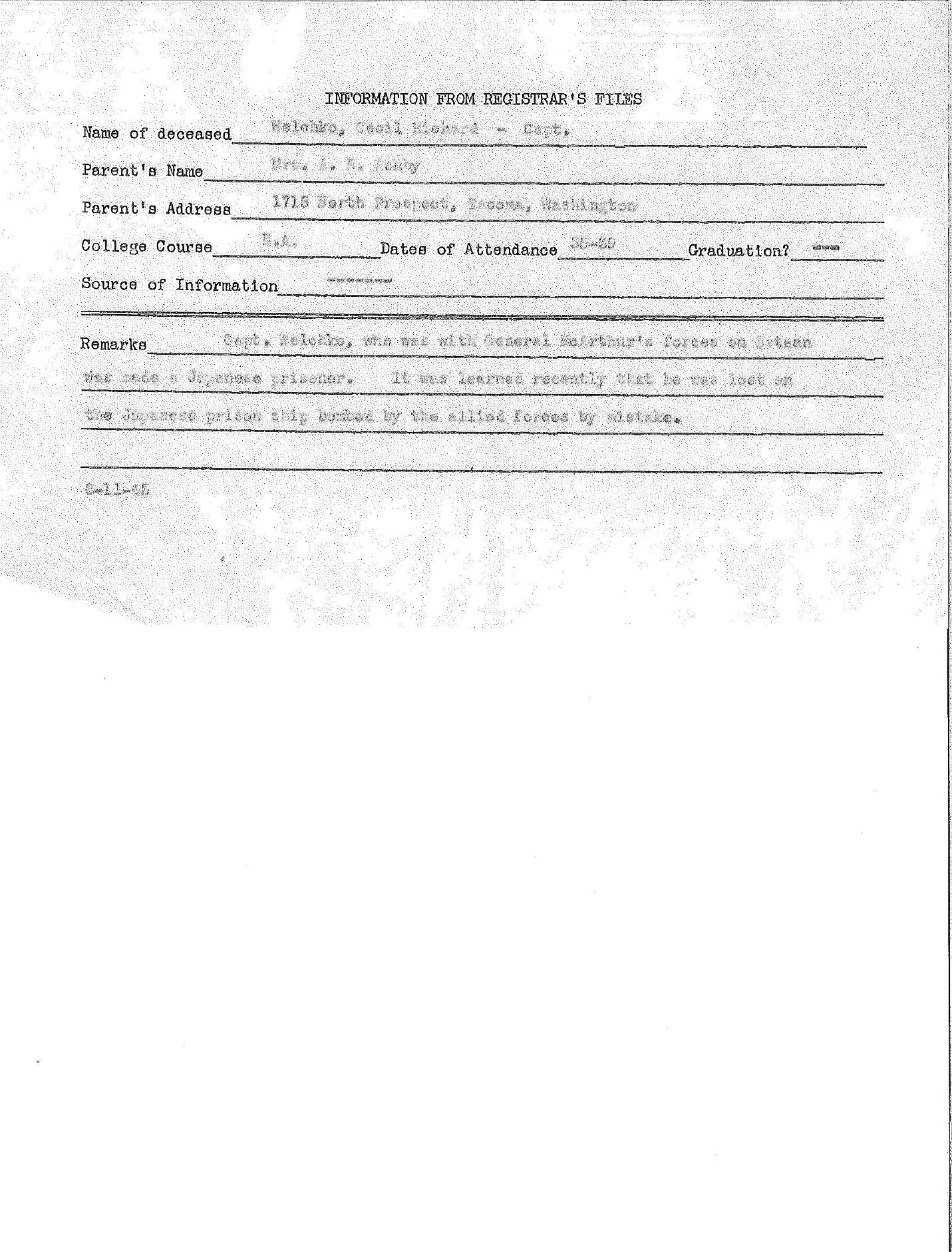
On December 15, 1944 the Oryoku Maru filled its hull with 1,600 prisoners from the Cabanatuan camps in the Philippines and set sail for Japan. The ship was attacked by Allied bombers and submarines that did not know it contained American POW’s. The ship was sunk. On January 9, 1945 another attack on the Enoura Maru had the same result. The estimates of POW’s that were killed in these attacks range widely. But it is believed that as many as 21,000 Allied POW’s lost their lives in these and other “friendly fire” attacks in the ending months of the war. Cecil Richard Welchko was one of them. It is difficult to say with certainty which ship Cecil Welchko was on, sources disagree. Given the number of sources that list a January date of death it is likely that Captain Welchko was killed on board the Enoura Maru or the Brazil Maru. The Prisoners of War Roster in the National Archives lists Welchko’s death with the note: “Brazil Maru – transported survivors of the Enoura Maru to Japan (January 13 – 29, 1945) Some POW’s died in transit.” But does not explicitly state that this was the location of his death, and his body was never recovered. It is likely that the exact time and location will never be known.
Postwar Legacy
Upon learning of Cecil’s death, President Emeritus of Washington State College, E.O. Holland, sent a letter to Emma Welchko-Ashby stating “Recently I saw in a Spokane paper the story of the death of your dear son . . . who died on board a Japanese prison transport, December 15, 1944.” He continued to reveal “I knew Cecil rather well and I am shocked and grieved that a young man of his superior ability and good college citizen should be lost to us. Over one hundred and fifty WSC men have made the supreme sacrifice in this terrible war.” Three years later E.O. Holland and others at WSC set out to honor those “WSC men” that gave their lives and sent another letter to Emma requesting she send a photo of Cecil in order to have him memorialized with honor on the WSC campus. Emma obliged the request but she was still looking for answers. In her response to E.O. Holland in November of 1948 she wrote “Dear Mr. Holland . . . It has never been known exactly where his death occurred. I have received two different accounts. I have received his picture and appreciate any information you may send me.” But those at WSC sadly had no answers for her either.
Cecil Richard Welchko is memorialized at the sites of both of his heroic defensive stands. His name is on the World War II memorial on the Washington State University campus in Pullman, and he is also memorialized in the Manila American Cemetery and Memorial in the Philippines. He is listed on the “Tablets of the Missing: A Structure erected in honor of someone whose remains lie elsewhere.” His death is listed as occurring on January 9, 1945.