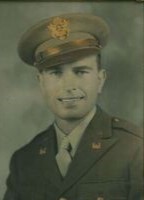
Captain Donald Harvey Froemke
Pre-WSC Background
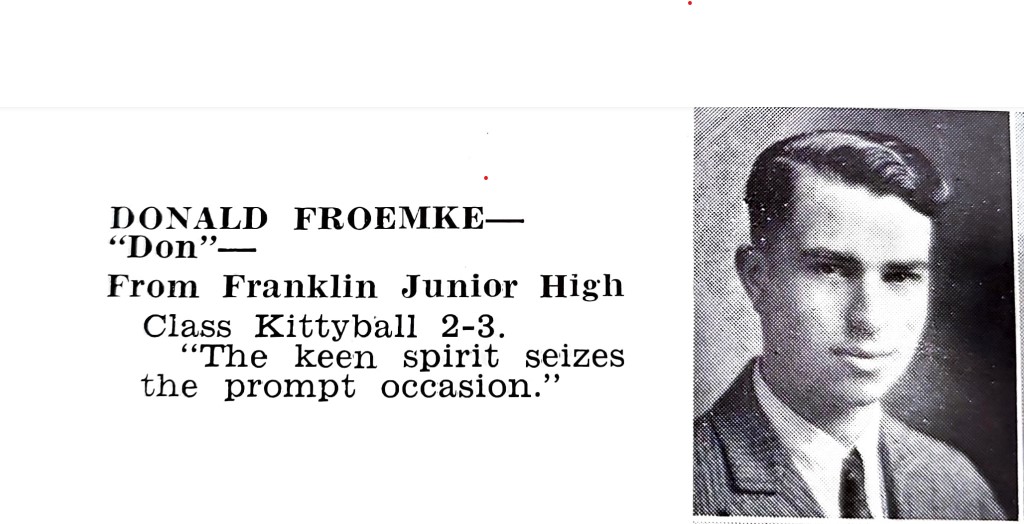
Donald Harvey Froemke was born on October 15, 1912, to parents Henry Ernst Clifford Froemke and Emma G. Komm Froemke in Vancouver, Washington. The family later moved to Yakima, where Froemke attended Nob Hill Grammar School and North Yakima High School. At North Yakima, he played on the kitty ball team—an early iteration of softball—and graduated in 1931. He attended Nob Hill Evangelical Lutheran Church.
WSC Experience
There are few records of Froemke’s time at Washington State College. However, the Chinook yearbook indicates he was a Montezuma and Forestry Club member. Either he or his brother Virgil Froemke served as a basketball team manager in 1935. Only a last name is reported, so it is unclear which brother worked with the team. He graduated with a degree in Forestry and Range Management in 1938.
After graduation, Froemke started his career with the U.S. Forestry Service. It is unclear how soon after graduation he joined the Forestry Service. He never married and had no children.
Wartime Service and Death
Froemke registered for the draft on October 16, 1940. He then enlisted in the United States Army in Tacoma, Washington, in March 1941 at the age of 28. Army records indicated he was honorably discharged on September 1, 1942, to accept a Second Lieutenant commission on September 2, 1942. He was promoted to First Lieutenant on May 4, 1943, and departed the United States for England on September 5, 1943, in preparation for the Allied invasion of France. Assigned to the 326th Airborne Engineering Battalion (AEB) of the 101st Airborne Division, his unit stayed and trained at a manor at Basildon Park, thirty miles west of London. Froemke participated in the invasion of France and the Normandy campaign. According to his niece, Ellen Holloway, Froemke flew a glider into Normandy during Operation Overlord. The 326th suffered losses among its officer corps during the Normandy campaign, and perhaps as a result, Froemke received a promotion to Captain on July 9, 1944. The 101st returned to England on July 13, 1944, to rest and train for its next mission.
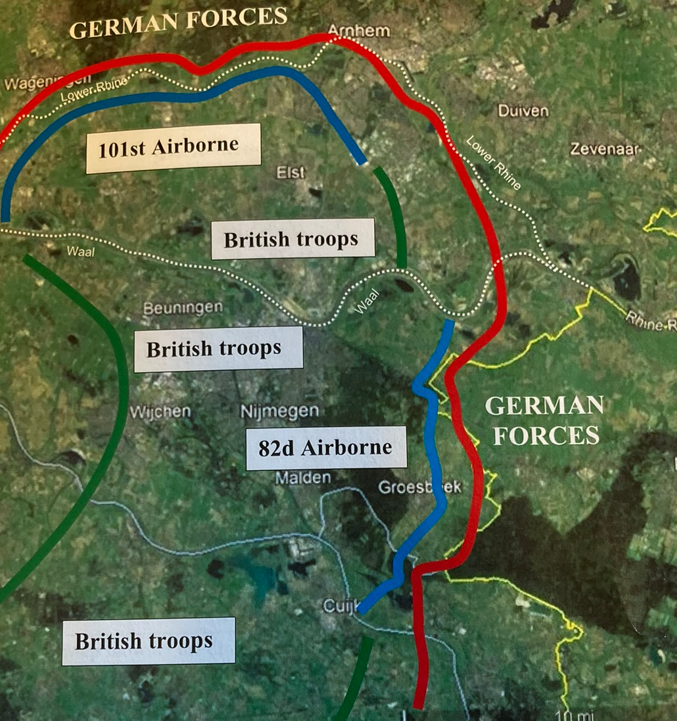
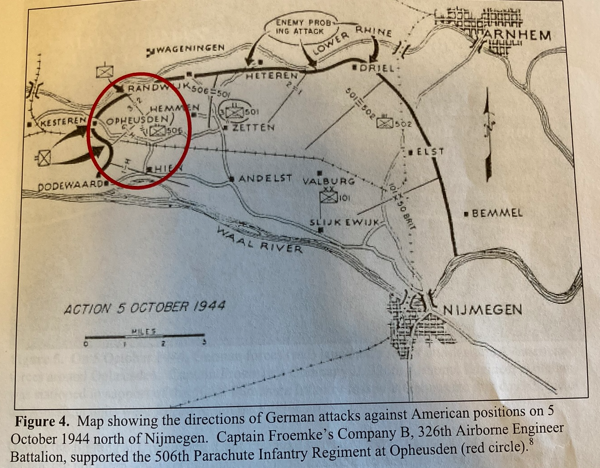
That mission was Operation Market Garden, a combined land and air offensive to create an Allied invasion route into Germany. On September 17, 1944, paratroopers from the 326th landed around Zon [Son], Holland, north of the city of Eindhoven. Froemke and the rest of the 326th Airborne Engineering Battalion landed gliders in the same area on September 18. Their task was to assist the 101st Airborne in laying and clearing landmines, repairing or destroying vital bridges, building or removing obstacles, and assisting in frontline combat when necessary. The 101st achieved most of their objectives in the first few days, and then engaged in the defense of Highway 69 “Hell’s Highway” to support British armored forces advance on the Dutch city of Arnhem. The Allies failed to capture Arnhem, and the mission turned to defending the salient around the city of Nijmegen that they had created. On October 3, the 101st Airborne moved into a defensive position in the northwest part of the salient. Their sector was flat and bounded on all sides by the Lower Rhine and Waal rivers. These geographic features led troopers to nickname the area “The Island.” Froemke’s battalion, and the 101st’s 506th Parachute Infantry Regiment (of Band of Brothers fame), set up around the Dutch town of Opheusden.
In the early morning hours October 5, German soldiers launched an assault on the salient, marking the start of the Battle of the Nijmegen Salient. The attack began with a massive artillery barrage, followed by an assault on Opheusden with infantry supported by armor. Froemke was killed in the fighting, though there are two differing accounts of how he died.
The first account comes from historian John C. McManus in his 2013 book, September Hope: The American Side of a Bridge Too Far. In this account, Froemke stopped to ask an infantryman for directions to the front. A German artillery shell exploded at his feet, dismembering him and throwing his body a hundred yards from where he stood.
The second account comes from a 326th AEB After Action Report for October 5, 1944. It states, “Captain Froemke was killed while moving across an open field to aid a wounded man.” According to independent researcher Doug Wilber, that man was Doug’s father, 326th Airborne Engineering Battalion Private Charlie Wilbur. Charlie Wilbur wrote of his wounding to his sister Kay in a letter on November 4, 1944.
On the morning of the [5th of October] we were awakened very early and told to move out as the Germans were counter attacking … After walking down the road for about a half mile we were told to take to the fields and keep spread out. After we had advanced about half a mile in that fashion a lot of lead started to fly around. The Germans were firing at us but we didn't know where they were so we kept advancing. After a few hundred yards of that we came into a small town that was under artillery fire. … By that time we had an idea where the enemy was and we were keeping low in ditches to escape the fire we were drawing. I wasn't low enough and one of the bullets went through the muscle of my back. … I sat still for a minute … I started to go back to look for a medic when I was hit again this time through the right leg. … I crawled back to the little town we had just came though and a couple of Hollanders took me in their house and as I was soaking wet from crawling through the ditches they took my clothes off and wrapped me in blankets.
Whatever the cause of Froemke’s death, the German’s overran Opheusden, preventing the immediate recovery of his body and other Allied casualties. The town would not fall under firm Allied control until 1945.
Postwar Legacy
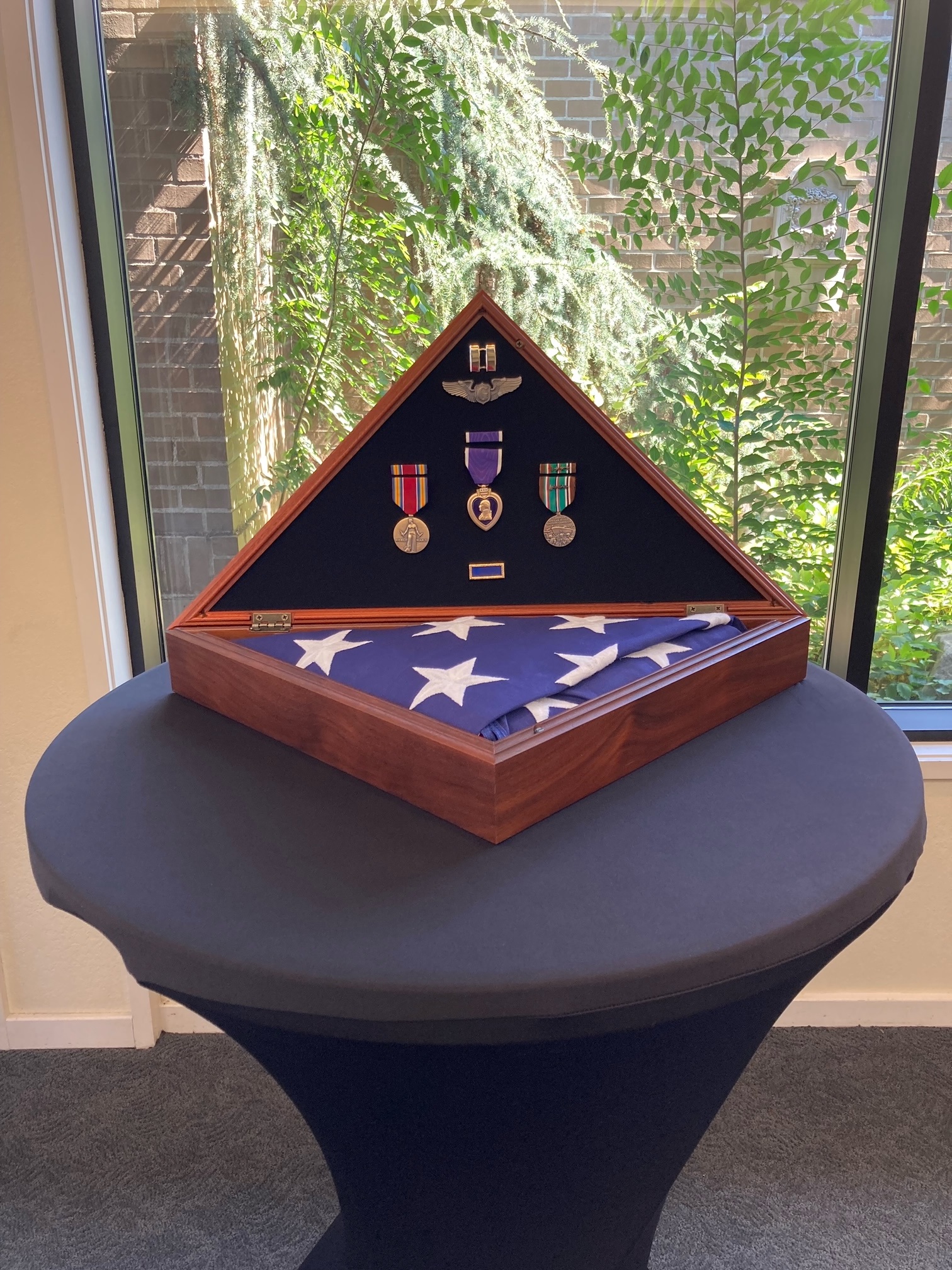
For those who die in the line of duty, the story does not end on the battlefield. The body must be recovered and repatriated, the family notified, personal effects returned. Froemke’s death reverberated through generations of his family. His parents, Harry and Emma were grief stricken at his loss. Emma passed away a few years after the war. Her granddaughter, Ellen, believes the grief played a role. Ellen also spoke of how Froemke’s younger brother Virgil—her father—struggled with survivor’s guilt. It would take 79 years, long after Froemke’s mother, father, and brother had passed, for Donald Froemke’s story to come to a close.
Back stateside, Harry and Emma Froemke received a letter on October 23, 1944, from Lieutenant Colonel Hugh A. Mozley of the 326th AEB notifying them of Froemke’s death. A War Department telegram with the news followed on October 26, 1944. An official letter on October 28 confirmed his death. Harry Froemke wrote to the government to try and find out the circumstances of his son’s death, but given wartime security concerns the U.S. military was not particularly forthcoming with details.
As for Froemke’s body, it is unclear what happened to it after the attack on Opheusden. Doug Wilbur believed local Dutch citizens recovered his body and buried it in a local cemetery. Indeed, remains thought to be Froemke’s were recovered in 1946 by members of the American Graves Registration Command (AGRC) in a cemetery near Opheusden. It appears the AGRC did not do a careful analysis of the remains with the biological and dental records the Army had for Froemke, instead using circumstantial evidence to make a positive identification. After identification, the remains were buried in a military cemetery in Belgium. Ellen Holloway reports that Virgil and Harry traveled to Europe to visit Froemke’s alleged gravesite in Holland. The U.S. Government arranged for the return of the remains thought to be Froemke’s in 1949. On May 27, 1949, they were buried in Tahoma Cemetery in Yakima, Washington.
In 1951, a set of remains, identified as X-3325 Neuville, were recovered from the Old Opheusden civilian cemetery. The remains contained an identification bracelet with the name “DONALD H. FROEMKE”, a set of glider pilot wings, and a set of captain’s bars. Despite this, the AGRC did not believe the remains belonged to Froemke. The remains were marked as unidentifiable and buried in the Ardennes American Cemetery in Belgium.
X-3325 Neuville rested for decades, unidentified at the Ardennes cemetery, but the U.S. government has never given up in its work in identified all unknown soldiers. The X-3325 Neuville remains were disinterred at some point during the 2010s and went to a Defense POW/MIA Account Agency in Nebraska for further analysis. Based upon DNA analysis and dental records, the remains were positively identified as Froemke’s. The agency publicly announced Froemke’s identification on August 24, 2022. In 2023, Froemke’s remains were flown to SeaTac airport, and a motorcade brought him first to Ellensburg and then to Yakima to be buried.
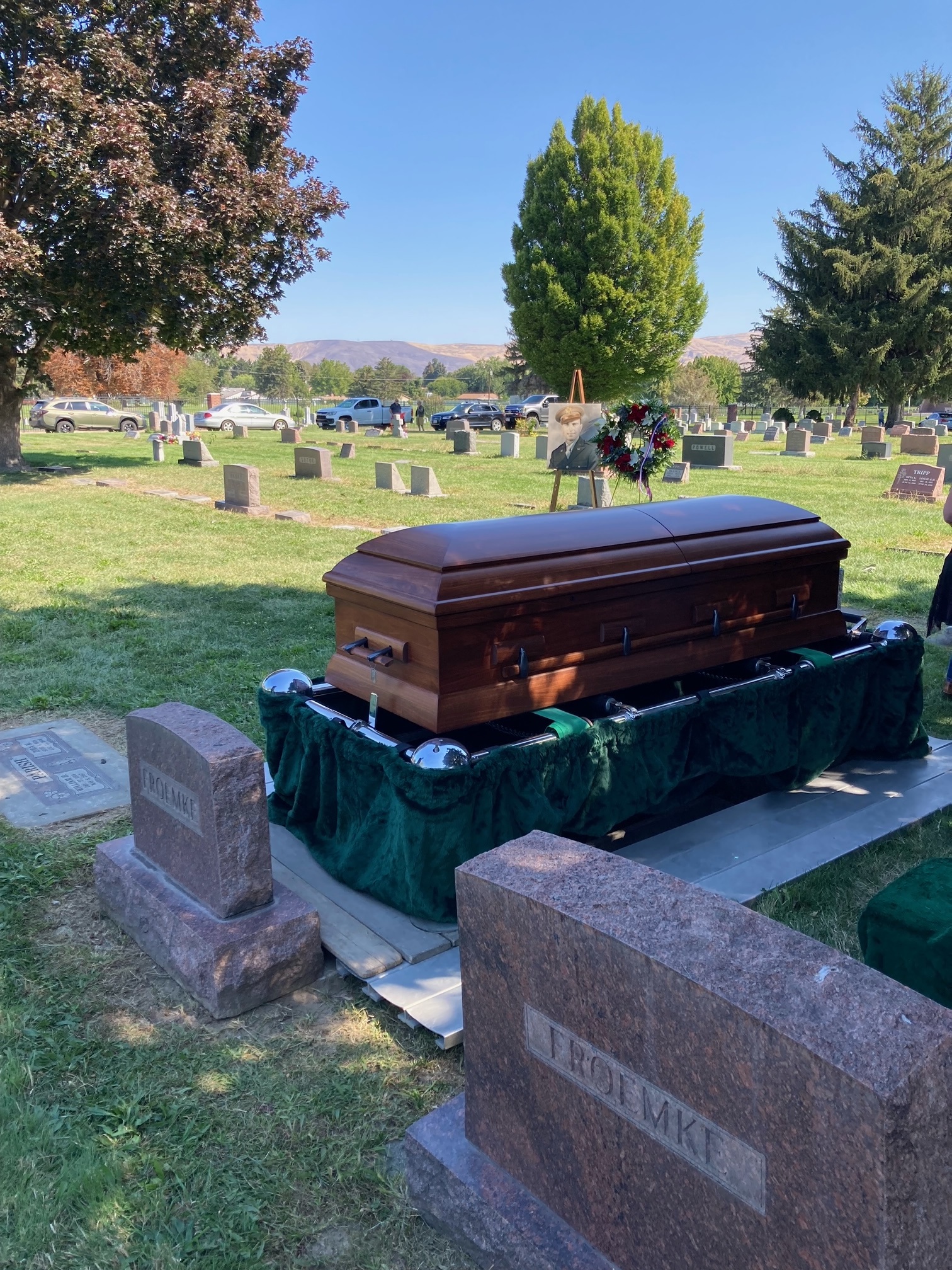
Captain Donald Harvey Froemke was laid to rest for good, on Saturday, September 9, 2023 before a moderate gathering of surviving family, military cadets, and community members. His return was widely publicized in his hometown Yakima’s media. At his funeral, Scottish bagpipes played “Amazing Grace”, he was given a 21-gun salute, and the reverend who presided over the ceremony led the crowd in the singing of “God Bless America.” The most direct descendent of Froemke present at the funeral was Ellen Holloway, Froemke’s niece, and the daughter of his brother, Virgil. “We’re glad he’s finally home,” Ellen Holloway told The Yakima Herald-Republic.