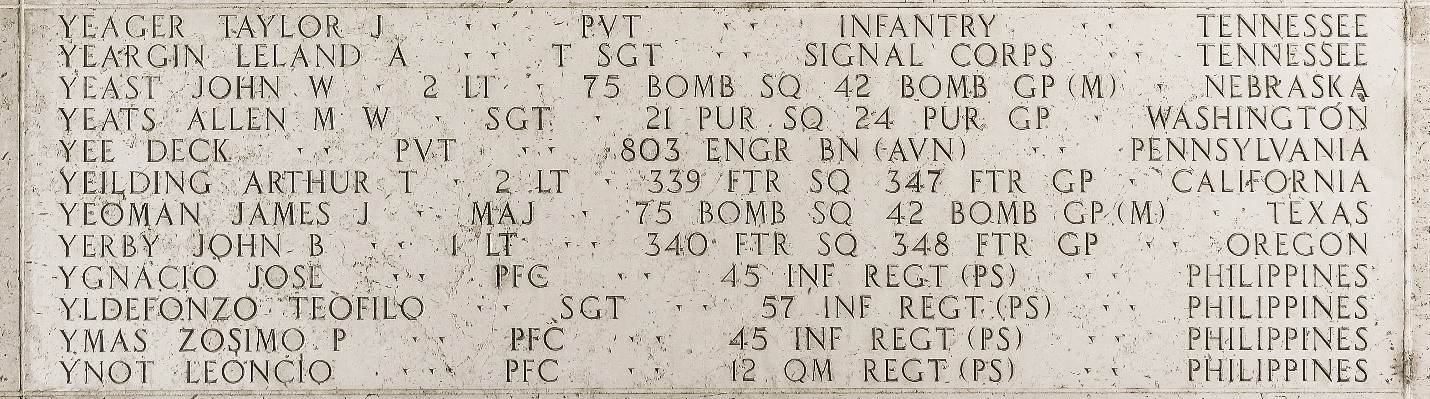
Arthur Tallas Yeilding
Pre-WSC Background
In the 1830’s many settlers from the east coast of the United States began to flood into the Willamette Valley in Northern Oregon. They build a small town called “Oregon City,” and planned for this town the be the trading hub of the region as it grew. However, a nearby area had been cleared by locals as a potential location for a new settlement. It was colloquially referred to as “Stumptown” or “the Clearing,” in reference to the many trees that had been cut down to make room for the prospective new settlement. By 1845 two men, Asa Lovejoy of Boston Massachusetts and Francis W. Pettygrove of Portland, Maine had purchased the land together. Each man wanted to name the city after their respective hometowns and could not agree on a compromise. As such they settled the dispute the only way they could, a best two-out-of-three coin-toss. Pettygrove won the contest and thus, Portland, Oregon was born. By the turn of the 20th century the city had boomed, becoming the major economic hub on the nexus of the Columbia and Willamette Rivers. By 1918, as the Spanish Flu ravaged the city, Portland had developed a reputation as a rough-and-tumble coastal town with rather unsavory political practices. During World War II the city was shamefully used as a staging area to transport Japanese Citizens to internment camps further inland, and in 1943 it was designated as a primary shipbuilding city for the war effort, leading to another massive influx of migration. This was the town where Arthur Tallas Yeilding was born and raised. He was a bright, ambitious, and fearless in his life’s pursuits. He was an Oregon kid that wanted to see the world, a college student that answered the call when his country was attacked, and a fighter pilot that ultimately gave his life in defense of that country.
From Portland to the Palouse: Upbringing and College Years
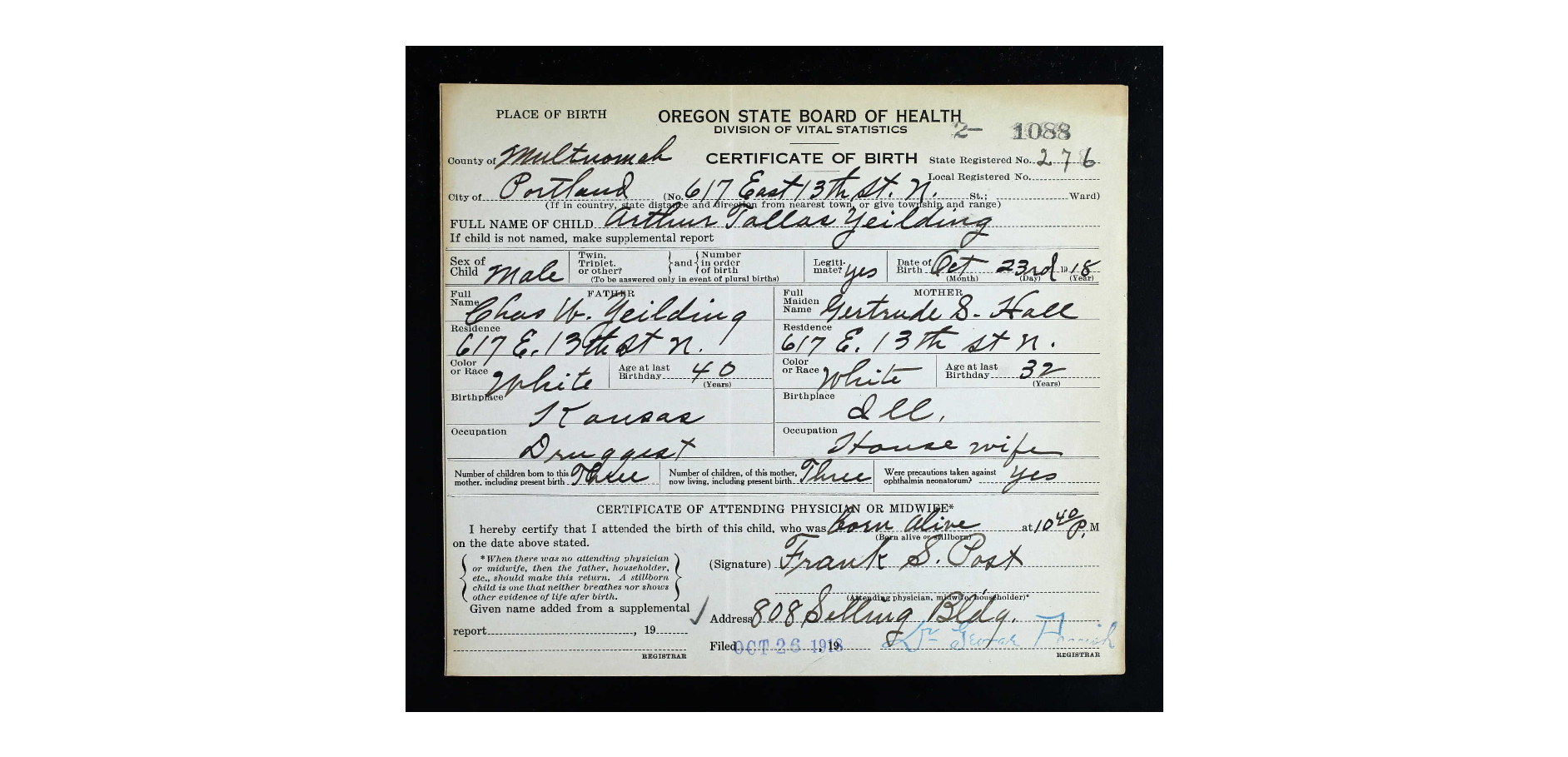
On October 24, 1918 Charles W. and Gertrude S. Yeilding welcomed their third son into the family. They had their first son, Andrew, 6 years earlier, and their second son, Daniel, 4 years earlier. The new addition was given the name Arthur Tallas. According to the 1920 Census the family lived at 617 NE 13th Street in Portland Oregon. Charles reported that he was a “druggist,” what today we would likely call a pharmacist, at his “own store” in the neighborhood. Gertrude’s mother, Sophia Hall, also lived with the family in Portland. She reported her parents place of birth as New Hanover in “Prussia,” because they were born prior to the 1871 unification of Germany. Tragically, Charles passed away in 1928, when Arthur was just 10 years old. According to the 1930 Census, Gertrude took over the duties as head of the household. The family moved to 903 80th Street in Portland and Gertrude listed her occupation as a “Saleswoman” at a local drug store, she is listed as an “employee,” not the owner of this store. She managed to keep her family’s head above water while raising her three boys to adulthood, no easy task to say the least.
The brothers grew up in typical American fashion. Arthur attended Benson Polytechnical High School in Portland where he graduated in 1936.
WSC Experience
Not much is available to explain what he did in the intervening two years, but in 1938 he moved to Pullman, Washington and attended Washington State College. Once in Pullman he put that analytical brain of his to work, majoring in chemistry and chemical engineering, likely pre-med courses possibly to follow in his father’s footsteps as a pharmacist, maybe with dreams of re-opening the family business or something of that sort. Arthur must have been a very serious devotee of his studies as he is nowhere to be found in campus clubs in yearbooks or newspapers, but after a short break from college he had his sights set on continuing his education after his days as a WSC Cougar came to an end in June of 1939.
From the Ocean to the Sky: College and War Years
In 1940 Arthur had moved to an apartment building on NE 67th Avenue in Portland, Apartment 2917. He listed his employment as a Maritime Seaman, working at one of the local ports. He worked 65 hours by the end of the second week of January, pulling in 700 dollars for his labors. Later that year he decided it was time to leave Portland for sunny California. He was accepted into the University of California at Los Angeles (UCLA), where he listed his residence as 10257 Santa Monica Boulevard, and where he listed his employer as UCLA. But this was not to last either.
Wartime Service and Death
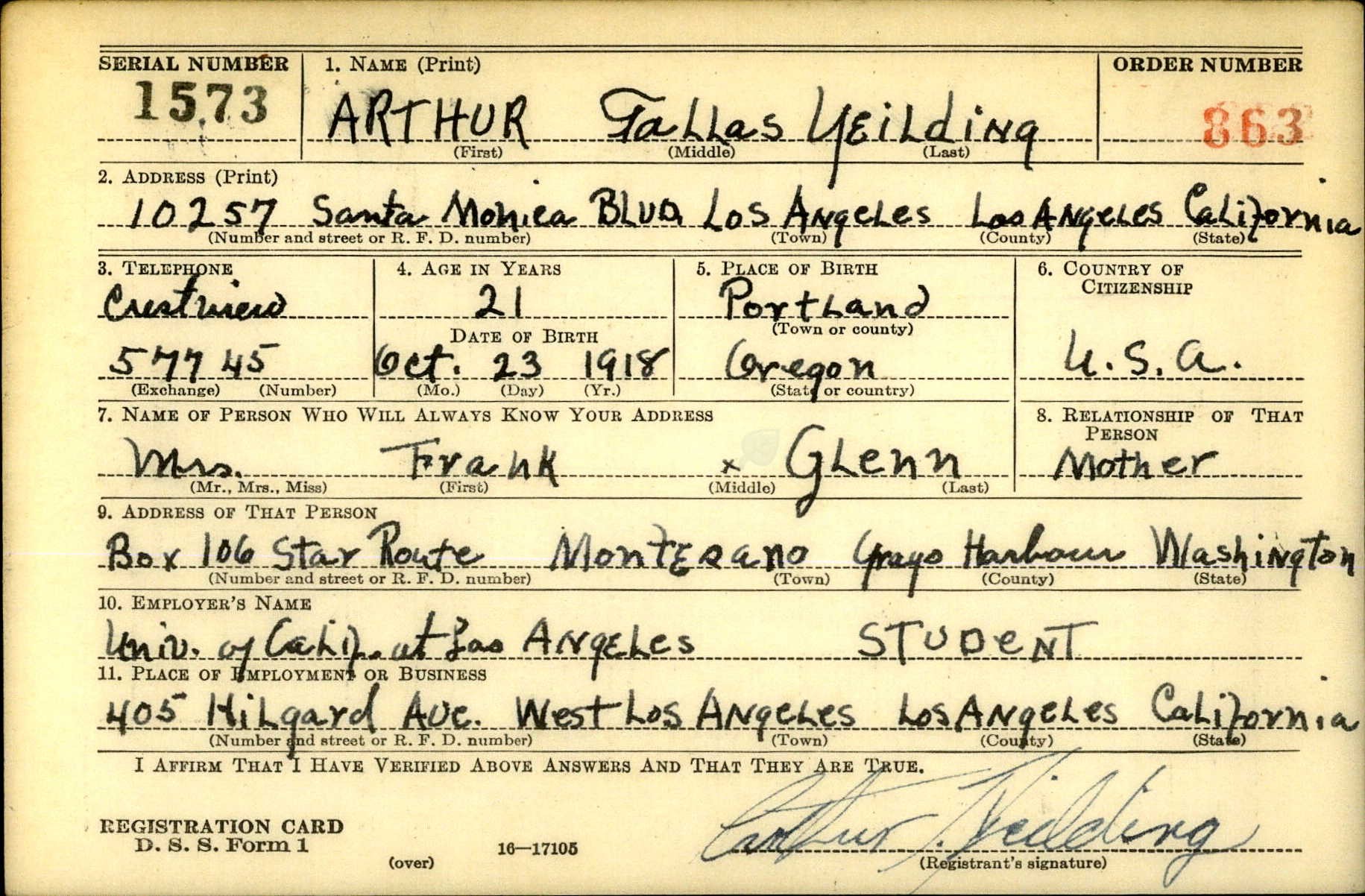
On October 16, 1940, just six days short of his 22nd birthday, Arthur decided he wanted to serve his country in the Army Air Corps. He enlisted in the military that day and began his journey into a war he did not know was coming. On his draft card he reported that he was 5 feet 9 inches tall, with a light complexion, blonde hair and gray eyes. Apparently, his mother had moved to Montesano, in Grays Harbor County, Washington. He was trained as a fighter pilot, the rest of his available military records are lacking in clear information. Upon completing his training, Arthur was promoted to the rank of 2nd Lieutenant and was assigned to the 339th Fighter Squadron of the 347th Fighter Group, eventually assigned to the 13th Air Force.
By 1941 relations between the United States of America and the Empire of Japan had soured. Japan had been at war with China since 1937. The Japanese home islands were not rich in natural resources and the material needs of conducting a war with a nation the size of China were immense. Japan had only been able to conduct the war successfully because the empire received a large amount of its oil from the United States. Without American oil imports Japan could not hope to win its war in China. When the United States cut off oil shipments to Japan in 1940, a response to the Japanese invasion of French Indo-China, the Imperial high command came up with a plan to take the resources by force. Their strategy was to take the resource-rich islands in the Pacific, fortify them against counter-attack, and continue their war in China in the West while extracting the natural resources and fending off the United States, Great Britain, and their allis in the East.
The surprise attack on the American Pacific Fleet at Pearl Harbor on December 7, 1941 is well known. However, the impact of the attack on Pearl Harbor distracts from the broader campaign throughout the Pacific that, when viewed in its entirety, constitutes the largest military campaign in history. Between December 7th and December 10th, 1941, the Japanese empire attacked or invaded British colonies of Malaya, Singapore, and Hong Kong as well as the United States naval bases on Wake Island, Guam, the Philippines, and more. They opened a battlefront that was 6,000 miles wide north-to-south. Men like Arthur Tallas Yeilding, with their unique skillsets as fighter pilots, made them extremely important for the war effort.
The 347th Fighter Group was officially formed on September 29, 1942 and activated on October 3rd of the same year. The United States strategy to defeat the Japanese in the Pacific is usually referred to as “island hopping.” It required the taking of particular strategically important islands in each island chain. One such island was Guadalcanal, which the United States attacked on August 7, 1942 and the 347th fighter group, including the 339th fighter squadron went into combat. After the successful seizure of Guadalcanal, Yeilding and his unit used the island as a base of operations to launch assaults on the rest of the Solomon Islands. From there they continued to attack New Georgia, the Russell Islands, and Bougainville throughout 1943.
On December 26, 1944 the United States initiated “Operation Backhander,” an assault against Japanese held New Guinea. The attack on New Guinea carried through to January 16, 1944. Japanese forces on the island were forced to a part of the island called the Gazelle Peninsula, a defensive position they would hold through to the end of the war. The Army Air Corp carried out bombing raids routinely over the Gazelle Peninsula and Cape Gazelle, actions for which the 347th Fighter Group were awarded the Distinguished unit citation in November of 1944. The Japanese had fortified their end of the island with anti-aircraft guns, and their part of the island also contained an airfield from which they could launch their own fighters to defend their position from near constant aerial assault, courtesy of Arthur and the Army Air Corp and navy pilots. On January 23, 1944, Arthur went on another raid in this region. He was shot down over Cape Gazelle. The circumstances of his death remain largely unknown, whether it was anti-aircraft guns or Japanese fighters that killed Arthur, no sources can specify, and tragically his body was never found. But Arthur’s actions throughout the years he served were vital to the United States victory in the many battles that raged throughout the Pacific Theater.
Postwar Legacy
Back in Washington State, the news of Arthur’s death hit hard for his family and those at WSC that had gotten to know him. In order to honor all of the W.S.C fallen, President E.O. Holland sent letters to bereaved families informing them of personal connections he had with their lost loved ones. In June of 1944, Holland sent one such letter to Arthur’s mother which read “I was grieved when Registrar Bernard informed me yesterday of the death of your on . . . who was killed in action over Cape Gazelle.” He reiterated his desire that “At the close of the war, we wish to pay tribute to Lieutenant Yeilding, and other former students who have served their country in the second world war.” To that end, E.O. Holland and others at WSC set about putting together books, pamphlets, and other sorts of memorials to honor the fallen. The modern incarnation of Dr. Holland’s efforts, the Fallen Cougars Project, seeks to do the same.
For Arthur's family, another loss was suffered on August 6, 1944, when his mother, Gertrude, died from acute myocarditis. Her death certificate lists the cause as "unknown."