Edward Morris Levine, Jr.
Pre-WSC Background
Many of the Fallen Cougars we cover were very young when they lost their lives. After all, most of them were in college or recently graduated when they got called up and died a year or so later. In other cases, like Edward Morris Levine Jr., they are substantially older and have much more life experience by the time they took up the cause to defend their country. This usually means they had wives and sometimes children; they had careers after their time at Washington State College and entered the military with higher ranks than their younger counterparts. Edward was a prime example of one of the more well-experienced WSC grads when he entered the service. Born in California in 1905, he spent time in California, Washington, Ohio, and Pennsylvania before joining the military. His wealth of experience and willingness to serve made him one of the vitally important few who trained our soldiers in the field, and his bravery meant that he lost his life in defense of his country and his family.
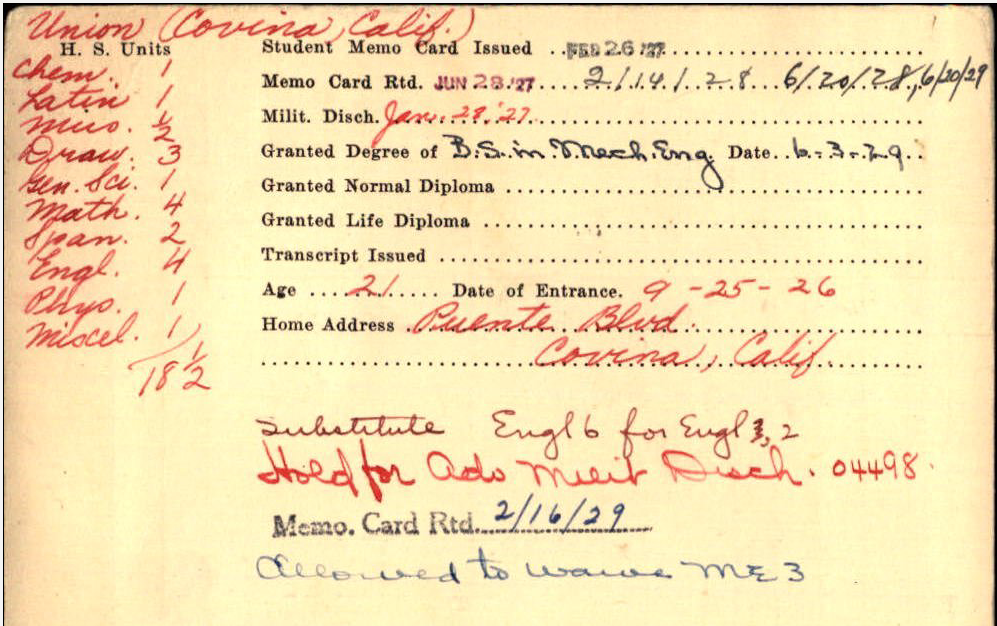
Edward and Ingrid Levine were both born in Sweden in the late nineteenth century, immigrating to the United States and getting married when Edward was 28 and Ingrid was 21. They lived in Los Angeles, California, by 1910 and had started a family. They welcomed Edward Jr. to their family on January 9, 1905, and welcomed their daughter Christel two years later. What little information we have on his time growing up in California points to a happy family life and success in school. Edward Sr. noted his occupation as a “teamster” (likely a driver) on an “ice wagon” in 1910. A union job could see families through very difficult financial times, aside from the labor unrest and danger that came with it through the 1920s. When exactly he went into business for himself is unclear, but a later obituary explains that Edward Sr. was a Christian Scientist and “he established the first ice company in Covina, later purchasing a ranch at 1550 Glendora Avenue.” He lived the American dream, from immigrant to business owner and rancher, husband, and father before his passing. While there is no official documentation I could find, it is likely that Edward Sr.’s children would have been raised with his religion, especially at that time. With a stable home life, Edward Jr. could focus on his studies. He graduated from Covina Union High School in Covina, California, right on time at the age of 18 in 1923. And, like many other Fallen Cougars, decided to stick close to home, enrolling at the California Institute of Technology for two years in Covina. While newspaper articles later claim he attended UCLA either during or instead of CIT, his transcripts held at Washington State University list credits transferring to WSC from “Calif inst. of tech” with recommendations to swap out certain classes for others that are more fitting within WSC’s credit system. After continuing his academic success in California, he decided to continue his education at Washington State College and moved to Pullman, Washington.
WSC Experience
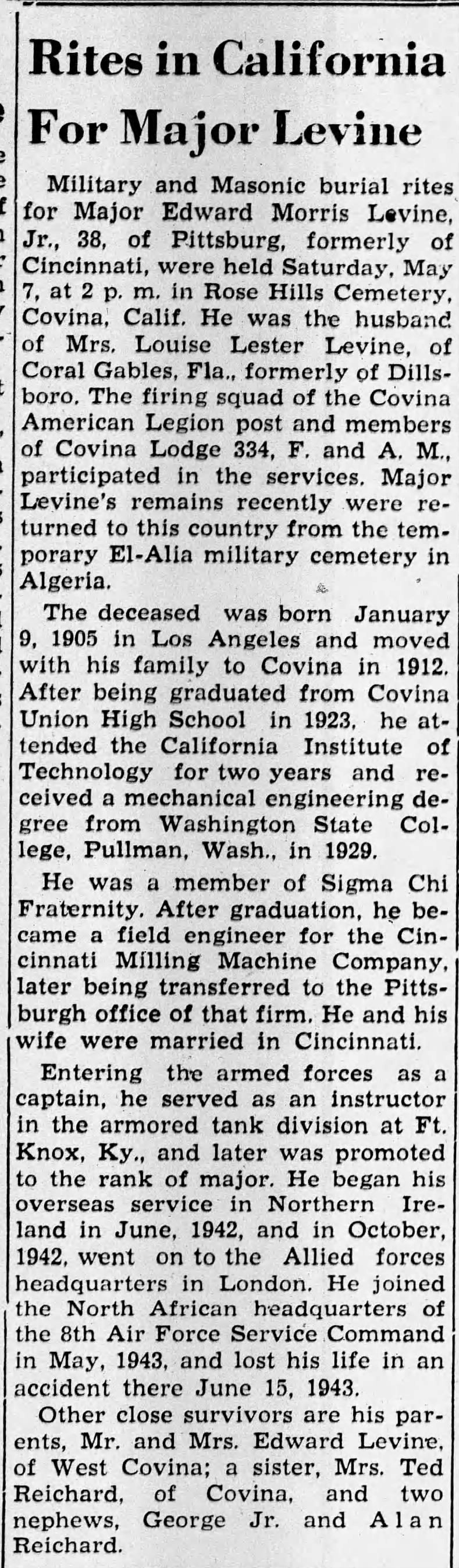
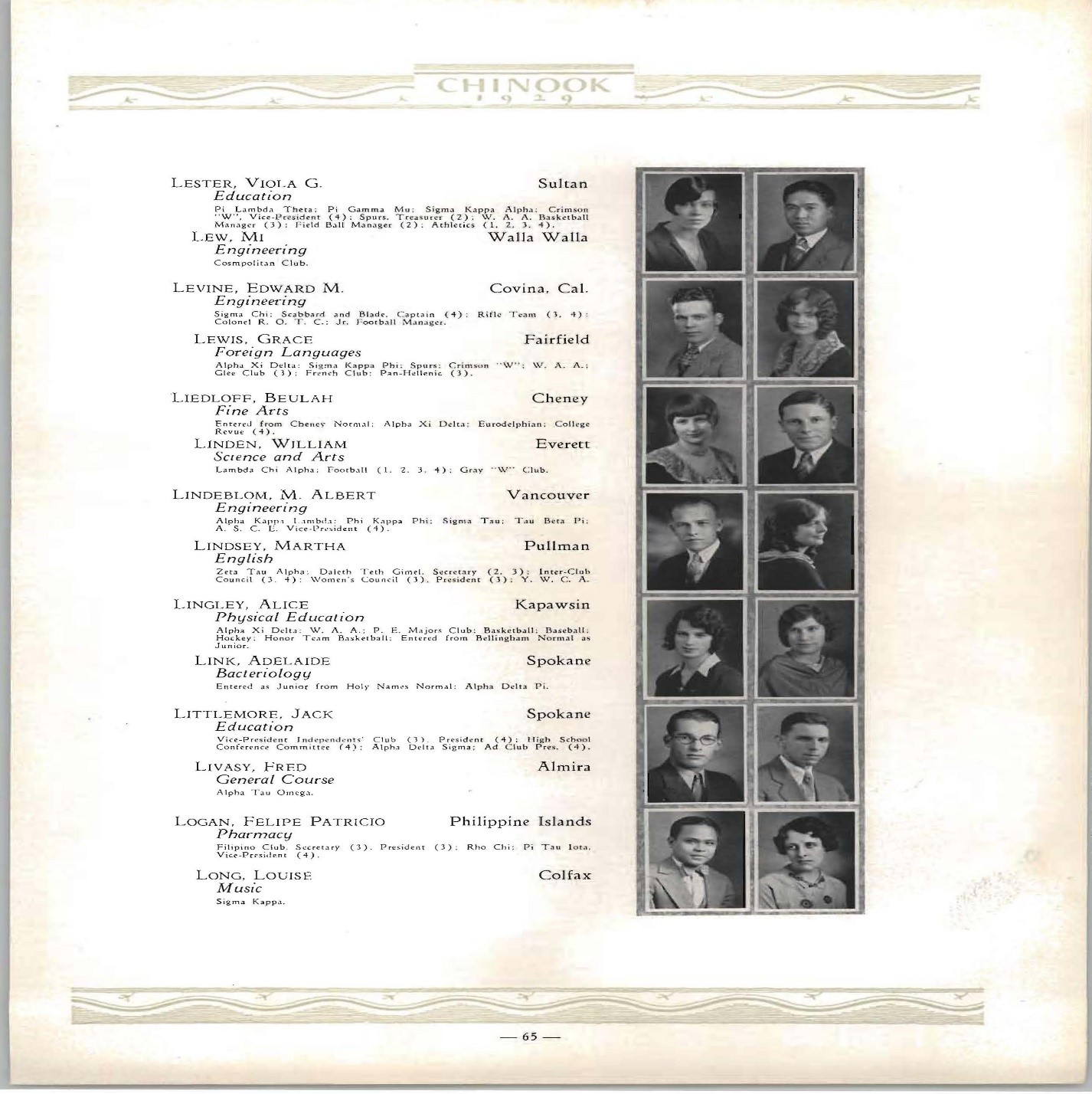
Edward arrived in Pullman in 1926 and quickly became a stellar student and constant presence all over campus. In his years on campus, he was involved in numerous campus activities and clubs. He was inducted into the Sigma Chi Fraternity, was on the rifle team his Junior and Senior Years, was a manager for the football team, among other activities, but where he truly excelled was in military training. While his grades fluctuated depending on his apparent interest in the field, one thing was always an A: his classes for the Reserve Officer Training Corps (ROTC). By his senior year, he had attained the rank of Colonel in the program and was a Captain in the Scabbard and Blade Society, a military fraternal organization open only to those who excel in ROTC. Edward graduated with a degree in engineering in 1929 and set out to make his way in the world.
After college, he moved to Cincinnati, Ohio, where he put his engineering knowledge to good use working for the Milling Machine Company. It turns out he also had a knack with people, moving to the sales division, selling engineering tools for the company in 1930. It was also here that he met and fell in love with Louise Lester of Dillsboro, Ohio. It is difficult to find articles on the marriage except that the two were married in Florida.6 Edward continued his successful career and was eventually transferred to the Pittsburgh branch of the Milling Machine Company, one assumes to bolster the sales numbers in that division. According to the 1940 census, Edward and Louise lived in Alleghany, Pennsylvania, outside Pittsburgh. Edward’s job remained consistent while Louise worked as a bookkeeper for a local newspaper. Together the two made about $6,100 per year, roughly equivalent to $136,845 today (though it is likely more than that, as spending power was much stronger back then, aside from the simple inflationary devaluing of the currency today). By all accounts, Edward had made it. The middle-class dream that characterized American life at the time was his through his determination, perseverance, and intellect; he had a home, a wife, a good career, and the future looked bright at 32 years old. But events half a world away conspired to pull Edward and men like him into violence and war.
Wartime Service and Death
World War II in Europe had been raging since Nazi Germany invaded Poland on September 1, 1939. The fascist government, under the leadership of Austrian-born dictator Adolf Hitler, waged war throughout Europe. They conquered both Denmark and Norway in April of 1940, followed by Belgium, the Netherlands, and tiny Luxembourg in May of that same year. Most astonishingly the Germans managed to conquer France in just 39 days, following up that light-speed victory with a massive aerial campaign against the United Kingdom. In 1941 the Germans turned their military aims to the east, conquering Yugoslavia and Greece in April before betraying and invading the Soviet Union on June 22, 1941. They then made a mistake they did not need to make. Largely to appease their Japanese allies and to satisfy Hitler’s ideological fanaticism, but also with an eye to destabilizing American politics, Germany then declared war on the United States on December 11, 1941. Men like Edward Levine Jr. were desperately needed for the ramping up of a largely dormant American military. Perhaps men like Edward were the most important in filling out the officer corps that formed the nucleus of the American military. Any military man knows that without good NCO’s and Commissioned Officers, a military stands very little chance of cohesion and effective combat fighting.
Edward had trained for just this possibility during his time at Washington State College, and as a member of the Army Reserve was ready and willing to enter the United States Army with the rank of Captain on March 31, 1941. He was officially enlisted with the Service Number 39231632, standing 67 inches (5’6") and weighing 173 pounds; his relatively short height and mechanical know-how made him uniquely suited for a particular job in the service: tanks. He was assigned to the engineer corps as a Captain, and, a man of relatively advanced age compared to most others joining the service, he was assigned to train a division of tankers. Sent to Fort Knox, Kentucky, he trained new American tankers in vehicle operation and tactics. He was so successful at this that he was promoted to the rank of Major before he was officially shipped to war.
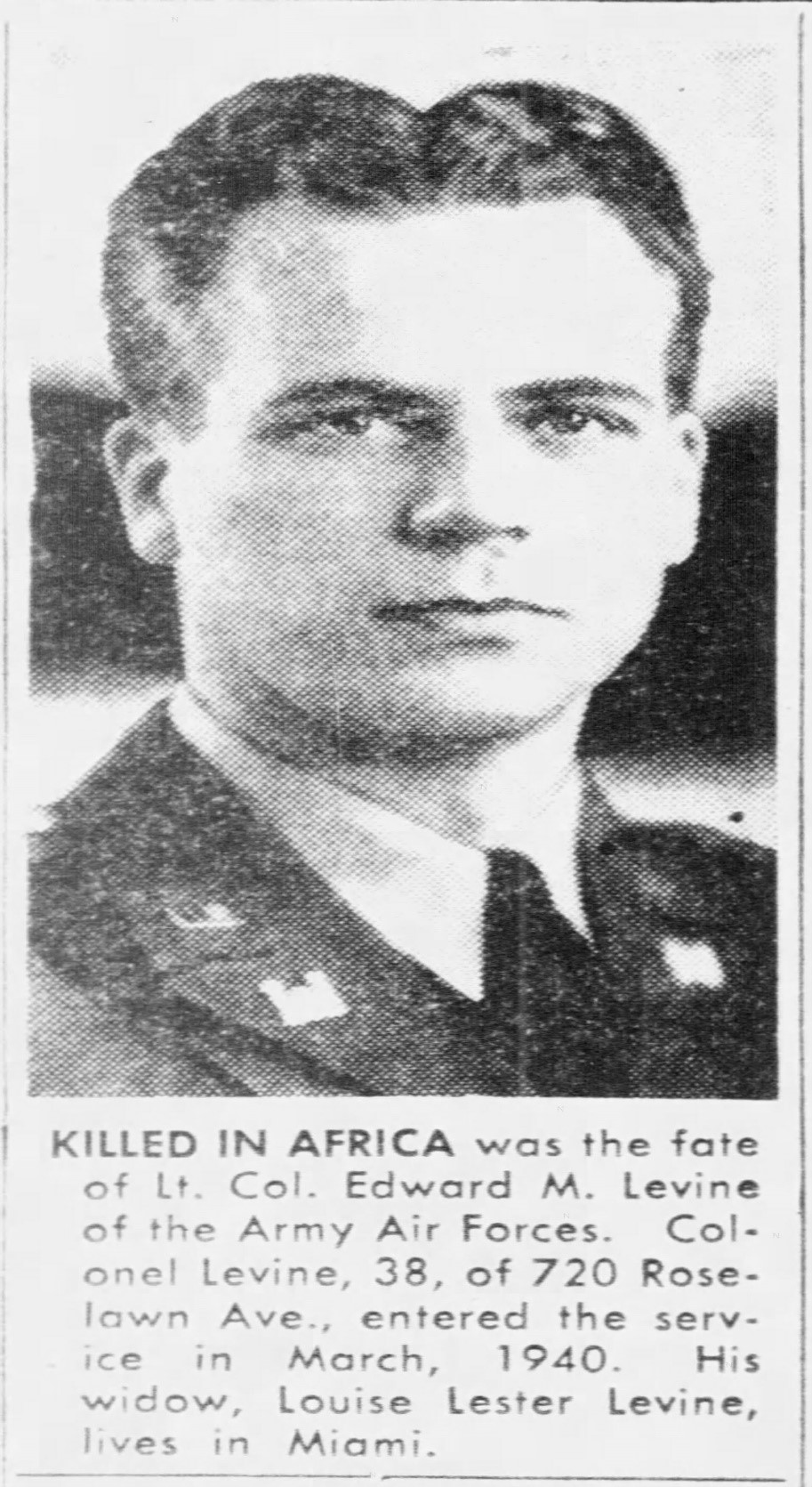
After the Pearl Harbor attacks and Germany’s declaration of war on the United States, Edward was tasked with training men as the army moved and fought in enemy territory. In June of 1942, he was sent to Northern Ireland to begin his overseas service in his training role. In October of 1942, he was sent to Allied Forces Headquarters in London, where he joined the North African Headquarters of the 8th Air Force Service Command. Operation Torch led to the successful capture of North Africa by Allied forces. In May of 1943, Edward was sent to Algeria to continue training forces engaged in combat. However, his stellar career and ascent up the ranks were brought to an end by a tragedy in North Africa. While stationed in Algeria, on June 15, 1943, Edward was killed in an accident on base; he was 38 years old.
Postwar Legacy
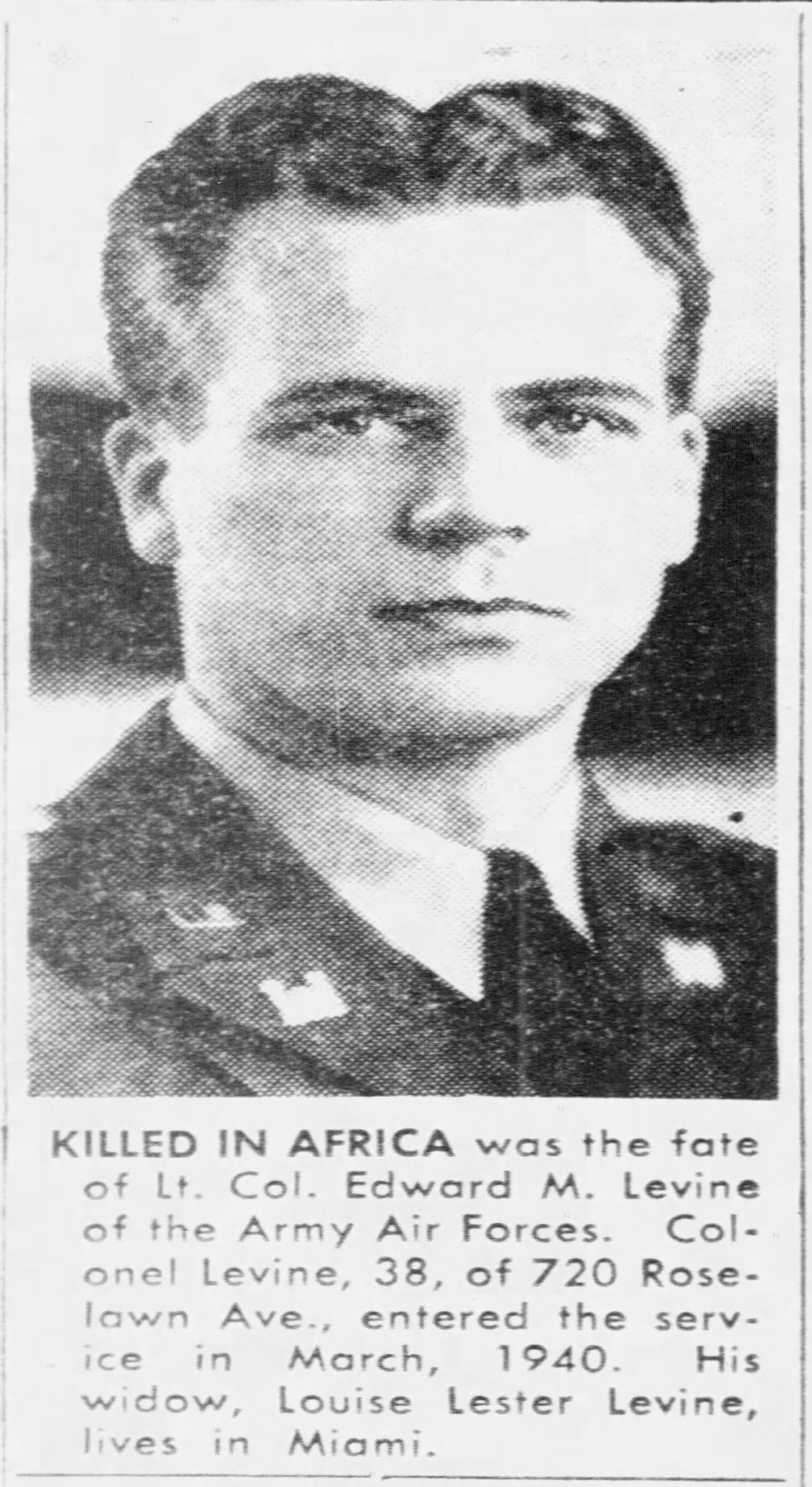
Back home, his family was devastated. Louise received the news at her home in Florida, where she had moved during her husband’s many training courses, and she informed the rest of the family herself. But the impact of the man was felt far and wide. Almost every town he lived in ran an article on the passing of Edward in the line of duty. The Pittsburgh Post-Gazette ran an article with a great photo of Edward in his military uniform with the rank of Lieutenant Colonel.8 The Pittsburgh Post followed suit. The Cincinnati Post also ran an article on June 22, 1943, detailing his service and tragic death in service to his country. Edward’s body was temporarily laid to rest in a burial at El-Alia Military Cemetery in Algeria before they were exhumed and sent back home for his final resting place. He received both military and masonic burial rites at Rose Hills Memorial Park in Whittier, Los Angeles County, California. It speaks to the respect of his family and the man himself that 334 members of American Legion Post of Covina attended his burial that day. He was survived by his mother, his sister, and his wife, as Edward Sr. had passed the year before.
Edward is also memorialized at his alma mater in little Pullman, Washington. There, on the campus of what is now called Washington State University, you will find the World War II memorial for all Cougars that gave their lives in the war. Beneath the iconic tower of Bryan Hall, you can find Edward M. Levine Jr’s name emblazoned in golden letters, rightfully so, alongside the names of his fellow Fallen Cougars. This digital memorial now adds one more place where he is honored and committed to memory.