
Edgar Allen Davidson
Pre-WSC Background
If one drives east from Moscow, Idaho and turns South in Troy on highway 99, they will eventually end up in the tiny hamlet of Kendrick, Idaho. Originally a tiny logging outpost built on the potlatch river, the community saw steady growth in its formative decades. In 1891 the railroad came through Kendrick, the population boomed to more than 600 people, and the lumber town’s economy blossomed. However, a few tragedies struck the community as well. A large fire in 1893 burned down most of the town. A train crash that dammed up the river for an extended period hurt the local economy and claimed the lives of five people. By the early twentieth century, the population had largely stabilized around 500, and that was as large as Kendrick, Washington ever got. Edgar Allen Davidson was born and raised in this tiny logging community. This community shaped him into the kind of man who joined the military two times, the kind of man who took up arms for the Republic to defend his community and his country, and the kind of man who sacrificed his own life so that others could live free.
George T. Davidson married Fern C. Davidson and settled in little Kendrick, Washington. George was a farmer to pay the bills for his sizable family. Tragically, Fern passed away in 1919, leaving behind her husband, ten-year-old daughter Winifred, six-year-old daughter Marjory, and two sons, three-year-old George and nearly two-year-old Edgar, born on April 15, 1918. According to the 1920 census, George hired Emma Frederkson as a live-in nanny to care for the children while he worked the farm. Emma was born in Sweden and raised in a Swedish-speaking household. By the 1930 census, George had married Emma, and the couple had added 4-year-old Barbara and three-year-old William to the Davidson family ranks. George still owned the family farm and the children attended local schools in Kendrick. Edgar graduated from Kendrick High School in 1934, and instead of heading straight to college like many of his fallen cougar compatriots, Edgar joined the Marine Corps.
WSC Experience
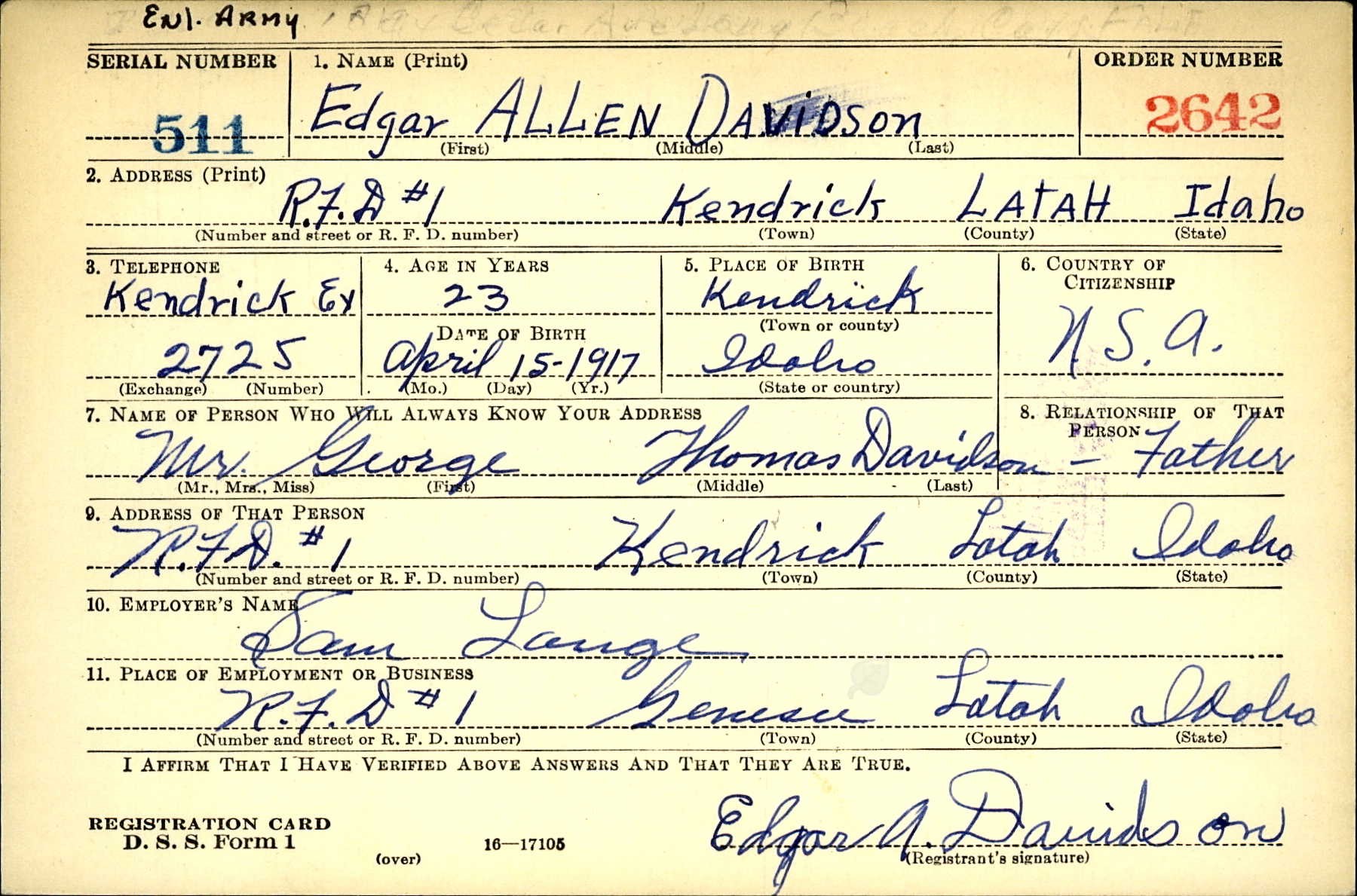
Edgar spent four years in the United States Marine Corps. According to the 1940 census, he attained the rank of Private First Class and was living in Chico, in Kitsap County, Washington. PFC Davidson worked at the Naval ammunition depot in Chico, and he had not yet attended college by the time the census was taken. While records are sparse on the intervening years between 1940 and 1943, WSC records indicate that he moved back to the Palouse in 1940. His draft registration card lists his employer as RFD #1, likely Rural Fire Department #1 in Latah. He also attended Washington State College in the summer of 1941. The reason for this schooling is unknown, perhaps taking classes required for his job. However, perhaps more important than his schooling is that this is likely where he began a relationship with one Mary Alice McIntosh. At some point after 1941, the couple moved to Florida. It is possible that Edgar re-enlisted in the military, this time into the United States Army Air Corps, and was stationed in Florida. Whatever the reason, Mary Alice and Edgar were married on March 26, 1943, in Escambia, Florida.
Wartime Service and Death
The newlyweds did not get much of a honeymoon. The couple moved back to the Palouse, and the Spokesman-Review announced that the newly married Mary Alice Davidson was hired to teach English and Dramatics at Pullman High School. The couple did not get to enjoy their new marriage or careers long before they were separated by the war that had ravaged the world for years. World War II in Europe had been raging since Nazi Germany invaded Poland on September 1, 1939. The fascist government, under the leadership of Austrian-born dictator Adolf Hitler, waged war throughout Europe. They conquered Denmark and Norway in April of 1940, followed by Belgium, the Netherlands, and tiny Luxembourg in May of that same year. Most astonishingly, the Germans managed to conquer France in just 39 days, following up that light-speed victory with a massive aerial campaign against the United Kingdom. In 1941, the Germans turned their military aims to the east, conquering Yugoslavia and Greece in April before betraying and invading the Soviet Union on June 22, 1941. They then made a mistake they did not need to make. Largely to appease their Japanese allies and to satisfy Hitler’s ideological fanaticism, but also with an eye to destabilizing American politics, Germany then declared war on the United States on December 11, 1941. Men like Edgar Davidson were called on in their nation’s time of need, and he answered. Edgar enlisted in the Air Corps and completed his training in February of 1943. Upon receiving his commission, he was awarded his Wings in March of that year and achieved the rank of 2nd Lieutenant. Lieutenant Davidson was assigned to the 49th Squadron of the 2nd Bomber Group, attached to the 15th Air Force. The Allies had taken North Africa and Sicily from the Axis by the time Edgar made his way to Amendola, Italy, to begin his career as a pilot in a B-17G Flying Fortress, a heavy bomber.
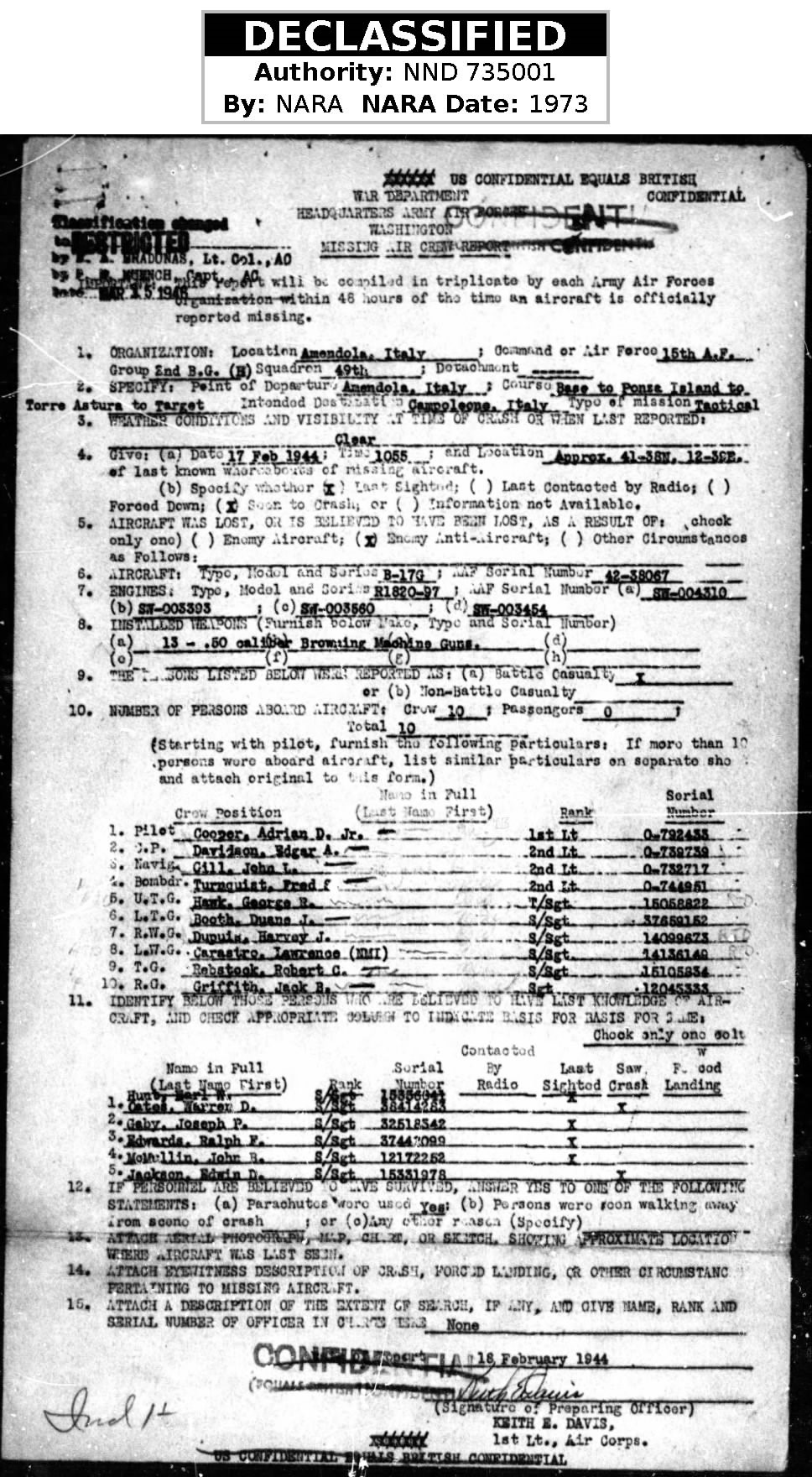
It is unclear how many missions Edgar flew between his arrival in Italy and February 17, 1944, but it was enough to have come close to death at least once. An article in the Spokane Chronicle noted that Mrs. Davidson had previously “received word through a returned flyer that her husband had been in an air crash, but the only injury received was a broken wrist and after convalescence had returned to duty. He had recently been awarded the air medal with five oak leaf clusters.” How the decorated airmen found the courage to get back into an airplane after breaking his wrist in a plane crash is beyond understanding for most people, but Edgar Davidson was not most people. On February 17, 1944, Edgar prepared for another bombing mission over enemy territory in Italy. His crew consisted of Adrian D. Cooper Jr. as a pilot, Edgar as Co-Pilot, John L. Gill as navigator, Fred F. Turnquist as a bombardier, George Hawk manned the upper turret, and Duane Booth handled the lower turret. In contrast, Harvey J. Dupuis and Lawrence Carastro handled the right and left wing guns, with Robert G. Redstock on the tail gun, and Jack B. Griffith as the rear gunner. The crew took their positions in the B-17 #42-38067 and took off from Amendola on a course for Ponse Island, then to Torre Astura, and then to their target at Campoleone, Italy. The crew took heavy enemy anti-aircraft fire over its target. Airmen in other planes in the formation witnessed what happened next, referring to Edgar’s plane as “B-17 No. 067.” Earl W. Hunt was a lower turret gunner in a plane directly behind Edgar’s. He recalled
As I turned my turret up, I saw B-17 No. 067 on fire. The fire was coming from the left side of the plane between number three (3) and Four (4) engines and number two (2) engine. The fire between number three and four engines was very large at this time (1054 hours). The plane went into a steep dive for about 3,000 – 4,000 feet, at which time he started to spin. When the plane started to spin, I noticed pieces of the plane come off and I saw the right win buckle and come off. I saw two (2) parachutes come out. The plane descended quite a bit further and the tail came off and two more parachutes came out. All this time there were little pieces of the plane coming off and burning. I would say that the plane was about 10,000 feet below us when it exploded one (1) more parachute came out. I did not follow the plane down to the ground.
Staff Sergeant Joseph P. Gaby, a tail gunner on another B-17 reported similar events:
I saw B-17 No. 067 get hit by flak on the left wing between No. 1 and No. 2 engines. Very shortly after this the plane started straight down, somewhat in a spin, on one turn the belly of this plane was facing toward our ship and I could see a large fire between No. 1 and No. 2 engines. No. 067 passed out of my sight very shortly after this and the next time I looked for this plane I saw four (4) chutes at about 8,000 feet below us. I did not see No. 067 again but I did see a large amount of smoke coming up from the ground where the plane should have crashed.
Interviews with surviving crew members like John Gill, the navigator, who made it out of the plane alive and was taken captive by the Germans, were conducted after he was released from a POW camp. From their reports it sounds as if the witness accounts from other planes were largely true. Flak raked the plane, beginning with a burst that smashed the tail and forced the plane into a dive, another burst hit between engines 3 and 4 starting a massive fire, and another tore through the flight deck, just behind the cockpit where Edgar and his pilot were sitting. When the wing came off, the plane entered a spin, and anyone lucky enough to have survived the direct hits would have been pinned inside the plane due to the force of the spin if they had not bailed out already. Survivors reported last seeing Edgar “Before Takeoff” and “It is believed that Lt. Davidson was killed because we got hit very near to the flight deck and he was not seen after this. Neither heard.” Lt. Turnquist, the bombardier, was seen lifeless on the ground. The tail gunner, Robert Redstock, was also likely killed immediately when the first flak burst smashed the tail of the plane. Duane Booth, in the ball turret, was last seen “revolving the ball turret as fast as he could,” but he was likely stuck inside the plane when it entered its spin. Harvey DuPuis survived the ordeal, and reported that Lawrence Carastro may have made it out, but George Hawk and Duane Booth were definitely inside the plane when it hit the ground.
Postwar Legacy
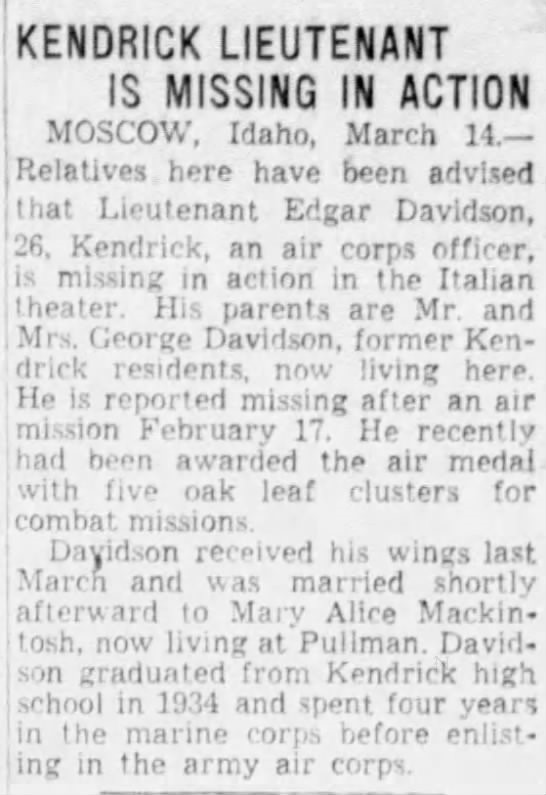
Because Edgar was shot down and his body was not recovered, the military listed him officially as Missing in Action. Newspapers back home ran stories about the local boy and his wife, the schoolteacher. The Spokane Chronicle ran an article with the headline “Former Kendrick Man is Missing,” detailing Edgar’s life and noting that his parents had moved to Moscow in recent months. The War Department officially announced Edgar was missing on April 5, 1944. However, it was obvious to many that if Edgar had survived the crash, he too would have been taken prisoner. His family commissioned a cenotaph for their son at American Ridge Cemetery in Julietta, Idaho, that reads: “In Loving Memory of 1st Lieutenant Edgar A. Davidson. Killed in Action in Italy, Feb 17, 1944. Buried in Golden Gate Cemetery.”
Though his remains went unfound for some time, WSC President E.O. Holland set about honoring all those who had ever worn the Crimson and Gray of WSC. He allocated funds to create brochures for former students who made the ultimate sacrifice in defense of their nation. His remains were eventually located and repatriated from Europe back to the United States. He was finally laid to rest with honor, alongside his brothers in arms, at Golden State National Cemetery in San Bruno, California. Aside from the medals he won, the cenotaph in Idaho, and the headstone in California, Edgar’s name is emblazoned in golden letters on the World War II Memorial on the campus of Washington State University in Pullman, Washington. His name is listed alongside all those Cougar men who fought to protect their communities, country, and way of life. The Fallen Cougars Project continues the work that E.O. Holland started many years ago. To update the memorials to these men for the twenty-first century and to ensure that their legacy lives on.
