Clair Livingston Daniels
Pre-WSC Background
The modern city of Spokane is a sprawling and continuously growing metropole. While the state of Washington is a singular political unit, the cascade mountains that divide the state into eastern and western regions have had a serious impact on the development of the state over time. While the city of Olympia is the recognized political capital of Washington State, people living east of the cascades only pay nominal attention. “east-siders” are much more likely to recognize Spokane as their region's economic and political hub. Today Spokane is the de facto capital of eastern Washington’s “Inland Empire.” However, that has not always been the case; in the nineteenth century, Spokane was just like all of the other towns in the region, a tiny agrarian outpost, except it spelled its own name wrong.
Originally just a trading post intended to conduct business with the local Native groups, the post gradually grew as the Spokane River made it suitable for small-scale settlement. As the nineteenth century wore on, more people came to the area to take advantage of newly discovered mineral wealth, especially gold in the Idaho Panhandle and British Columbia. In 1873, James Nettle Glover officially founded the town of “Spokan Falls,” a phonetic spelling of the name that was used for a decade before the “e” was added to the end, and the “Falls” was chopped off. By 1880, the town had a population of 300. Anyone who has seen the Mel Brooks classic Blazing Saddles knows how important railroads were to local economies. In 1881 the Great Northern Railway reached Spokane and in 1883 linked to the transcontinental line. Spokane’s prime position at the center of the railroad established it as the Capital City of the Inland Empire. By 1909 the Hamlet with a misspelled name had 100,000 inhabitants. By the 1920’s the mining economy was in decline and gave way to timber and agricultural production. It was in this Spokane that Clair Livingston Daniels was born and raised. It was in Spokane that he became the kind of man who worked hard to make a better life for himself and his family, to pursue higher education, and to risk his life in defense of his community and his country.
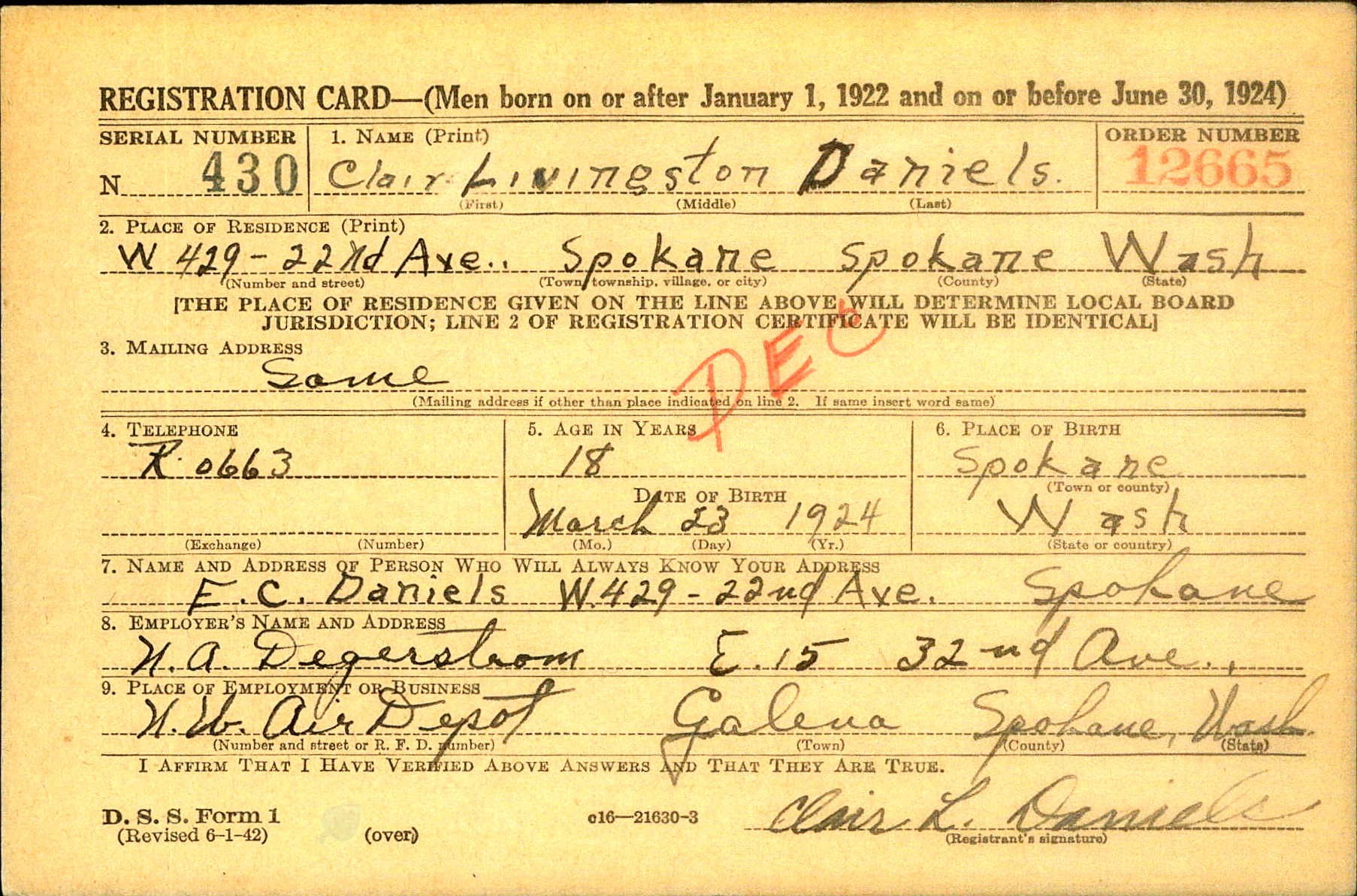
Albie “Alba” Livingston Daniels was the daughter of Kasota, Minnesota farmers. She spent her youth in Minnesota before she graduated from Mankato State Teachers College in Mankato, Minnesota. Emery Clair Daniels was born in Washington State, the son of Sylvester Daniels, a carpenter, house builder, and fruit farmer. He served in World War II before attending the University of Washington, which we will choose not to hold against him. Clair and Albie somehow crossed paths and fell in love. They were married in Spokane in 1922, where Clair had set up his first practice as a certified public accountant (CPA). Clair became a respected man in the field of accounting, establishing the Spokane chapter of CPA’s in 1922, later he became the President of Washington CPA’s in 1941, and served on the State Board of Accountancy from 1925 to 1942. The couple had their first child, a boy who took the middle name of his parents, Clair Livingston Daniels, on March 23, 1924. They welcomed their second and final addition to the family, a daughter they named Nancy L. Daniels, in 1928. Emery and Alba raised their children through their entire childhoods at West 429th and 22nd Avenue in Spokane, with the telephone number R0663.
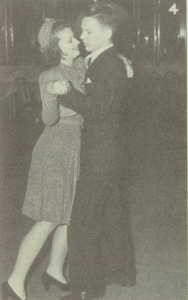
Clair grew into a very talented young man with varied interests in his time at Lewis and Clark High School in Spokane. In the 1939 through 1942 school yearbooks, Clair listed his favorite President in American history as Woodrow Wilson. He was a member of the mathematics club, the history club, the language club, the Classical literature club, and he was a member of the Fleur De Lys club. As if that were not enough to keep him busy, he managed the school golf team, edited the school newspaper, The Tiger, and served as a Corridor Control Officer (hall monitor). Clair appears to have been a popular young man by all accounts, and not just among the boys. The High School yearbook in 1942 includes a “senior snapshot” section in which Clair is pictured dancing with a well-dressed young woman identified as Lou Justice. He won the Freshman Latin award and listed his intent to follow in his father’s footsteps and attend the University of Washington in Seattle. He came to his senses and instead chose to go to Washington State College.
WSC Experience
Unfortunately, there is very little information on Clair’s time as a Washington State Cougar; as Clair graduated high school and enrolled at Washington State College in Pullman, his country was pulled into a global cataclysm. World War II in Europe had been raging since Nazi Germany invaded Poland on September 1, 1939. The fascist government, under the leadership of Austrian-born dictator Adolf Hitler, waged war throughout Europe. They conquered both Denmark and Norway in April of 1940, followed by Belgium, the Netherlands, and tiny Luxembourg in May of that same year. Most astonishingly the Germans managed to conquer France in just 39 days, following up that light-speed victory with a massive aerial campaign against the United Kingdom. In 1941 the Germans turned their military aims to the east, conquering Yugoslavia and Gust Damascus’s ancestral homeland of Greece in April before betraying and invading the Soviet Union on June 22, 1941. They then made a mistake they did not need to make. Largely to appease their Japanese allies and to satisfy Hitler’s ideological fanaticism, but also with an eye to destabilizing American politics, Germany then declared war on the United States on December 11, 1941. By late 1942 the Allied powers had attacked the “soft underbelly” of the Axis, taking North Africa and invading the island of Sicily. Back in Pullman, Clair was preparing to join the fray.
Clair majored in business administration at Washington State College when he enlisted as an aviation cadet in the United States Army Air Corps in the Fall of 1942. Clair continued his classes until he was called up to begin his training.
Wartime Service and Death
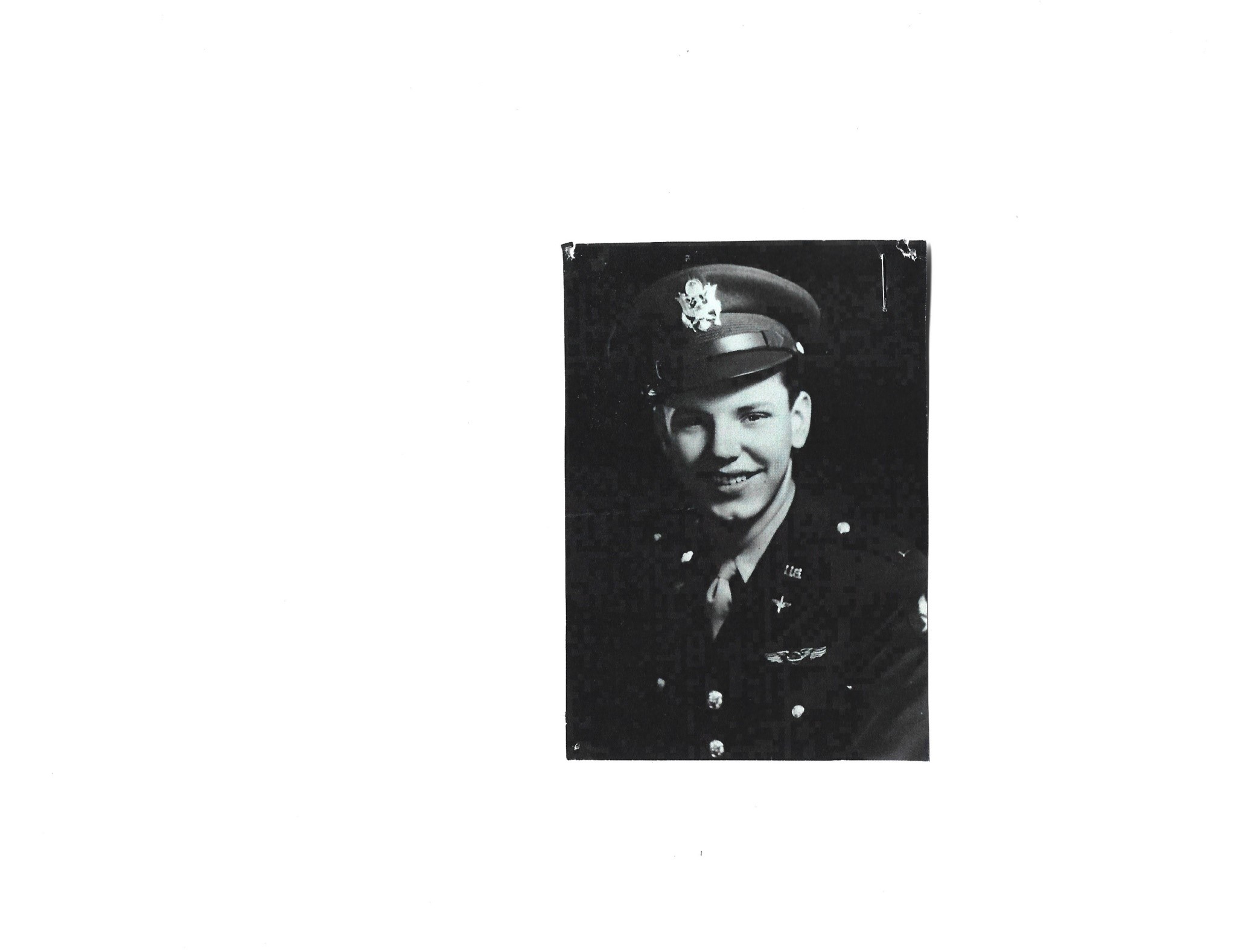
Clair completed his pre-flight training at Central Washington College of Education, modern-day Central Washington University in Ellensburg, Washington. He then completed his flight training at the Air Corps Navigation School in San Marcos, Texas. Perhaps he inherited his gift for numbers from his father, or perhaps he realized that his time in the math club in high school was well spent when he was commissioned as a second Lieutenant in the United States Army Air Corps and was awarded his wings as an aerial navigator in December of 1943. He was assigned to the 484th Heavy Bombardment Group, equipped with B24 Liberator heavy bombers. The 484th was assigned to the 15th Air Force. Clair went to North Africa, where he completed more training before his first combat flight from Foggia, Italy, in April of 1944.
While airmen often jumped from one plane to another, they were more often than not with the same basic crew in a single plane. Records held by the 484th Bomb Group’s personal website list Clair’s plane as # 42-52685, or the “Luscious Lucy,” in the 825th Squadron. Various war records and personal remembrances show that Clair flew as the Navigator on more than a dozen bombing missions, and a letter which will be discussed later puts his total number of missions at eighteen, all flown from the airfield in Foggia. On May 20, 1944, Clair flew a bombing run over Wels, Austria. The 484th dropped more than 81.0 tons of bombs over their target with no casualties to the planes or crew. On May 31, 1944, another successful mission was carried out by the crew of Luscious Lucy, this time in a raid that dropped more than 76.5 tons of ordinance over Ploesti, Romania. It was on the way bag to base that disaster struck.
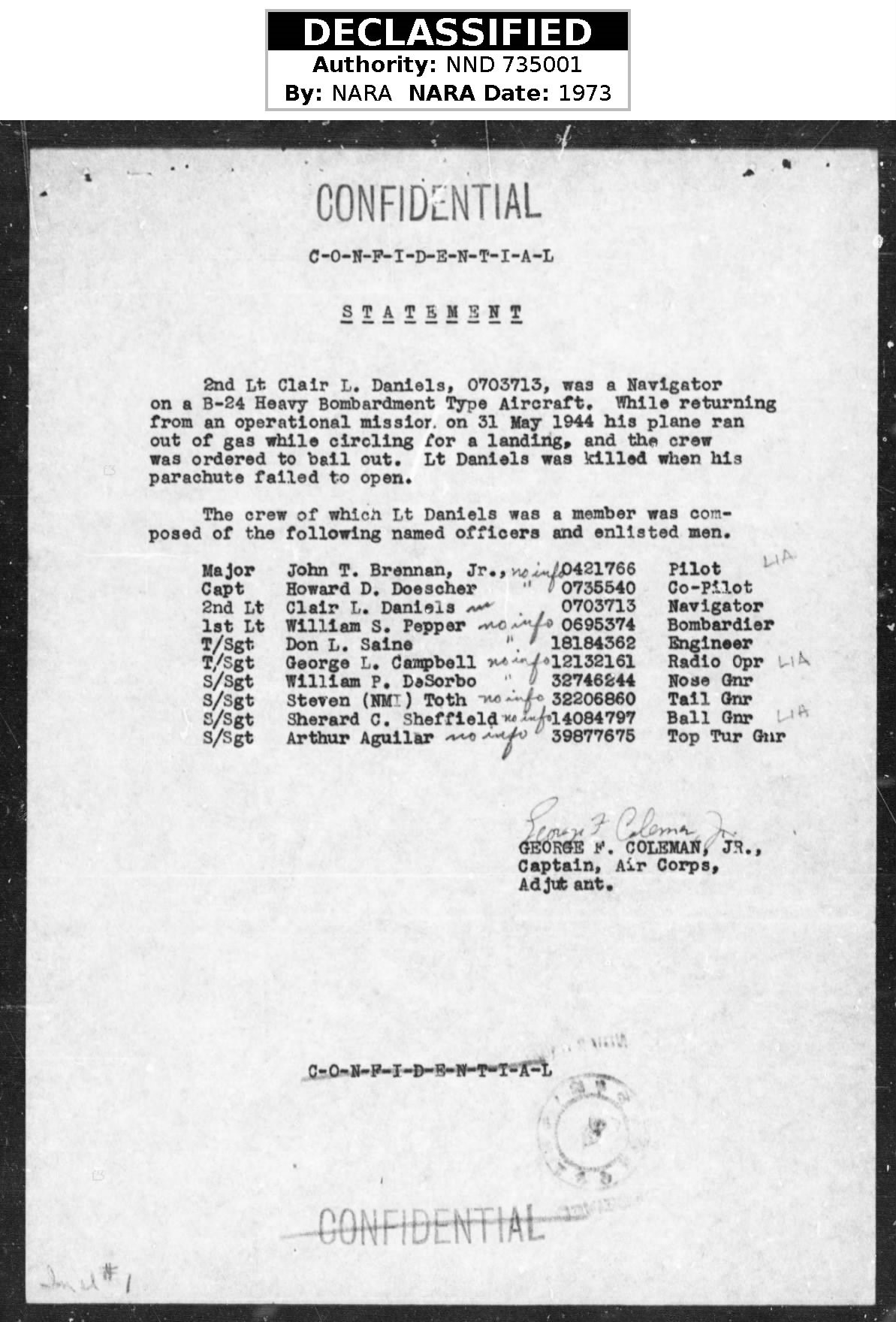
The crew on that mission consisted of pilot Major John T. Brennan Jr, Captain Howard D. Doescher as Co-Pilot, 2nd Lieutenant Clair L. Daniels as Navigator, First Lieutenant William S. Pepper as Bombardier, Sergeant Don L. Saine as Engineer, Sergeant George L. Campbell as Radio Operator, Sergeant William P. DeSorbo as Nose Gunner, Sergeant Steven Toth as Tail Gunner, Sergeant Sherard C. Sheffield as Ball Turret Gunner, and Sergeant Arthur Aguilar as Top Turret Gunner. In a letter to Mr. and Mrs. Daniels after the incident, Co-Pilot Captain Doescher, a personal friend of Lieutenant Daniels, explained what he remembered happening on that disastrous return trip. “I haven’t written anybody this month.” Wrote Doescher, “On May, 31 we flew a very rough mission and our crew had a close one with death. We went on a long raid, we got the hell shot out of us at the target and on the way home, in fact we were only five miles from the field, when we ran out of gas.” The plane drifted as it circled the airfield with no clearance to land. The plane was a mere 2,000 feet from the ground and “no one had their chutes on, and the ship was out of gas, heading for the ground like mad. I rang the alarm bell and the men started bailing out. Every one got out of the plane. When I left the plane was only 250 feet from the ground. Just as my chute opened I hit the ground—so you can see how close we really were.” Unfortunately, though “My Navigator’s chute never did open and he was killed. Four other men from the crew received the purple heart that day and I was recommended for the DFC. Our Navigator was from Spokane. I don’t know whether you knew him or not. His name was Lt. C.L. Daniels. He really was one swell guy. All of us sure miss him.” There is some disagreement on how exactly Lieutenant Daniels failed to make it out of the plane and to safety. The official Missing Air Crew Report States that “2nd Lt. Clair L. Daniels, 0703713, was a Navigator on a B-24 Heavy Bombardment Type aircraft. While returning from an operational mission on May 31, 1944, his plane ran out of gas while circling for a landing, and the crew was ordered to bail out. Lt Daniels was killed when his parachute failed to open.” However, both Doescher and Mrs. Daniels believe that “it appears that Lieutenant Daniels struck his head on leaving the plane and was rendered unconscious.” And thus, unable to pull the rip cord on his parachute after exiting the plane.
Postwar Legacy
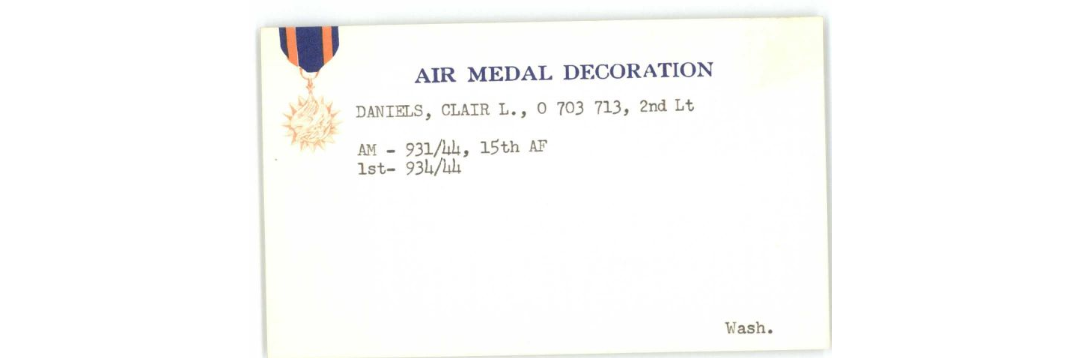
On May 12, 1945, Lieutenant Daniels was awarded posthumously the Air Medal with one Oak-Leaf Cluster, the citation reads “For meritorious achievement in aerial flight while participating in sustained operational activities against the enemy from April 29 to May 6 1944 and from May 7 to May 24, 1944.” Spokane newspapers ran articles with pictures of Lieutenant Daniels and descriptions of his life in the community, his family, and sorrow for his loss. Washington State College President E.O. Holland took it upon himself to contact all families of WSC men that lost their lives in the war. In his correspondence with Mr. and Mrs. Daniels he wrote that “Lieutenant Daniels represented the best in American life and he was a splendid College citizen.” And that it is “proper and essential that future generations of American will be willing, in time of peace, to protect those ideals for which your son and other splendid young men gave their all.”
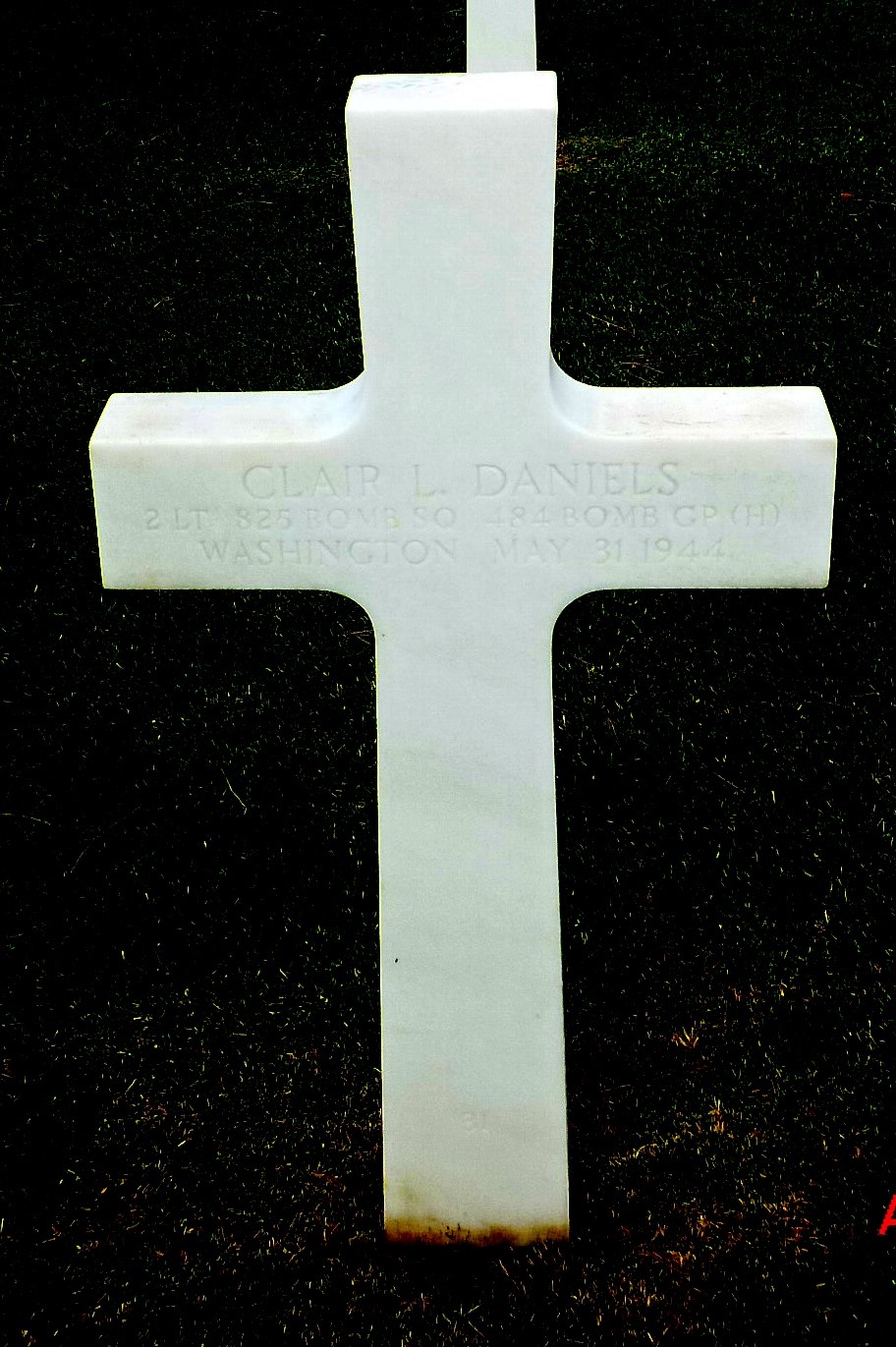
President E.O. Holland carried on his mission to honor those WSU men who gave their lives in the war. While he never completed the brochures they had planned, he personally wrote to every family, sent them memorial plaques that held photos of their fallen loved ones, and set the groundwork for the tradition of honoring these men. The modern Fallen Cougars project seeks to carry on and complete Dr. Holland’s mission through these biographies, the website, and other media platforms to bring the memory of the fallen into the twenty-first century. Clair Livingston Daniels was memorialized in newspapers, letters from loved ones, in the medals he was awarded for his valor in the face of the enemy, and lastly his name is inscribed in gold letters on the World War II memorial on the campus of his alma mater, now called Washington State University, in Pullman, Washington. Lieutenant Daniels was laid to rest at the Sicily-Rome American Cemetery and Memorial, Plot G, Row 1, Grave 31. His citations for the Air Medal and Purple Heart are recorded there as well.