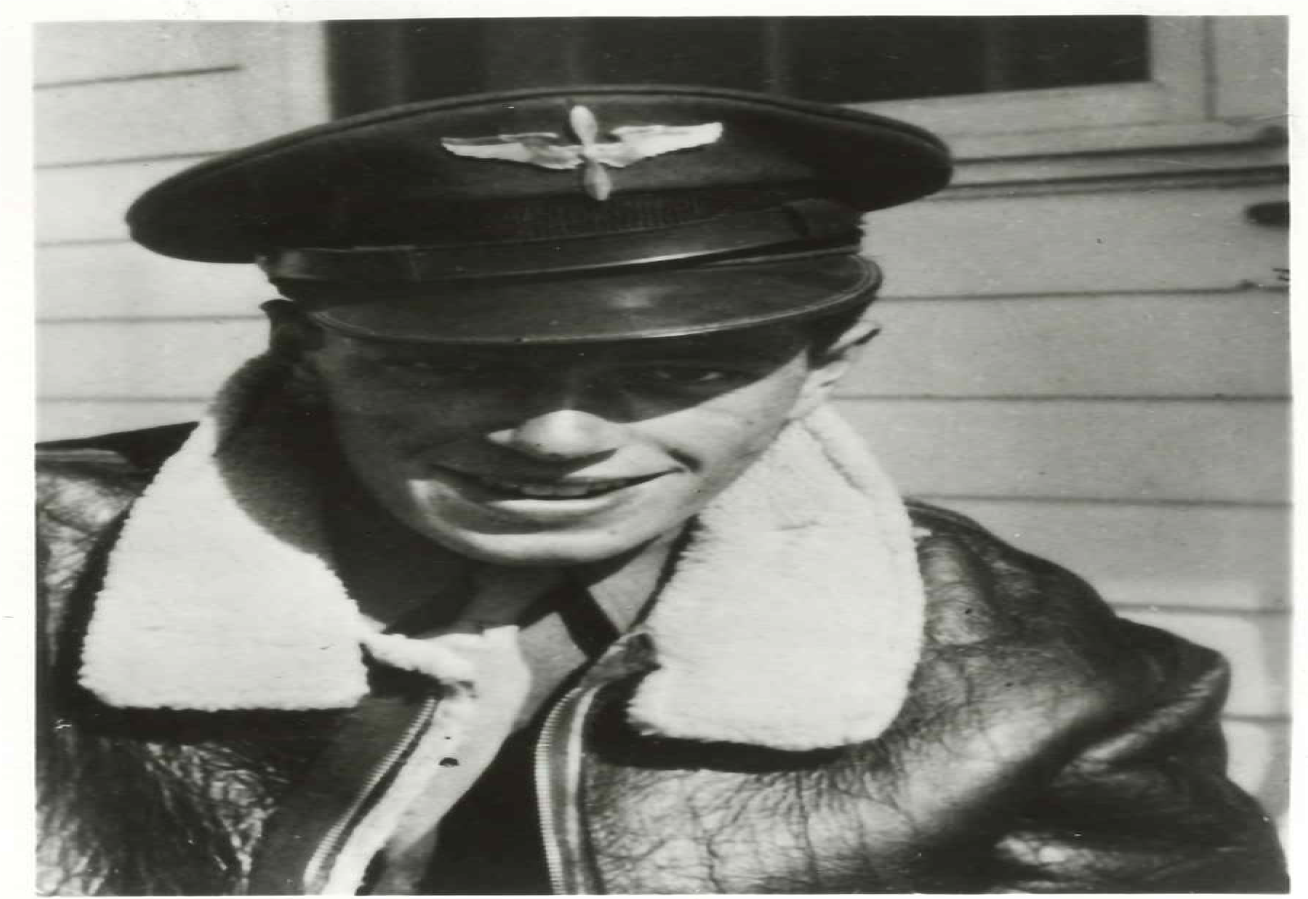
William Earl Costley
Pre-WSC Background
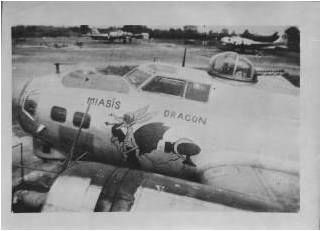
She rolled off the assembly line in Palm Springs California on May 10, 1944. Produced by Lockheed Martin she was a B-17G-70. The United States Army Air Corps produced more than 8,000 of the “G-series”, considered to be the “defensive” model of a plane already famous for its ability to defend itself from enemy aircraft. The B-17G series featured no less than 13 .50-caliber machine guns, including two “chin” turrets to take on enemy planes coming right at the cockpit, a favorite tactic learned by German fighter pilots through much painful experience attacking B-17’s. The crew gunners, of which there were six, could throw up a shield of lead around the plane when attacked, proving the plane’s nickname, The Flying Fortress, was more than appropriate for the G-series. She could carry 4,000 pounds of bombs deep into enemy territory and deliver them with more accuracy than any other plane produced during the war. It is no wonder that air crews gave their planes names and considered them anthropomorphic crew members. This one’s name at creation was B-17G-70-VE and dutifully arrived for duty at Doapham Green airfield in England. It was there that William Earl Costley, and the crew of this unfortunately named weapon of war gave her a new name: The Miassis Dragon.
William Earl Costley was born on June 14, 1925, in Portland, Oregon. His father, William (Bill) J. Costley reported his occupation as an auditor at “Public Mills” in the Portland area. William Earl, at four-years-old, was the second child born to Ruth E. Costley as William’s sister Evelyn was born in 1922. By all appearances the family was doing quite well for itself in Portland, living at 93 E. 15th Street. Bill’s good income allowed Ruth to maintain the household and care for her two energetic children. But perhaps city life was not for them. Between 1930 and 1940, the family moved away from Portland to Craigmont, Idaho.
The town of Craigmont was officially incorporated when the towns of Ilo and Vollmer decided to end a long-standing feud and merge their school districts, changing the name in the process. Located on the Nez Perce Indian Reservation, Craigmont once had U.S. Route 95 Northbound routed through the town, serving as the Main Street for local inhabitants. The local school is often referred to as Craigmont High, or Craigmont-Highland, to distinguish Highland High School from its much larger neighboring school with the same name in Pocatello, Idaho. By 1940, the Costleys lived on a farm near Craigmont, and Bill listed his primary occupation as the owner-operator of his family farm. William was 14 years old and his sister was three years older; they both attended Craigmont High School. William excelled in school, even making Spokane newspapers with some of his scholastic achievements. The Spokesman-Review in Spokane ran an article in April of 1941 announcing the results of a “Central State Annual Scholarship Test.” It appears that the contest occurred over numerous subjects and “the winners in the annual scholarship contest held here yesterday as top-ranking students from eight central Idaho high schools competed for honors and medals.” William Costley, representing Craigmont, placed third in the English category. Sources on William’s early years are few and far between, but from the evidence we do have, it appears he enjoyed and performed well in school, living an idyllic small-town life for American kids of that era. After graduating in 1942, William decided he wanted to continue his education, so he applied to and was accepted at Washington State College in Pullman, Washington. The following year, William became a Cougar for once and forever.
WSC Experience
William, who took on the nickname Bill, arrived at Washington State College in Pullman in 1942. He had grown into a tall and slender man with big white teeth and angular features. He did not stay on campus very long unfortunately. Few sources exist that give us a more thorough picture of Bill’s brief time as a college student. We do know that his outstanding academic performance in high school was not a fluke, as he declared a major in Chemical Engineering in his freshman year at WSC. President of Washington State College, E.O. Holland later wrote to Bill’s parents that “I think I recall William fairly well. He was a good college citizen and a young man of promise.” Unfortunately, Bill could not stay on campus longer and leave a more substantial paper trail to follow today, as I am sure he would have. Global circumstances conspired to separate the bravest young people in the country from their lives and loved ones to fight in a war they did not ask for.
Wartime Service and Death
World War II in Europe had been raging since Nazi Germany invaded Poland on September 1, 1939. The fascist government, under the leadership of Austrian-born dictator Adolf Hitler, waged war throughout Europe. They conquered Denmark and Norway in April of 1940, followed by Belgium, the Netherlands, and tiny Luxembourg in May of that same year. Most astonishingly, the Germans managed to conquer France in just 39 days, snapping up North Africa from the French and British. They followed up those light-speed victories with a massive aerial campaign against the United Kingdom. In 1941 the Germans turned their military aims to the east, conquering Yugoslavia and Greece in April before betraying and invading the colossal Soviet Union on June 22, 1941. They then made a mistake one of the most famous mistakes in military history. Largely to appease their Japanese allies and to satisfy Hitler’s ideological fanaticism, but also with an eye to destabilizing American politics, Germany then declared war on the United States on December 11, 1941. The United States desperately needed manpower, especially intelligent and brave young men to fill the ranks of the United States Army Air Corps. Establishing air superiority over the Axis Powers would be crucial in any invasion of their territory. Lucky for the United States, there were men like Bill Costley to call upon.
Bill traveled to Spokane, Washington, and enlisted in the United States Army Air Corps on October 18, 1943. He was assigned Service Number 39468561 and wrote that he had successfully completed one year of college. Bill then proved that country boys and their guns are not easily separated; he traveled to Buckley Field, Colorado, for basic training before moving on to attend aerial gunnery school in Yuma, Arizona where he placed fourth in a class of 450 and where the top ten won national championship honors in aerial gunnery at Las Vegas, Nevada. Bill completed all of his extensive training in early 1945, was promptly promoted to the rank of Sergeant, and was assigned to the 452nd Bomber Group (Heavy) 728th Bomber Squadron, in the Eighth Air Force and made his way to Deopham Green Airfield in Norfolk, England.
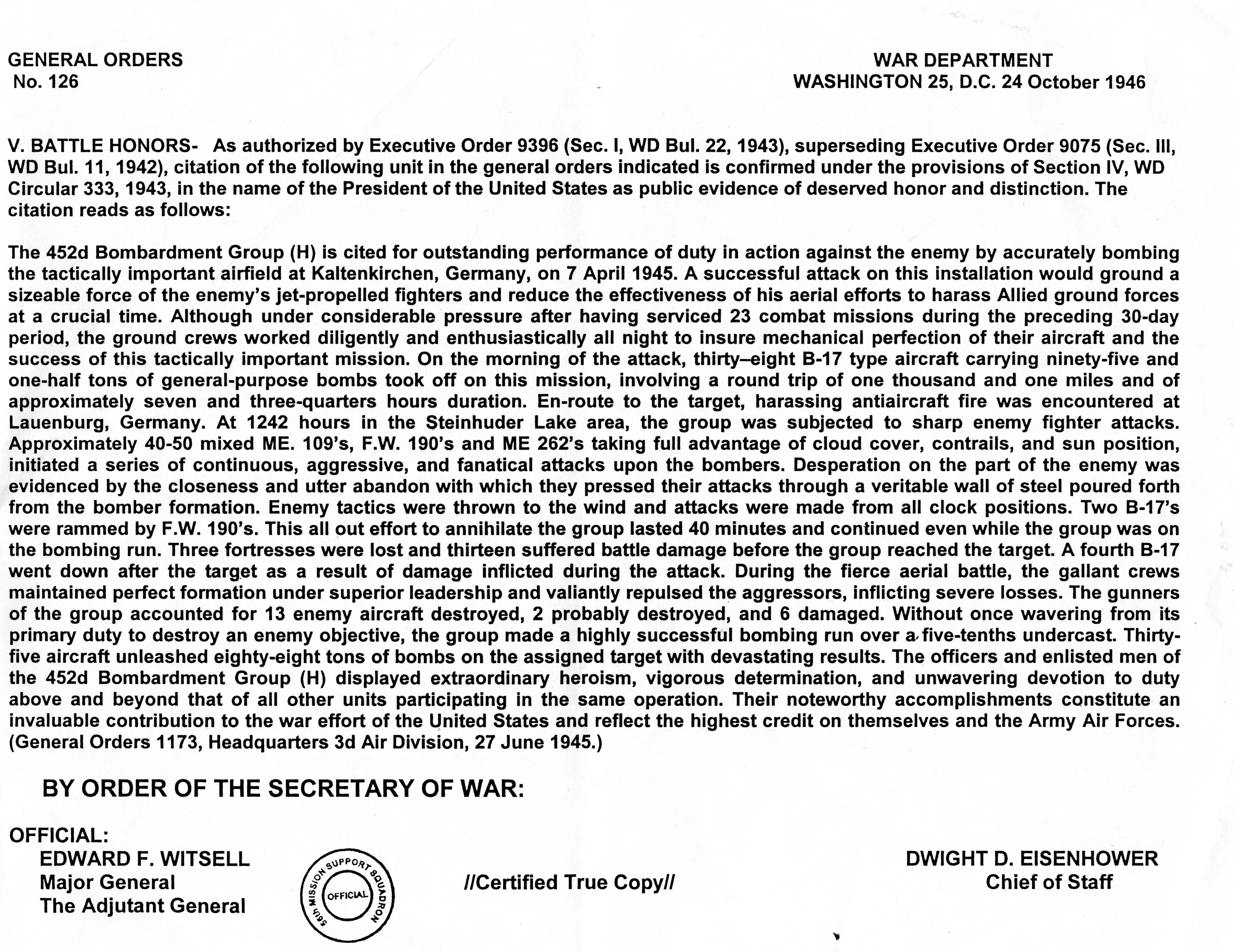
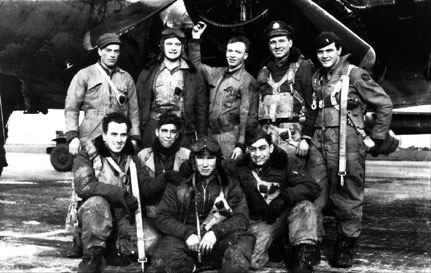
Bill joined up with the nine other members of his crew at Deopham Green: Co-Pilot Bill Barbeau, Navigator Bill Lazzari, Bombardier Hubert Smart, Flight Engineer/top turret gunner Sam Mock, Radio Operator Jim Perlonge, Ball turret gunner Leon Verrilli, Waist gunner Darwin Kusian, with Bill taking his position as the tail gunner. The crew met and named the Miassis Dragon, presumably painting the cartoon on the nose of the plane: a maniacal dragon with a bomb clutched in its tail before going on their first mission together. The Miassis Dragon flew first took to the skies over Germany on March 29, 1945, in a successful bombing raid on Hannover. Their second mission came just two days later with another run on Hamburg, Germany. A slightly longer break followed before their next run targeting the city of Gera on April 5, 1945. Just two days later, April 7, 1945, they were given their target for that day, an emergency airfield erected by the Germans to shield Hamburg from attacks like the one the Miassis Dragon had already carried out. The airfield at Kaltenkirchen, Germany was, as one might expect with the Nazi regime, built by the forced labor from Jewish Concentration camps. In August of 1944, the Germans, pre-empting the possible necessity of forced labor, opened it as a subcamp to the Neuengamme Concentration Camp. Approximately 700 Jewish prisoners died there while being forced to work for the Nazi regime, and now it was the primary target of the Miassis Dragon.
As the Miassis Dragon made its way over Celle, Germany, it was spotted by at least two German Focke-Wulf 190 fighter aircraft that quickly fell in behind and gave chase. The surviving crew members were required to fill out after-action reports describing what happened next, and specifically what happened to Bill Costley. The following questions and answers are extracted and lightly paraphrased for brevity from the report filed by the Bombardier of the Miassis Dragon, Hubert Franklin Smart. They are the most reflective of the consensus of crew members who report the same series of events:
Question: Location of loss of crew member?
Answer: Over Celle, Germany.
Question: Circumstances of loss of aircraft?
Answer: Shot down by fighters, setting fire to the left wing and bomb bay. I saw the aircraft explode mid-air as I was floating down in my chute.
Question: Known information (eyewitness only) Fate of the above-mentioned crew members?
Answer: Unknown. The last time I saw them they were still in the plane.
Question: Did he bail out?
Answer: I don’t know.
Question: Why not?
Answer: I do not know why he did not if that is the case.
Question: Last contact or conversation just prior to or at time of loss of plane?
Answer: He called out “enemy fighters coming in from rear.”
Question: Was he injured?
Answer: I do not know.
Question: Where was he last seen?
Answer: I last saw him in position to bail out.
Question: Any hearsay information?
Answer: Hearsay information was of a parachute caught on a tail wheel of an airplane. I don’t know how true this statement is.
Question: Source of the information?
Answer: It was told to me by intelligence officers at the 452nd Bomb Group of which we were attached. This was in turn told to them from other crews on the same mission.
Question: Total number of missions of above crew member?
Answer: He was on his fourth mission.
According to Samuel C. Mock, the radio operator, “most of the crew bailed out in the area east of Schwarmstedt, Germany. I landed six 960 kilometers due east of Schwarmstedt, about 100 yards north of a paced road, on the edge of a small village.” All the reports from the other crew members reflect that which Sgt. Smart and Sgt. Mock wrote in their reports. When the plane took fire, a direct hit in the number two engine blew up and caught the plane on fire. The fire quickly spread to the bomb bay, still loaded with ordinance. All crew members made it to the ground alive and were taken prisoner by the Germans, except for Bill, who was lost somewhere between Celle and Schwarmstedt, Germany.
Postwar Legacy
William’s bereft family was caught in a horrible state of emotional limbo when he was reported missing from Germany. The family could do nothing but wait for information from the War Department. During that waiting, Dr. E.O. Holland, the President of Washington State College, kept in touch via letters with the Costley family. Dr. Holland and the rest of the administration at Washington State College were working hard to make sure that no WSC man who gave his life in World War II would be forgotten. They commissioned plagues, brochures, and beautiful frames with lovely poems sent to each family that had a loved one dead or missing on the battlefields of Europe, Africa, and Asia. On May 2, 1947, William Costley sent a letter to Dr. Holland expressing “our sincere appreciation for your kind words and are fond of the memorial which you sent. It is a great satisfaction to know you are honoring, not only one son, but all the boys who failed to come home, with a permanent record of their actions.” He then revealed, two years after the war, that “so far as we know, no trace was ever found of our son and we do not know in what manner he lost his life.” Fortunately, the family's suffering was reduced somewhat by September of 1948. In another letter to Dr. Holland, William wrote, “We do not know what information you may have on our son so will give you this additional information we recently received. His status has been changed from a presumptive finding of death to that of Killed in Action in Winsen, Germany, April 7, 1945. His remains have been found and buried in the U.S. military cemetery Neuville-en-Condroz near Liege, Belgium.”
Whether Bill’s body was permanently interred in Belgium or returned to his hometown, this researcher could not tell. He has a headstone at the Normal Hill Cemetery near his hometown in Lewiston, Idaho. He was likely buried in absentia as so many young men had to be in this most brutal conflict in the history of our species. But Bill is not forgotten; just as Dr. Holland sought to keep the memory of the Fallen Cougars alive, this current Fallen Cougars project seeks to do the same. And if anyone were to visit William Earl Costley’s Alma Mater, today called Washington State University, they would find his name etched in gold letters on the World War II monument on the main campus in Pullman, Washington. Once a Cougar, always a Cougar.