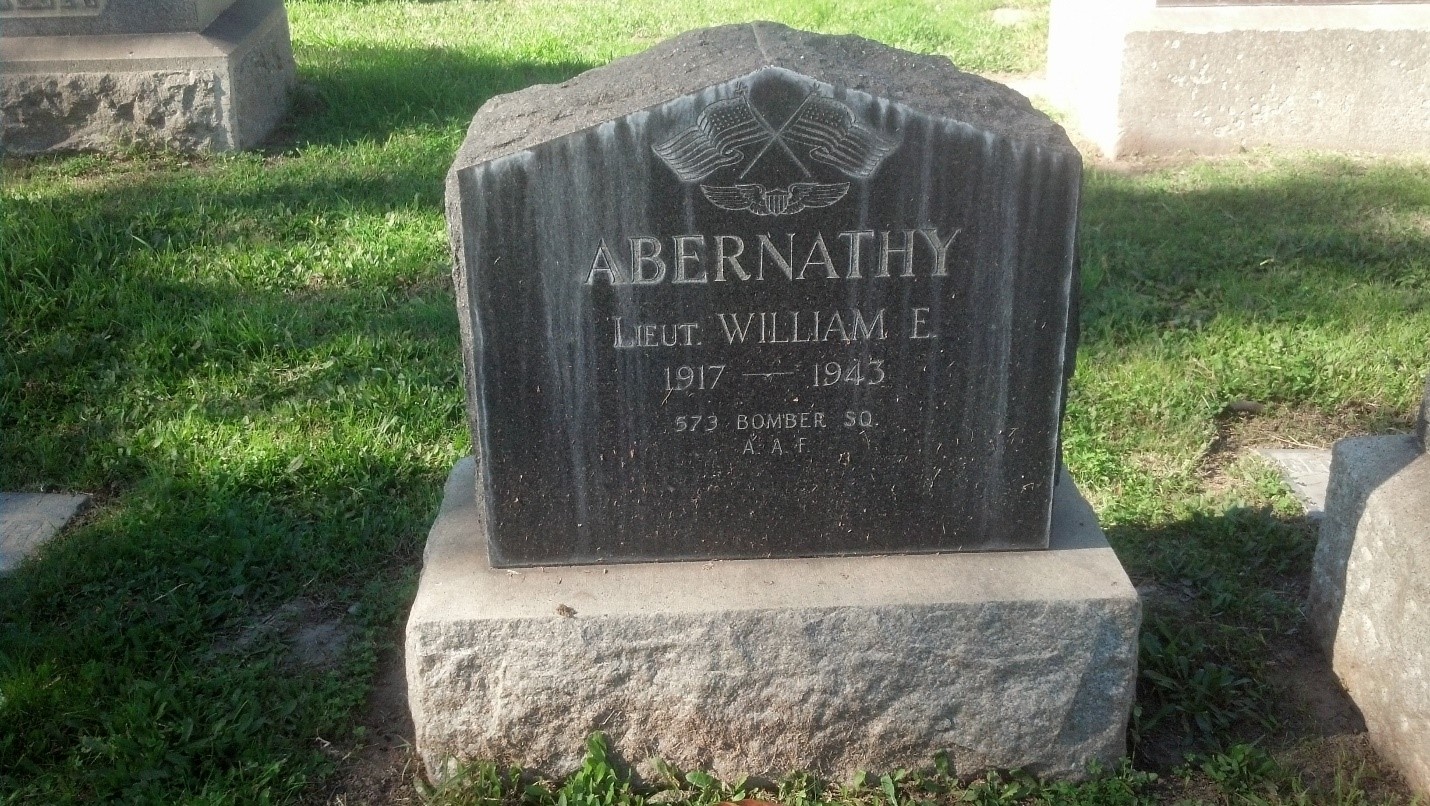
William Edgar Abernathy
Pre-WSC Background
William Edgar Abernathy was born on June 29, 1917, in Palouse, Washington, to Anna Mae Kennison Abernathy and Clarence Edgar Abernathy. Clarence was a barber who owned his shop, while Anna stayed home to raise her children. William had one older brother, Clark, born in 1908. Before William graduated from high school, Anna and Clarence divorced. He was a cast member in the Palouse High School junior class production of “Oh, Kay.” He was among thirty-four Palouse High graduates in June 1936.
WSC Experience
Abernathy attended Washington State College (WSC) from 1936 to 1937. Like many first-generation students, whether due to financial difficulties or lack of support, he dropped out of WSC. However, Abernathy worked for four years as the credit manager of Franklin’s Store in Spokane, Washington, following his time at WSC. Given that this was during the Great Depression, he was fortunate to have such a position. Abernathy’s draft card listed his height as 5’11”, and he weighed 142 pounds. He had a “dark” complexion, brown hair, and gray eyes. He was also a member of the Baptist Church in Spokane.
Wartime Service and Death
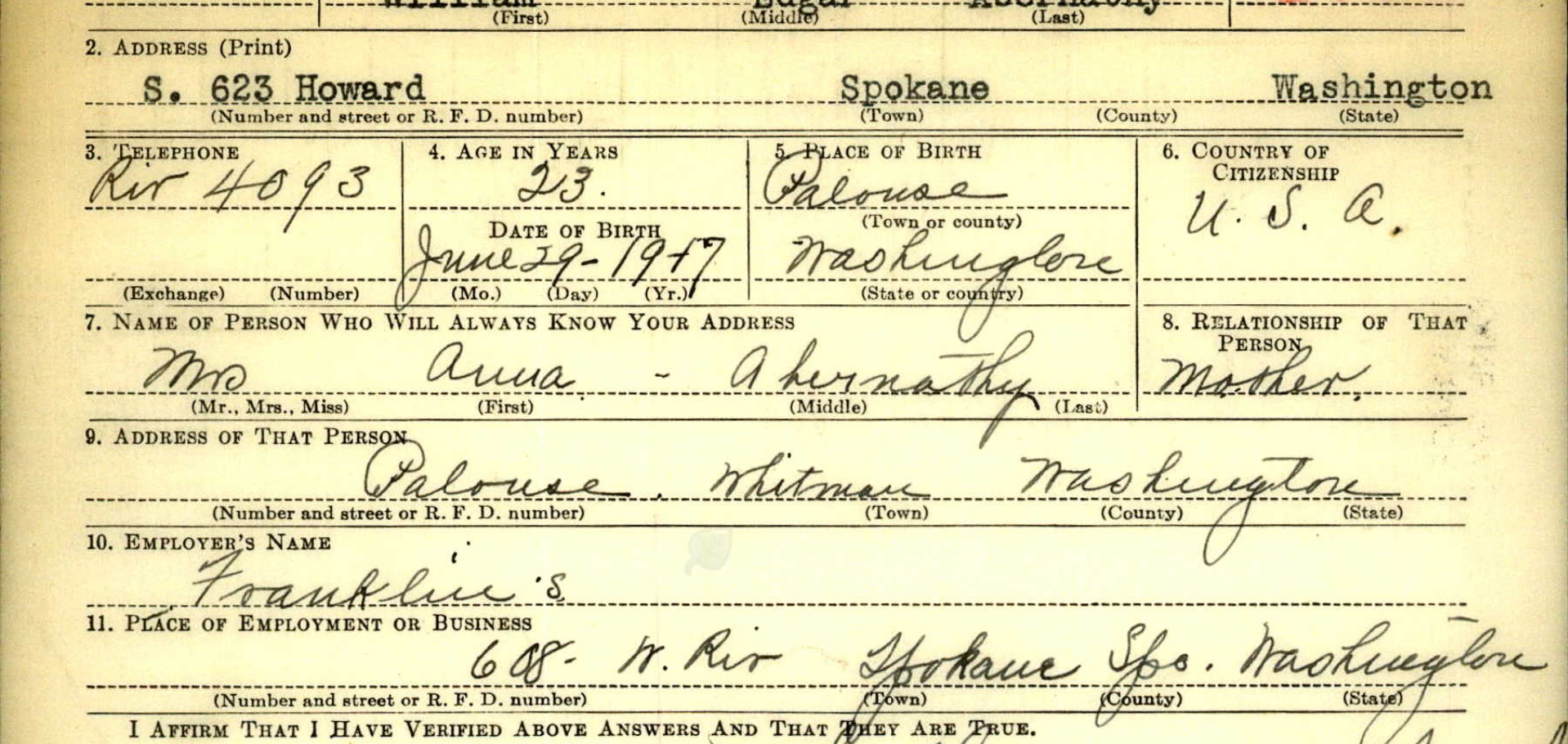
Abernathy enlisted in the United States Army on February 26, 1942, at Geiger Field in Spokane, Washington. He eventually received his commission as a First Lieutenant and was assigned to the 573rd Bomb Squadron, 391st Bomb Group, U.S. Army Air Forces. The 391st trained with B-26s for duty in Europe with the Ninth Air Force. The Group moved to England from January to February 1944 and entered combat on February 15, 1944. They would go on to bomb targets such as airfields, marshaling yards, bridges, and V-weapon sites in France and the Low Countries to help prepare for the Allied invasion of Normandy.
The 573rd Bombardment Squadron was one of four original squadrons of the 391st Bombardment Group. After training with Martin B-26 Marauders in the U.S., the Squadron departed for the European Theater of Operations in December 1943. The Squadron was part of the 391st’s first combat mission on February 15. It initially concentrated on attacks to support Operation Overlord, the invasion of Normandy. They also attacked V-1 flying bomb and V-2 rocket launch sites as part of Operation Crossbow, the Anglo-American operations against the German long-range reprisal weapons (V-weapons) program. The 573rd would also support Operation Cobra, the breakout at Saint Lo in July 1944, and the Battle of the Bulge.
Abernathy was a co-pilot of a Martin B-26C Marauder, #41-35067. The B-26 Marauder was a twin-engine, cigar-shaped medium bomber that “was loved by some and hated by many.” Lt. Gen. James H. “Jimmy” Doolittle used a Marauder as his personal plane. However, the planes gained a terrible reputation due to losing dozens of crewmembers in training accidents. Due to the many crashes, the B-26 had been given several derogatory nicknames, including “Widow Maker,” “Flying Prostitute,” and “Baltimore Whore.”
On October 8, 1943, Abernathy and his crew, including pilot 2nd Lieutenant Norment G. Boyette, took off from Godman Army Airfield in Hardin County, Kentucky (Fort Knox) on a simulated bombing mission. The aircraft was flying at 12,000 feet when they were authorized to reduce altitude to fly below cloud cover. Witnesses observed the B-26 with its nose up at around 3,000 feet above the ground as if it intended to climb when it suddenly spiraled out of control and dove into the ground. Control forces were found a quarter mile from the crash scene, but investigators could not determine if they detached first, causing the spiral, or because of the heavy G-forces caused by the spiraling. It was undetermined if the airmen were attempting to return to the airfield when they crashed on the north side of the Ohio River at Evans Landing, Indiana, nearly opposite Fort Knox. “Dummy” bombs were found in the wreckage, indicating they had not completed the practice mission. All five airmen were killed.
Postwar Legacy
Abernathy’s mother, Anna, had moved to Long Beach, California, to be close to her son while he trained there. He was buried there at Sunnyside Cemetery on October 16, 1943. Abernathy’s father, Clarence, didn’t live much longer after the death of his son; he died on December 17, 1945, at the age of 66. Anna lived to age 92 and is buried in Sunnyside Cemetery alongside her older son, Clark, who died in 1974. Abernathy is memorialized at the WSU Veterans Memorial.