Marvin Scott Clinton
Pre-WSC Background
World War II in Europe began when Nazi Germany invaded Poland on September 1, 1939. The fascist government, under the leadership of Austrian-born dictator Adolf Hitler, waged war throughout Europe. They conquered both Denmark and Norway in April of 1940, followed by Belgium, the Netherlands, and tiny Luxembourg in May of that same year. Most astonishingly the Germans managed to conquer France in just 39 days and snapping up North Africa from the French and British in the process. They followed up those light-speed victories with a massive aerial campaign against the United Kingdom. In 1941 the Germans turned their military aims to the east, conquering Yugoslavia and Greece in April before betraying and invading the colossal Soviet Union on June 22, 1941. They then made a mistake one of the most famous mistakes in military history. Largely to appease their Japanese allies and to satisfy Hitler’s ideological fanaticism, but also with an eye to destabilizing American politics, Germany then declared war on the United States on December 11, 1941. One of the most fearsome weapons in the German arsenal was the submarine, or Unterseeboot, but best known in English as the U-boat. Germany’s geographic position offered minimal access to the sea, and the small part of the sea that they did have access to was perpetually filled with British Royal Navy vessels. If they were going to stand a chance on the seas, the Germans had to get creative with the Kriegsmarine (Navy). The U-Boat was the solution to their problem. Cheaper to produce than the massive battleships and carriers of the British fleet, they could focus on attacking Allied shipping in quick and deadly attacks before fleeing the scene. If an attempt to starve the British Isles into submission had any chance of success, the U-Boat was essential. Because of the effectiveness of German submarine warfare, finding new ways of combatting submarines became a primary goal of the United States Navy once they entered the war, especially in two strategic locations.
The first was a key point of access from the outset of the war, the “Western Approaches.” The Western Approaches were the waters leading directly to the British Isles and the entry point at which the ocean narrows into the English Channel. If the Germans had any hope of strangling trade to the United Kingdom, they had to dominate the western approaches. Secondly, by 1943 the Allies had taken back North Africa from the Axis powers and pried Sicily and the lower half of the Italian Peninsula away as well. This made the Strait of Gibraltar a crucial chokepoint for shipping. The small strip of water separating Spain from Morocco made an ideal target for German submarines. Allied troops fighting in Africa and Italy needed a constant flow of food, weapons, ammunition, medicine, tanks, motorized vehicles, artillery, and everything else needed to fight a war of this scale. Delays, even momentary delays, in the supply chain could cost untold lives. It was with these two strategic areas in mind that the United States Navy began developing new prototype airplanes designed to hunt submarines from the air. And perhaps more importantly, they began a search for American soldiers brave enough, or crazy enough, to fly the experimental aircraft into battle. Lucky for them, men like Marvin Scott Clinton existed.
Marvin Scott Clinton was born in Colville, Washington on February 15, 1921. Although, technically, according to the 1930 Federal Census, the family lived in an unincorporated part of Colville called Columbia. His parents were Lester H. Clinton and Florence M. Clinton. The Clintons were a rather large family by today’s standards. In 1930 Robert Clinton was 14 years old, making him the eldest of the Clinton Brood. Next was Stanley, just one year younger than Robert. Then came Marvin, nine years old at the time of the census, followed by little Lois, just five years old at the time. Lester listed his employment as working for himself on a farm, presumably a farm that he owned in the area. Marvin spent his first sixteen years in Colville before the Clintons packed up and moved to Pullman, Washington for his final two years in high school. Marvin graduated from Pullman High School in 1939. According to the 1940 census the family lived on a farm outside town, and the Washington State College registrar lists their address simply as “Route 2” outside Pullman. Lester and Florence had also added yet one more child to the Clinton family roster, little Dale Clinton, who was three years old and the last of the Clinton children, at the time of the census. Upon completing high school Marvin decided he wanted to continue his education but must not have wanted to venture too far from his loving family.
WSC Experience
Upon completing high school Marvin decided he wanted to continue his education but must not have wanted to venture too far from his loving family. He enrolled at Washington State College in Pullman and chose a major in General Studies to start his academic career. It was to be a short-lived academic career, however, as he only stayed at Washington State College through the 1940 school year, leaving WSC to join up with the United States Naval Reserve. Regardless, his time at Washington State College was less important for his academic achievements put on hold by the military, than it was for who he met there, one Miss Betty Book of Bainbridge Island.
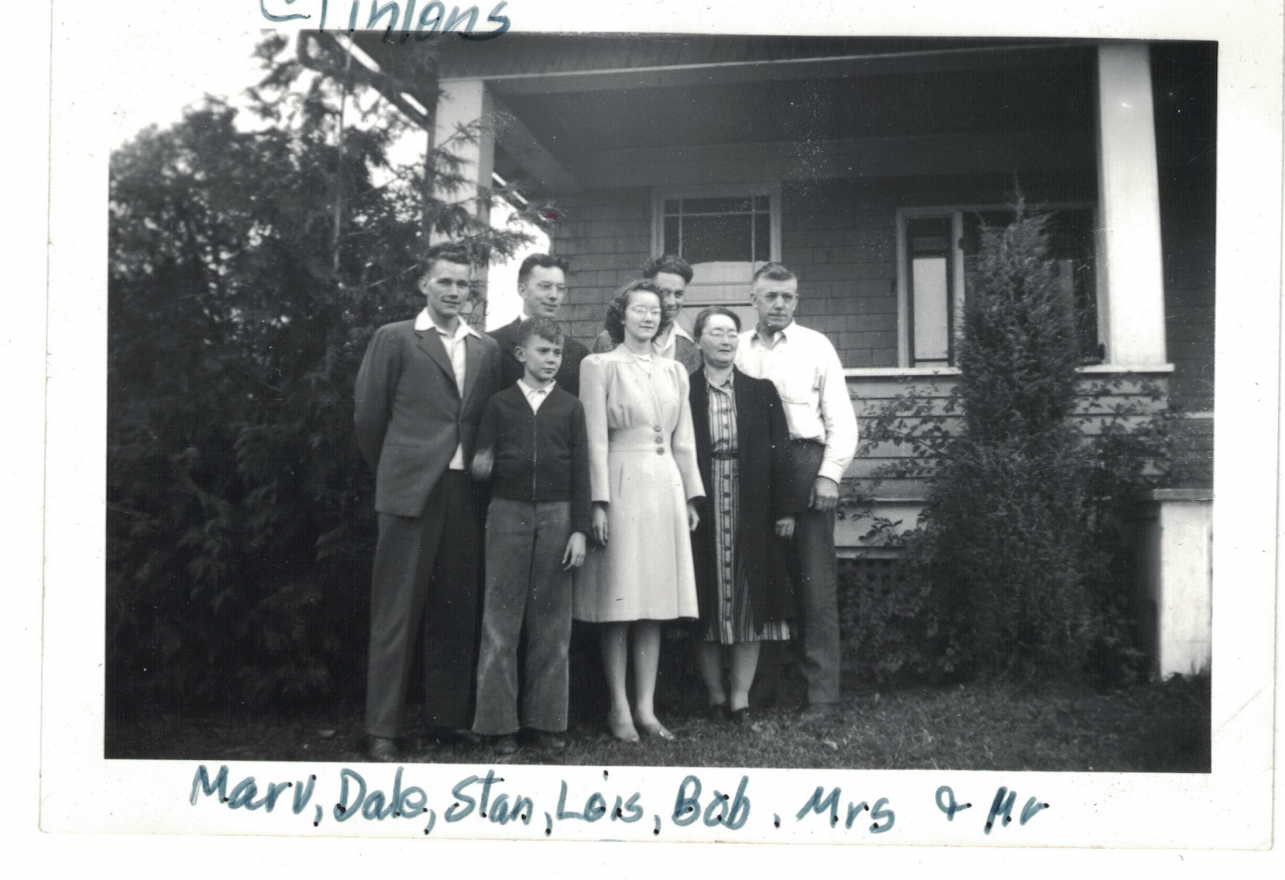
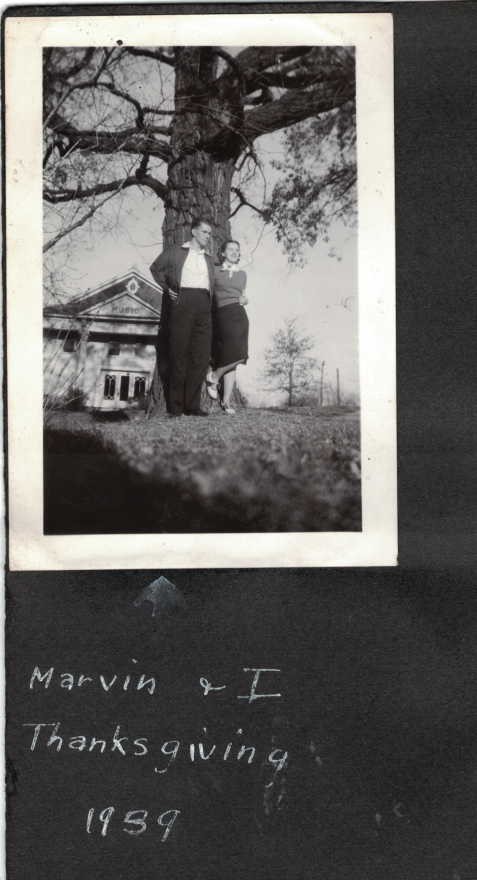
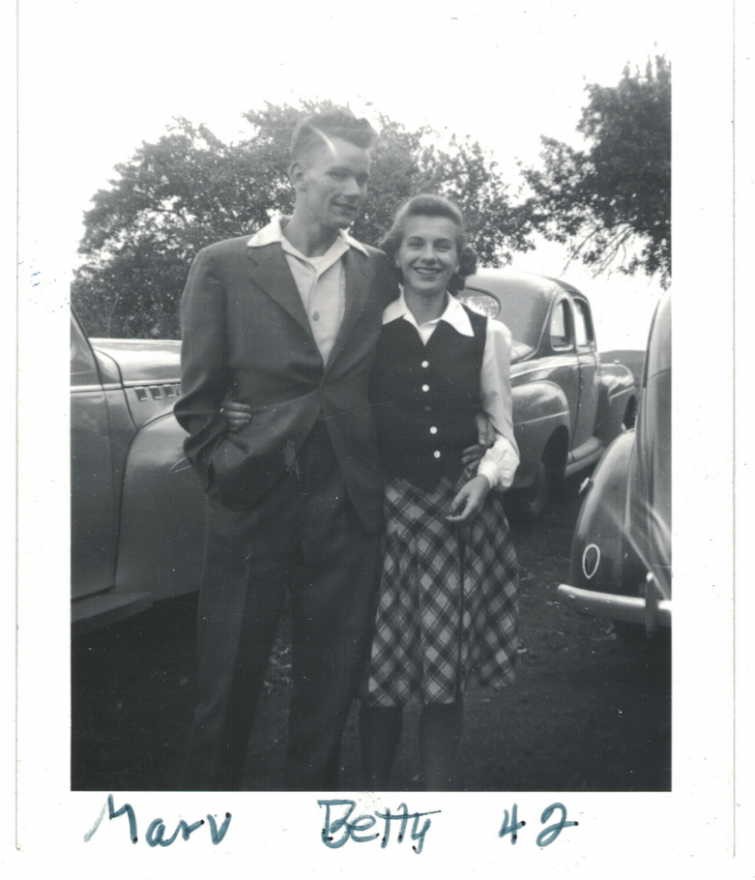
Betty was a student at Washington State College slated to graduate in 1942. This researcher was quite fortunate to luck across photos of Marvin taken over the course of his year and a half at Washington State College, and he was always in the company of Betty Book. The two must have met and fell for one another rather quickly, as their first photo together is marked “Marvin & I. Thanksgiving 1939” and shows Marvin and Betty sitting next to one another on a hill with Washington State College buildings in the background. Another photo was taken that same thanksgiving break. This one shows the two of leaning against a tree together with a building in the background. The next is an even more dashing photograph of the two of them. Marvin is in a white collared shirt and leaning on the hood of an absolute tank of a car. Betty is sitting on the left front fender in front of Marvin with a big smile on her face. The photo is marked “Marvin & I Spalding, Idaho. May 5, 1940”. Another shows Marvin and Betty at a family home and is marked simply “Betty Marv.” This photo shows Marvin looking dapper in a suit with dress shoes and Betty sitting on the porch with Marvin’s right arm around her. It is in this photo that the height differential between the two is truly noticeable. Marvin was quite a tall and slender man, whereas the top of Betty’s head reaches the middle of his chest. Yet another photo of the two of them, marked “Marv Betty 1942” features the two of them arm-in-arm in what appears to be a field. Marvin is once again in a stylish suit with a white shirt with the collar unbuttoned. Betty is also well-dressed, wearing a shin-length patterned skirt and a button-up vest over a collared blouse. She, as always, is smiling. Marvin has more of an amused look on his face than an outright smile. They are standing in front of several cars arranged as if in a parking lot. The last photo is a family photo of the Clintons marked “Clintons Marv, Dale, Stan, Lois, Bob, Mrs. & Mr.”, the resemblance between Marvin and his father is striking. As is the resemblance between Marvin and little Dale. This is the one and only Fallen Cougar I have been lucky enough to find personal photographs of in online databases, and I consider myself quite fortunate for that. Pictures say a lot about people that data, newspapers, and even letters, can say. It is obvious in these photos that this was a close-knit and happy family, and that Marvin and Betty were utterly smitten with one another. And as so often happens with couples so obviously in love, they got engaged. Marvin Scott Clinton and Elizabeth “Betty” Book received their marriage license on October 8, 1942, and were officially married on October 10, 1942, at the Book family home in Winslow, Washington, in Kitsap County. Marvin’s brother Stanley was his witness, and Peggy Book witnessed for Betty. The ceremony was performed by Chas P. Milne, the minister of the local Congregational Church in Winslow.
Wartime Service and Death
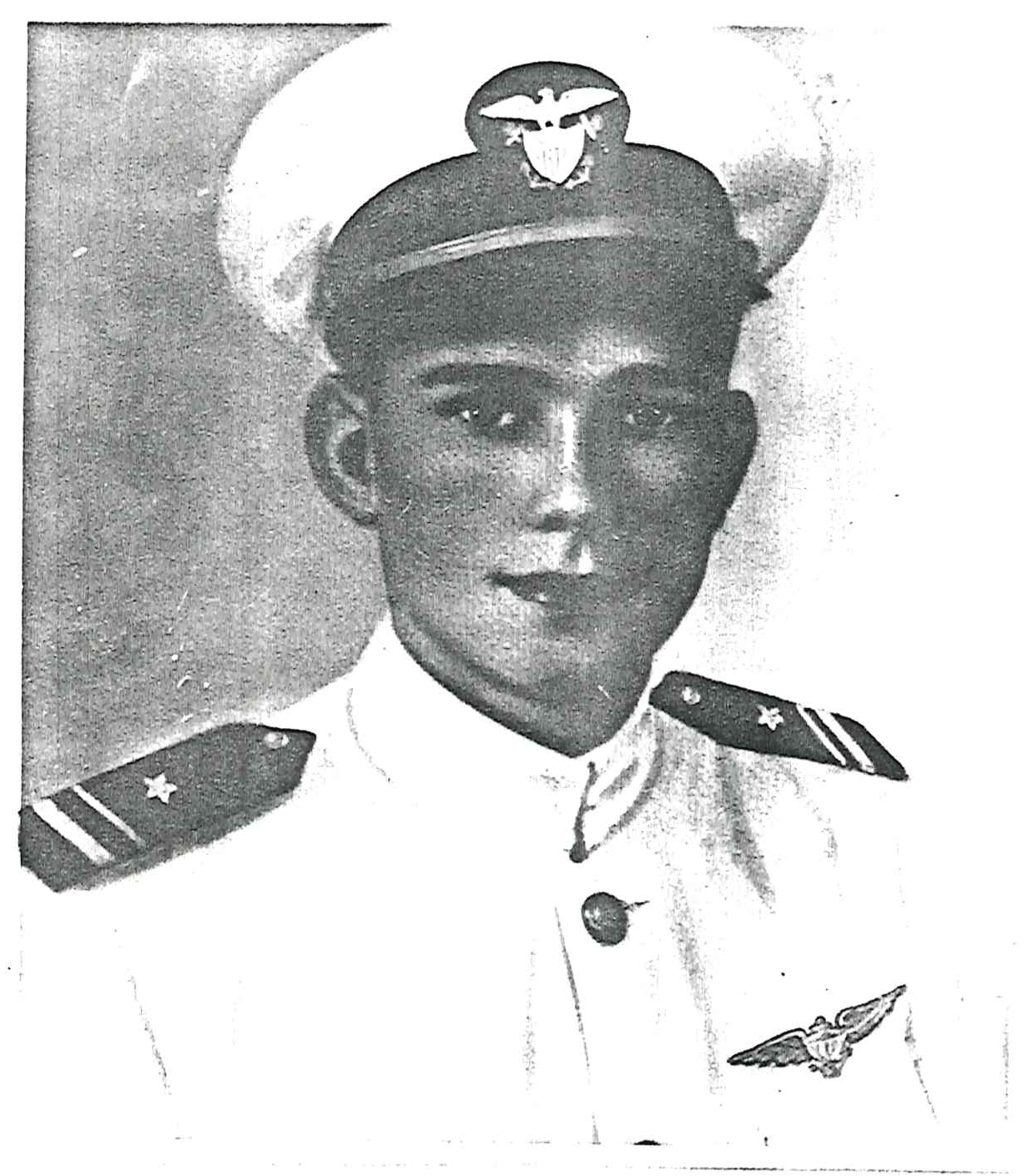
Somehow Marvin managed to take all of these photos while undergoing what can only be described as rigorous military training. According to his military paperwork stored in Washington State University’s Manuscripts, Archives, and Special Collections, Marvin “enlisted at headquarters, 13th Naval District, Seattle, Wn. An Apprentice Seaman, Class V-3, USNR,” (United States Naval Reserve) and was placed on inactive duty. On March 3, 1941, Marvin “Reported to active Duty and transferred to Receiving Station, Puget Sound, Washington for assignment to Naval Reserve Radio School.” Marvin successfully completed Naval Radio School at Bainbridge Island on July 12, 1941, and was earmarked to travel to “Naval Reserve Aviation Base, Seattle, Washington for elimination flight training,” which he successfully completed on January 15th, 1942. He was then transferred to Naval Reserve Aviation Airbase in Dallas, Texas, and again to another station in Corpus Christi. Somehow Marvin was juggling his military responsibilities which took him all over the country and his responsibilities to his family and his lovely young wife. But manage it he did, and his journey up the ranks of the Naval Reserve continued apace. On February 18, 1942, Marvin’s “enlisted service” was “terminated to accept appointment as aviation cadet.” And he accepted his new appointment as a cadet the following day when he swore his oath of office and reported to U.S. Naval Air Station in Corpus Christi for active-duty training to fly an old type of plane in a new kind of way.
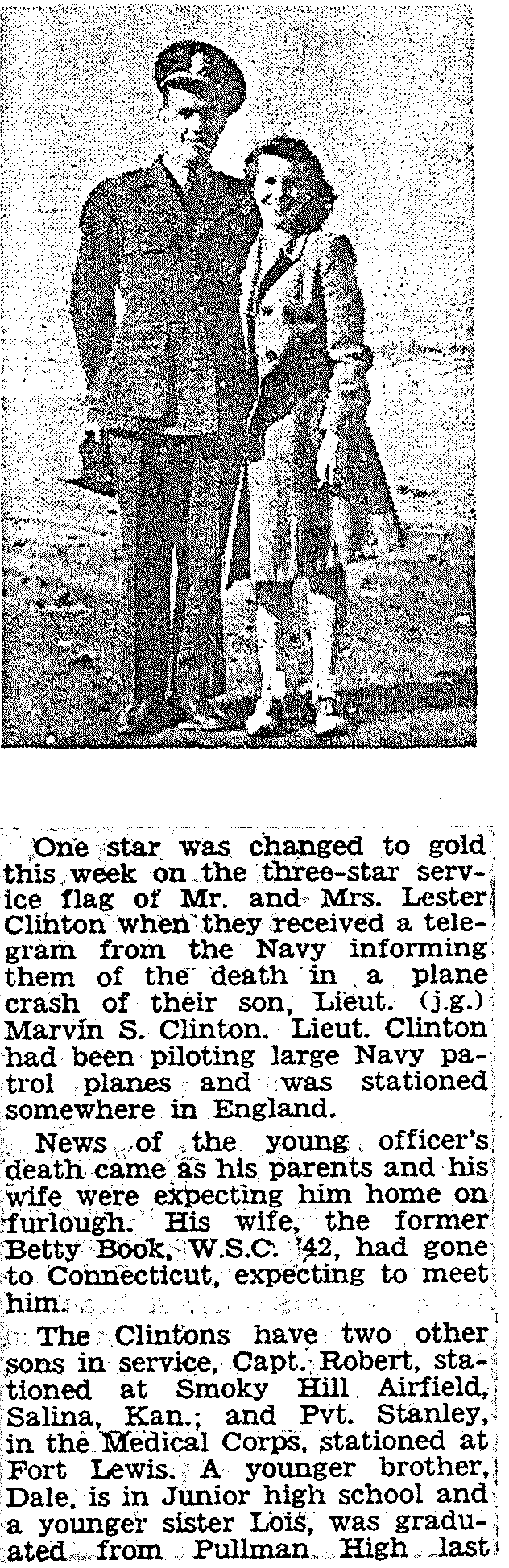
Marvin was not the only Clinton boy in the United States military. According to newspaper articles written in 1944 “The Clintons have two other sons in service. Capt. Robert stationed at Smoky Hill Airfield, Salina, Kan., and Pvt. Stanley, in the Medical Corps stationed at Fort Lewis.” The article makes sure to note that Dale was a junior in high school and Lois had just graduated from Pullman high school and was visiting her brother in Kansas at the time the article was written. Three of the Clinton boys spread themselves out through the armed services and prepared to fight the Third Reich or Imperial Japan as the nation required. On September 22, 1942, Marvin was officially appointed a Naval Aviator. Three days later he accepted that appointment and executed his oath of office as an Ensign. He was then “Detached from the U.S. Naval Air Station, Corpus Christi, Texas and transferred to Transition Training Squadron, Pacific Fleet for temporary active duty involving flying under instruction, and further transferred to Fleet Air West Coast for assignment to active duty flying.” He reported for Active duty flying on October 19, 1942, just ten days after he and Betty were married. In January of 1943 he was finally assigned to “Patrol Squadron SIXTY-THREE” to which he reported on February 1st. He received his final promotion to Lieutenant Junior Grade for “temporary service” in July of 1943 and went to war overseas.
During all this training in the American Southwest, Marvin was flying PBY planes all over the Caribbean, which does not seem terribly unusual, but the way they were flying was the important distinction. German submarines had become the bane of American naval and aerial existence. They succeeded in seriously hampering American shipping through the important chokepoints and seriously compromised Allied supply lines. And now it was time for Marvin and the men of Patrol Squadron SIXTY-THREE to test their new weapons and tactics against the U-boats, to keep open the shipping lanes, and save American and other Allied soldiers battling on the continent. The Patrol squadrons like Patrol Squadron Sixty-Three were specially designed aircraft fitted with the ability to drop “Magnetic Anomaly Detection” (MAD) technology to attack enemy submarines. MAD devices “detected variations in the earth’s magnetic field due to the presence of a large iron object near the detector that caused distortions in the field. A plane flying over a submarine using a MAD device detect its presence by this distortion. At the time, the U.S. Navy put great faith in the ability of MAD to find submarines. It was their latest ‘secret’ invention.” When tests of the accompanying weapon, dubbed the “Retro bomb” or “Retro Rocket” proved successful when coupled with MAD, the Navy ordered the creation of a patrol squadron to use them. The U.S. Navy chose the Consolidated PBY-5A Catalina Patrol plane with specially trained pilots, like Marvin Clinton, and formed VP-63 (Patrol Squadron SIXTY-THREE) to employ the weapons technology in the field.
Marvin and the rest of the men in VPB-63 arrived in North Africa intending to use the Retro Bomb to root out submarines hunting Allied vessels in the Strait of Gibraltar. VPB-63’s MAD equipment would be used to set up a 12-hour continuous patrol across the Strait, the route the planes flew took on the name “The Fence,” and crews flew The Fence at “approximately two-minute intervals continuously from sunrise to sunset. At an altitude of just 100 to 150 feet.” For comparison, the base of the Statue of Liberty, just the part that Lady Liberty stands on, is 150 feet high. The planes were nearly skimming the water. The intent was to force U-boats to stay submerged and either turn on their electric batteries, which Allied naval vessels could detect with sonar, or attack the submarine. Or force the U-boat to sit still under the water, draining the solar-powered batteries by starving them of sunlight, and forcing them to surface. If they found a submarine and it dove, they could drop the MAD devices and destroy the submarines, or at the very least mark the U-boat with smoke devices using MAD to track its movements. VPB-63 was successful right away and was ultimately responsible for numerous destroyed submarines or forcing submarines to the surface.
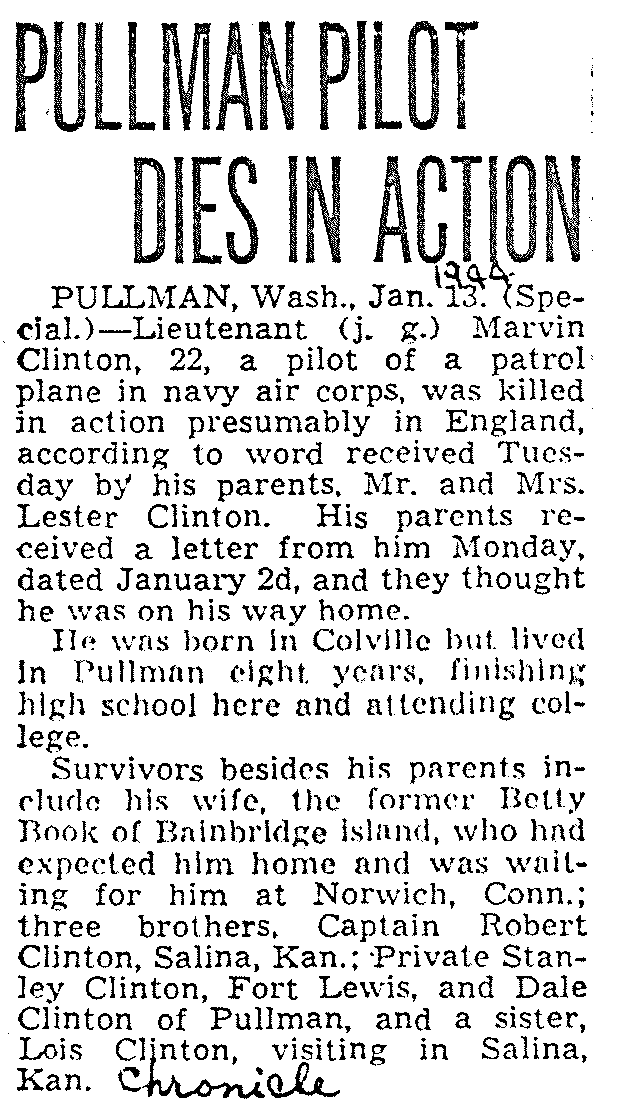
While Marvin was running successful missions with VPB, Betty, and his family anxiously waited for his return on furlough. One newspaper article reported that Marvin was due for leave following his mission on January 9, 1944, and that “His wife, the former Betty Book, W.S.C ’42 had gone to Connecticut, expecting to meet him.” Unfortunately, the long-awaited and much-deserved meeting never took place. VPB-63 only had between 12 and 18 aircraft at any given time, considering the specialized nature of their design and use. There is only one listed flight occurring for VPB-63 on January 9, 1945. This plane was taking off from Port Lyautey in Morocco for its run on “The Fence.” Lieutenant Woodrow E. Sholes was piloting, and Marvin Clinton was co-pilot. The plane took off from the runway but shortly after takeoff it plummeted into the Oued Sebou river, killing both Marvin and Lt. Sholes instantly. Fortunately, two other crewmen are reported to have survived the crash.
Postwar Legacy
The news of Marvin’s death shook the Pullman community, and of course, poor Betty and the Clinton family. Newspapers produced numerous stories on Marvin’s life, his service, his heroism, and his tragic death in the line of duty. Many in the local community rallied to ensure his memory lived on, including those at Washington State College. Dr. E.O. Holland, President of Washington State College, and the rest of the faculty and administration at WSC set about making sure that no student that lost their life fighting for the United States during the war was forgotten, and that their families knew that WSC appreciated them. The WSC administration produced brochures, plaques, pamphlets, and other pieces to memorialize the students that had fallen in service. Dr. Holland also engaged in correspondence with the family members. Exchanging letters, and providing them with framed poems, and later an ornate frame to place a picture of their lost loved one in and to cherish in the family. One such letter sent to the Clinton family read “We are sending you today a sincere tribute in memory of your son, Lieutenant Marvin Scott Clinton, who lost his life in an airplane crash in England in January of 1944. It is not necessary to add that your son met the death of a hero just as much as if he had been killed in action in the South Pacific, over North Africa, in Italy or in Normandy. “You, his parents, his wife who was Miss Betty Book, class of 1942, and other members of your family have our sincere sympathy in your bereavement.” The Clintons responded in a letter saying “Dear Mr. Holland, I would like to thank you for the nice tribute you sent for Marvin. I am sorry I was so slow in thanking you for it, but our daughter brought it home and I did not know until just lately that Mr. Thornton handed it to her and that she did not thank you. I would also like to thank you for the letter of sympathy you sent and have you know we appreciated it.” But WSC was not alone in honoring the fallen war hero who flew dangerous flights 150 feet above enemy-infested waters with experimental weapons systems.
Marvin was present for several of VPB-63’s most successful missions, as evidenced by the two medals he earned for his service. First, he was awarded the Distinguished Flying Cross, the citation read:
The President of the United States takes pride in presenting the Distinguished Flying Cross posthumously to LIEUTENANT, JUNIOR GRADE, MARVIN SCOTT CLINTON UNITED STATES NAVAL RESERVE. For service as set forth in the following CITATION:
For heroism and extraordinary achievement in aerial flight as Co-Pilot of a Patrol Plane in Patrol Bombing Squadron Sixty-Three, during operations against enemy German forces in the Bay of Biscay and the Western Approaches to the United Kingdom, from August 17, 1943, to June 25, 1944. Participating in twenty aggressive anti-submarine patrol missions, Lieutenant Junior Grade, Clinton rendered valuable assistance to his pilot in pressing home vigorous strikes against targets of opportunity despite frequent attacks by hostile aircraft. By his outstanding skill, efficient cooperation and valiant devotion to duty, lieutenant, Junior Grade, Clinton contributed materially to the success of our theater of War, and his courageous conduct throughout these perilous missions reflect the highest credit upon himself and the United States Naval Service.
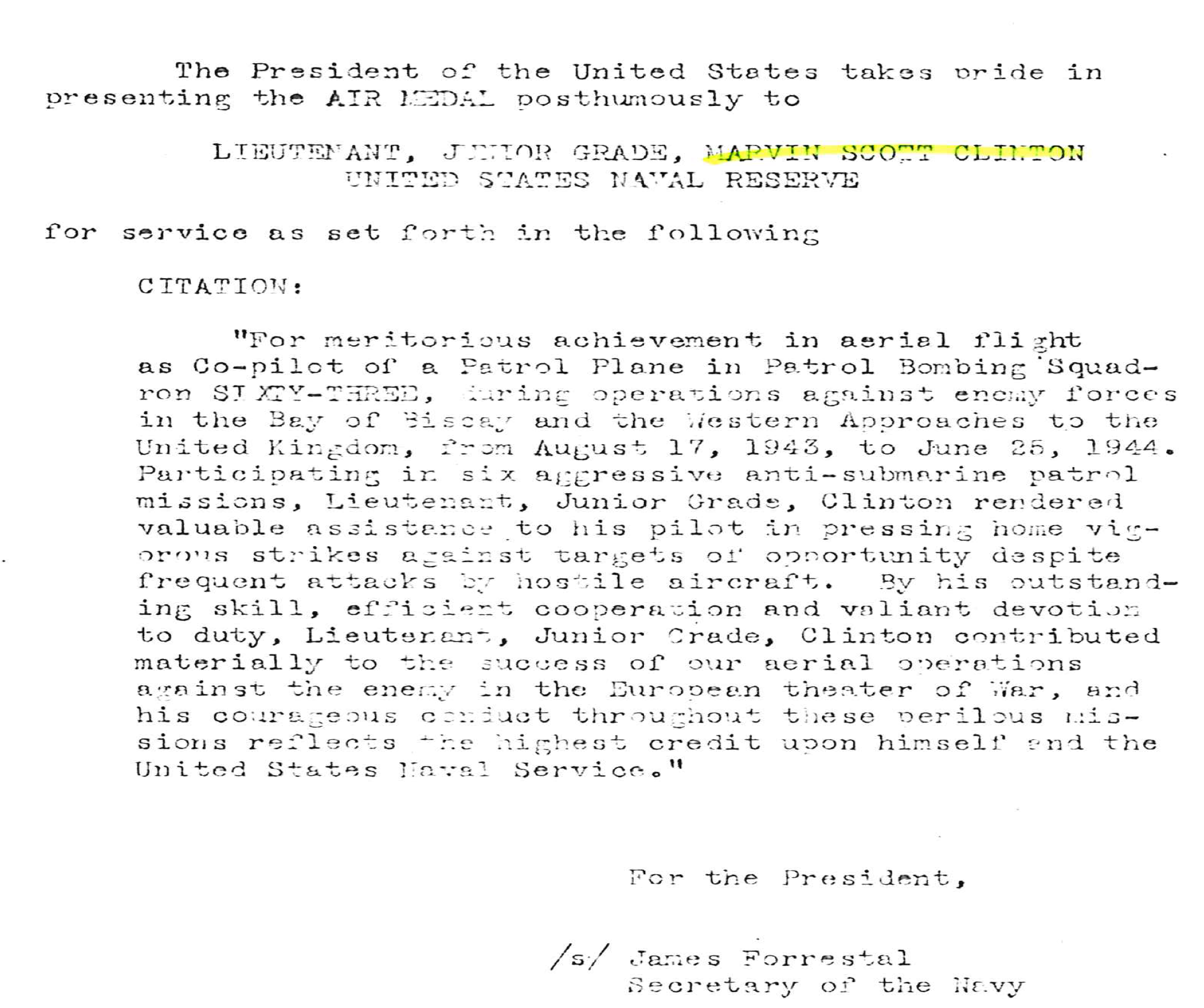
Marvin must have also run several missions on the Western Approaches to the British Isles. His Air Medal citation reads that Marvin was awarded the medal “for meritorious achievement in aerial flight as Co-pilot of a Patrol Plane in Patrol Bombing Squadron SIXTY-THREE, during operations against enemy forces in the Bay of Biscay and Western Approaches to the United Kingdom, from August 17, 1943, to June 25, 1944. Participating in Six Aggressive anti-submarine patrol missions.” On January 31, 1947, evidence of the uniqueness and bravery required of the men that flew “The Fence” was made all the clearer when the Navy “at an informal ceremony to Mrs. L.H. Clinton at her home in Pullman, Washington,” presented her with her son’s Distinguished Flying Cross and Air Medal. The “presentation was made by A.S. Keeth, SC, USN, Supply Officer in Command of the Naval Supply Depot, Spokane, Washington, under request of the Commandant, Thirteenth Naval District.”
Marvin was laid to rest next to his brothers in arms in the North African American Cemetery and Memorial in the ancient city of Carthage, Tunis, Tunisia. His name is written into the memorial at that quite lovely cemetery. The current iteration of the Fallen Cougars Project tries to carry on the legacy of Dr. Holland and all those that worked to make sure men like Marvin were not forgotten. This biography is one more memorial. But perhaps the most moving one is located at his Alma Mater in Pullman, where he met Betty, joined the Navy, worked the family farm, and lived a happy life. His name is emblazoned in golden letters on the World War II memorial alongside the names of his fellow fallen cougars that gave their lives fighting for their country, and in opposition to the vilest tyranny.