Frederick Richard Wollenberg
Pre-WSC Background
Roughly 35 miles Southwest of Spokane, Washington lies the tiny farming community of Edwall, Washington. Established in 1892 by Peter Edwall, the story of the town’s founding is identical to many similar towns that dot the landscape of eastern Washington. While driving cattle through the region in the 1870’s, Peter recognized that this stretch of land provided fertile soil and access to water that would make for good farming. After establishing his own ranch, others began to buy parcels in the area. Slowly the little community was constructed to serve the basic needs of the nearby wheat farmers, whose farmlands sprawled for miles. A post office, a water tower, a school donated by the Great Northern Railroad, and some small churches connected the local farmers to the distant communities, educated their children, and tended to their spiritual needs. The town experienced a decline in population when the mass production of the automobile allowed the locals to drive to Spokane to shop, which destroyed local businesses. This was not helped by the actions of a serial arsonist that terrorized the town from 1915 – 1930. It was in this sleepy and isolated farm town that was set on fire with disturbing regularity that Frederick “Fred” Richard Wollenberg was raised. Fred’s life is full of seeming paradoxes. He was big-brained-small-town-kid that came of age on a wheat farm before attending Washington State College. He lived his whole life in an uneventful desert before joining the Navy where he entered combat as a fighter pilot. Ultimately, he was a young man with a promising future that, like so many others of his generation, sacrificed his life in service to his country.
On October 17, 1916 Ferdinand Frederick “F.F” and Elise Wollenberg welcomed their fourth child, Frederick “Fred” Richard Wollenberg, to the family. Both F.F. and Elise’s parents were German immigrants and, like many German immigrant families in United States, they were farmers. Elise’s father, Sebastian Ott, opened the Ritzville hotel in Ritzville, Washington while running his independent farm. Frederick, along with his brothers Lincoln and Leroy, and his sister Ella, lived their early years on the family farm in Hartline, Grant County, Washington. According to the 1920 census, F.F. personally owned the little farm in Hartline. By 1930, however, the family had moved to little Edwall, Washington. F.F. Wollenberg listed his occupation as a “Grain Buyer” for a local grain warehouse. They now rented their home, valued at $14, in Edwall. Fred, just thirteen years old in 1930, attended the tiny all-purpose school that had been donated by the railroad decades earlier. He must have been a good student, as he decided to continue his education after graduating from Edwall High School in 1934.
WSC Experience
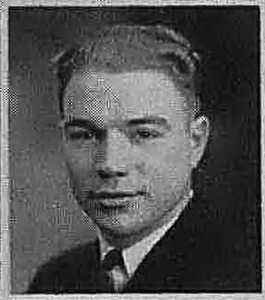
Fred selected Washington State college as the place to continue his education and moved to Pullman, Washington in 1934. He put his farmboy work ethic and intellectual aptitude to work during his time on the Palouse while growing into a handsome young man. Fred was slim but broad shouldered, with dark hair slicked straight back, and wide-set but kind eyes, he majored in Electrical Engineering and joined the Theta Chi fraternity on campus. He was also active in the Montezuma Club, the primary governing body of Stimson Hall, named after Fred S. Stimson, a founding member of the board of regents at Washington State College. At the end of 1938 he graduated from WSC with his Bachelor’s degree and, on May 15, 1939, he enlisted in the United States Navy.
Wartime Service and Death
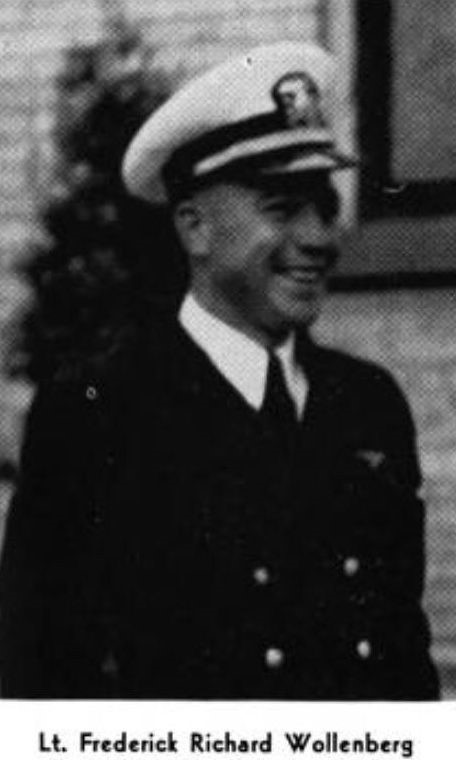
Fred underwent his training to become a Navy pilot, graduating from his aerial training at the Naval Air Station in Pensacola, Florida. In June of 1940 The Spokane Chronicle ran a story that got Fred’s father’s initials wrong, about the Edwall graduate, reporting that ““Ensign Fred R. Wollenberg of Edwall, son of Mr. and Mrs. F.S. Wallenberg, left here this week to rejoin his ship, the U.S.S Boise, from which he flies as a member of scouting squadron No. 9.” After his graduation he achieved the rank of Lieutenant Junior Grade. While Fred carried out his training and his duties on board the U.S.S Boise, the United States was inching closer to war in the Pacific.
Tensions between the United States and the Empire of Japan increased as the 1930’s became the 1940’s. Japan had been at war with China since 1937. The Japanese home islands were not rich in natural resources and the material needs of conducting a war with a nation the size of China were immense. Japan had only been able to conduct the war successfully because the empire received a large amount of its oil from the United States. Without American oil imports Japan could not hope to win its war in China. When the United States cut off oil shipments to Japan, the Imperial high command came up with a plan to take the resources by force. Their strategy was to take the resource-rich islands in the Pacific, fortify them against counter-attack, and continue their war in China in the West while extracting the natural resources and fending off the United States, Great Britain, and their allies in the East. The surprise attack on the American Pacific Fleet at Pearl Harbor on December 7, 1941 is well known. However, the impact of the attack on Pearl Harbor distracts from the broader campaign throughout the Pacific that, when viewed in its entirety, constitutes the largest military campaign in history. Between December 7th and December 10th, 1941, the Japanese empire attacked or invaded British colonies of Malaya, Singapore, and Hong Kong as well as the United States naval bases on Wake Island, Guam, the Philippines, and more. They opened a battlefront that was 6,000 miles wide north-to-south.
The available records, and the data we have about the proximate timing of Fred’s death in combat seem to coincide with known actions of the U.S.S. Boise. In February of 1942, the U.S.S. Boise leant its planes from Scout Squadron 9 (VCS-9 in Navy lingo) to the Royal Air Force to assist in searching for Japanese patrols in Ceylon. On July 27, 1942 they departed Pearl Harbor toward the Japanese Home Islands with the intent to generate mass radio traffic, convincing the Japanese that an entire American strike force was inbound to the home islands, thus drawing attention away from American landings at Guadalcanal. The Boise was also ordered to attack small Japanese patrol vessels near Honshu if possible. On August 5, 1942 the Boise was continuing its clandestine mission to trick the Japanese. The Cruiser deployed its scout planes, Fred must have been in one of them. The mission was a failure and did not convince the Japanese of an incoming attack, causing the Boise to abandon its mission and instead move to support American Landings at Guadalcanal. The details are difficult to come by, but both planes of the Scout Squadron were lost in the August 5th mission. Fred was considered Missing in Action from that day in 1942.
Postwar Legacy
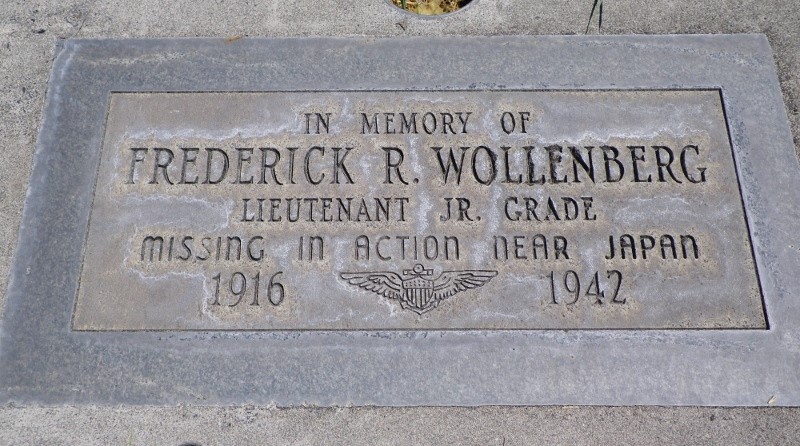
News that Fred had gone missing in action filled the papers back in Washington. The Spokesman Review in Spokane ran an article that read “Fred Wollenberg of Edwall, a Lieutenant, junior grade, in the navy flying corps, is reported missing in action since August 5, according to word received by his parents, Mr. and Mrs. F.F. Wollenberg of Edwall.” Before detailing his impressive educational and military training record at WSC and the naval air station. By 1944, still with no word regarding Fred’s fate, the Spokesman Review ran another article about WSC students killed in combat. “Death has come to three of the W.S.C Theta Chis.” The article reported, “Lieutenant (J.G.) Fred Wollenberger, Edwall, a navy flyer missing in action since August 1942 is believed dead.” Fred’s headstone marks 1942 as his official date of death, other military records show that Fred was not considered officially killed in action by the United States Navy until December 4, 1945.
Fred is memorialized in numerous locations. His official resting place is the Ritzville memorial cemetery in Ritzville, Washington. He was awarded a posthumous purple heart and is listed on the Tablets of the Missing, a “structures erected in honor of someone whose remains lie elsewhere.” at the Honolulu Memorial in Honolulu Hawaii, part of the National Memorial Cemetery of the Pacific. Lastly his name is emblazoned on the World War II memorial located on the main campus of his alma mater, now called Washington State University, in Pullman, Washington.