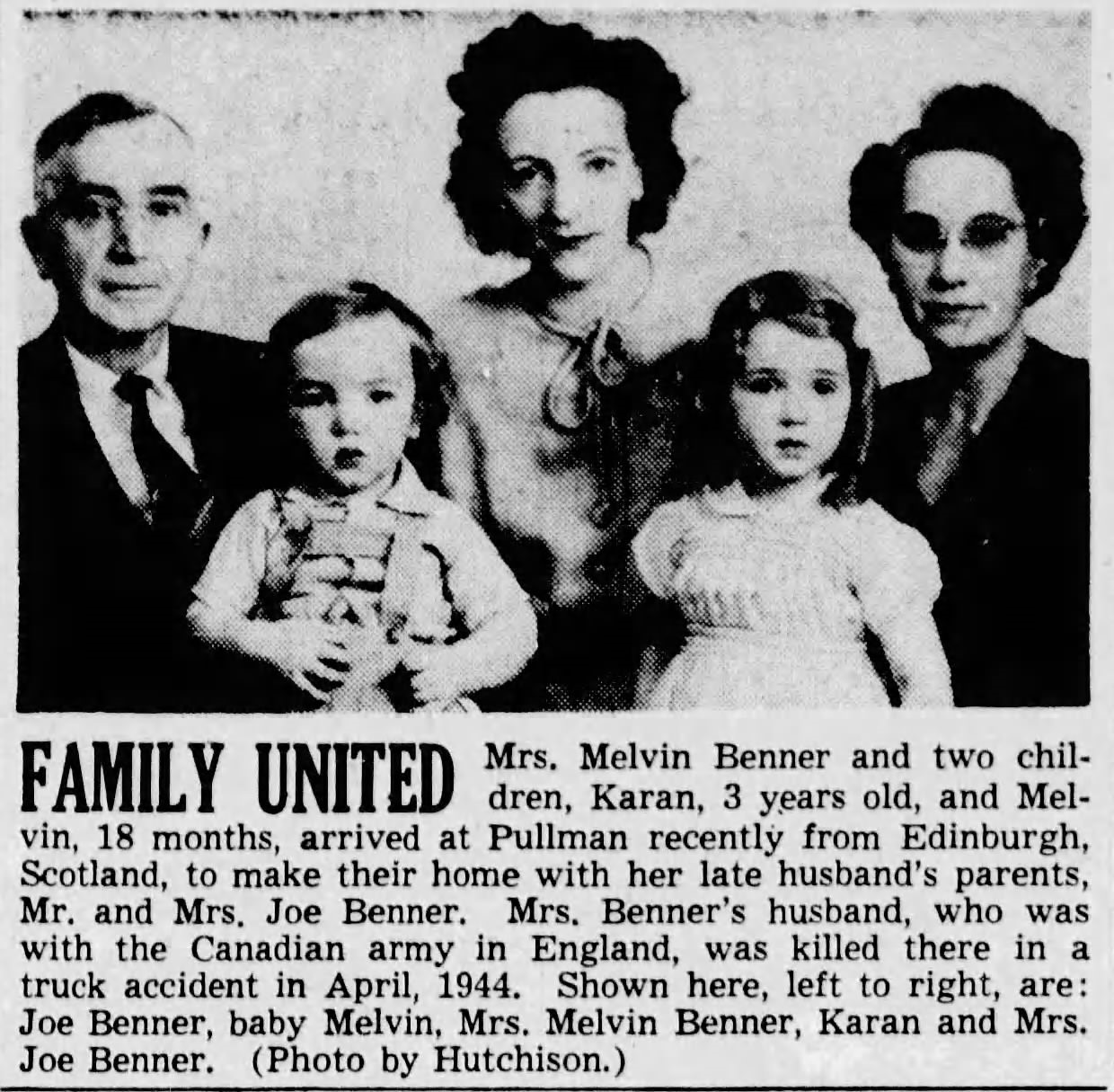
Melvin Joe Benner
Pre-WSC Background
The tiny town of La Crosse, Washington has as typical a backstory as a small Eastern Washington town can have. The ancestral home of the Palouse people, the rolling hills and grass lands of the Palouse proved perfect for the breeding and raising of horses, so much so that the modern horse breed “Appaloosa” most likely originated as a word for the horses favored by the Palouse Native American people. The Palouse people became expert horsemen, hunting the vast stretches of their lands that extended approximately from the confluence of the Snake and Columbia rivers in the west to the confluence of the Snake and Clearwater Rivers in the East, with the Spokane, Coeur d’Alene, Nez Perce, Cayuse, Walla Walla, and Yakima peoples as neighbors. The Lewis and Clark expedition came through Palouse territory in 1805, but unlike Lewis Clark, Americans that came in the following years did not leave. By the 1830’s more and more Americans settlers moved onto Palouse territory. Four tumultuous and violent decades followed, ending with the defeat of all Native American resistance in the region by 1877. With the land in the hands of the United States, settlers moved onto what is now Whitman County and, as always, the railroad determined where villages and towns would arise. When the Oregon Railroad and Navigation Company finished a line to the now-extinct town of Riparia, Washington, George Dawson and his wife built a shack made from left-over railroad ties along the rail line in 1889 and named their new home La Crosse. La Crosse grew into a wheat farming community officially incorporated in 1917 and today hosting a population of around 320 inhabitants. This is a story about a Native Son of La Crosse, and while his hometown may have a typical backstory, Melvin’s life only started typical before it became something rather unusual for men of his time.
Joseph Foote (J.F.) and Jennie Benner lived on the aptly named Dusty Road in La Crosse. J.F. worked on a farm and Jennie tended to their home. On September 20, 1916, Jennie gave birth to their first and only child, Melvin Joseph Benner. The family remained in La Crosse throughout Melvin’s early life but went through substantial changes over the course of the following decades. When he was five-years-old Melvin was diagnosed with Polio. The Scourge disease of the age, polio attacks spinal tissues and renders many of the poor souls so afflicted paralyzed or even dead very young. Luckily Melvin managed to overcome the disease and suffered no long-term problems as a result. In the 1930 census the family still lived on the Dusty Road farm but J.F. lists his occupation as a vendor for a Milk Company while Melvin attended La Crosse High School.
By 1940 the family appears to have accomplished a long-term goal and opened their own business. The family moved from Dusty Road in La Crosse to a new home on Albion Road in Pullman. J.F. lists his occupation in the 1940 census as the owner-operator of a Dairy, writing “dairyman” as his official title and Jennie lists her occupation as dairy worker at the family-owned business.
WSC Experience
By this time Melvin had graduated from La Crosse high school and after a few years working with the family he made the decision to continue his education at Washington State College in Pullman in 1936. Oddly, Melvin lists his education level as “C1” or “College 1st Year” in that same 1940 census, but Washington State College records show he completed two years at WSC, 1936 – 1938. Regardless Melvin then lists his occupation as a delivery man for a “retail grocery market,” bringing in about $1,500 per year. Newspaper articles preserved in Washington State University Manuscripts Archives and Special Collections (MASC) files show that the “retail grocery store” was actually two stores; Burgan’s Grocery and Maxwell’s Meat Market in Pullman. This is the first mention of Melvin driving a delivery truck in his life. But it turned out that operating and driving big trucks loaded with precious cargo was the defining skillset of his life. The Daily Evergreen newspaper also noted that “during two summers he was a Soil Conservation Employee working out of St. John,” another tiny town on the Palouse. With Melvin working hard at his delivery driving and soil conservation jobs and with his parents getting older, the family must have needed extra help around the house. Frederic A. King, a twenty-eight-year-old high school graduate lists himself as a “lodger” in the Benner family home while working as a grocery store clerk at a retail grocery store. Unfortunately, there is shockingly little material on Melvin’s time at Washington State College. Records from the Registrar’s office show that Melvin lived in Pullman and attended the university as an Agriculture major from 1936 – 1938. Perhaps his busy work schedule and being so close to home occupied much of his time, or perhaps his wanderlust kicking in took him away from his time as a Cougar. Whatever the case, it is at this point that Melvin’s life changed unexpectedly.
In 1939, Melvin moved to Victoria, Canada, ostensibly to take another truck driving job there. But in September of 1939, whatever plans Melvin may have had for his long-term life in Canada were radically altered. World War II in Europe began when Nazi Germany invaded Poland on September 1, 1939. The fascist government, under the leadership of Austrian-born dictator Adolf Hitler, waged war throughout Europe. They conquered both Denmark and Norway in April of 1940, followed by Belgium, the Netherlands, and tiny Luxembourg in May of that same year. Most astonishingly the Germans managed to conquer France in just 39 days, snapping up North Africa from the French and British in the process. They followed up those light-speed victories with a massive aerial campaign against the United Kingdom. The nation of Canada was, at the time, a “Commonwealth” in the British Empire. This meant that Canada had control of its own internal politics and policy but deferred to Great Britain in international affairs and foreign policy. With Great Britain officially in the war against the Nazis, the Canadian Commonwealth was at war too. Suddenly men with Melvin’s education, skillset, and courage were in desperate need. The ability to drive enormous trucks in bad conditions with speed and skill was a prized military asset.
Wartime Service and Death
Melvin wasted no time after his acceptance into Canada and on June 6, 1940, he petitioned to enlist in the Canadian military. In his application he listed himself living in Bay St. Armouries in Victoria, British Columbia. He listed his profession as a truck driver, and his specific occupation as a Dairyman. He was not yet actually married, but the files kept in Canadian archives are altered resubmissions of the original files that only alter necessary information for resubmission. His marital status on the initial paperwork was unmarried, on the resubmission this is marked out with a red pen, and he is listed as married. He noted his education as two years of college, majoring in “Agronomy” at Washington State College and confirmed that he had never served in the American Armed Forces. He was 5’6 inches tall, weighed 215 pounds with blue eyes, perfect vision, and good teeth according to the medical examination in his application.
Melvin was assigned to the Royal Canadian Armed Services Corps (RCASC) attached to the 3rd division of the Petrol Company on June 18, 1940. In December of that year, he was then transferred to work with the Canadian Air Service in his logistical capacity. He got his first furlough from duty, with pay, on December 17 – December 30. In February of 1941 he was again shifted to another unit, working with the 3rd Division Composite Company before being shifted back to the 3rd Division Petrol Company in late May. By this time the Canadians were ready to move their military units to England, so Melvin was finally transferred to the HQ 3rd Division Canadian “For All Purposes.” Melvin did not know it at the time, but when he got on the boat to go to the United Kingdom, he was going to find a lot more than military service and comradery with his fellow soldiers, he was going to find the love of his life. On July 30, 1941, Melvin stepped off the boat at Gourock, Scotland. Of all the places he could have been sent, all the ports accepting Allied military personnel, he ended up in Edinburgh, Scotland, the home of one Peggy Brown.
Melvin met Peggy while attending to his duties transporting petroleum to Allied aircraft, a vital necessity in the air war over England, Northern France, and Germany. Maybe it was Melvin’s country boy charm, his courageous spirit jumping into the war before his country had, no one can know, but whatever it was, Melvin and Peggy hit it off quickly. They were engaged to be married by August of 1941, and on February 18, 1942, they were married in Edinburgh, Scotland. The couple did not waste what precious little time they had while living in a country under siege by German air force and rocket attacks. On March 19, 1943, they welcomed their first child, Karen Estelle, into their little family.
While Melvin was not serving in a front-line capacity, the jobs of the logistical units were far from safe. Aside from driving vehicle full of highly combustible materials from one bomb-target location to the next, there were other dangers. Because of German air attacks and worries about giving away troop concentrations on the British Isles while they prepared for the D-Day invasion, England was in blackout after dark. This required military personnel to drive in near darkness much of the time as they hurriedly fueled and outfitted the forces bound for Nazi-occupied France. One such dark night came on April 20, 1944, when Melvin and another soldier were driving on Lorry Road “somewhere in England” when a large military vehicle, sometimes described as a bulldozer, backed into the road in front of them. They could not stop their vehicle in time and Melvin was killed on impact. Melvin Benner was an American man from a typical American town who lived a typical American life through his early twenties, moved to a foreign country, then joined the Canadian military, sailed across the Atlantic Ocean to England, where he promptly went to war with the Axis powers, and married a Scottish woman with whom he started a family. Melvin’s life turned into quite a harrowing saga, and his death was tragic and left his family in such severe grief, but much like their son, the Benners had a fighting spirit, and his tragic passing signaled the beginning of a harrowing journey for them.
Postwar Legacy
Almost immediately, the members of the Benner family back in Pullman and the members of the Benner family in Scotland began a struggle to make the family whole. As if this were not a pressing enough issue, Melvin gave the family one last gift before his passing. In Jennie Benner’s attestation letter to the Canadian military on May 25, 1944, she explained that “Peggy Benner (wife) and Karen Estelle Benner (child) at Edinburgh Scotland wish to come to Pullman, Washington before this unborn child comes in September so the parents of the deceased can take care of them. This was also the wish of the deceased. We the broken-hearted parents wish this So Very Much. She has made application to come as quickly as possible and we hope it won’t be long.” While the family beseeched the Canadian government to allow them to unite, they also had to make sure to make decisions about Melvin’s earthly remains. The Canadian Ministry of Information replied to Melvin’s burial by explaining, "It may be some measure of comfort to you to learn that most satisfactory arrangements have been made for the burial of deceased Canadian servicemen in England in the Canadian plot in Brookwood cemetery. This is a very beautiful place and is maintained at a high standard by the Imperial Graves Commission. The plot will be a place of honour where those who have fallen while under arms will lie side by side, under perpetual government care and attention.”
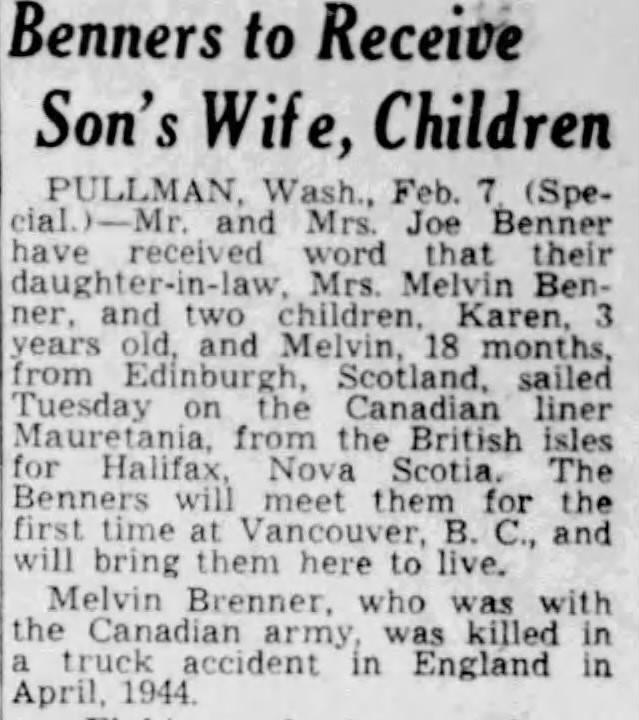
In late May of 1944, the topic of uniting the Benner family hit the local papers in Washington State, often with good news. On May 26th The Pullman Herald ran an article with the headline “Benners Get Word Son’s Widow and Baby will Come Here,” The article informed the public that “Mr. and Mrs. Joe Benner this week received word that their daughter-in-law, widow of their only son, private Melvin Benner who was killed in a lorry accident ‘somewhere in England’ April 20, has applied for and been granted permission for herself and her year-old daughter, Karen, to join the Banners here.” However, the military situation had not changed, and “However, the present embargo on English shipping is delaying their departure for the States.” Four months later, the Benner parents received more wonderful news that was then published in the Spokane Chronicle: “Mr. and Mrs. Joe Benner received a cablegram Wednesday from Scotland announcing the birth of a son, Melvin Joe, September 27, to their daughter-in-law.” Little Melvin not only had his father’s name, but also his mother’s birthday.”
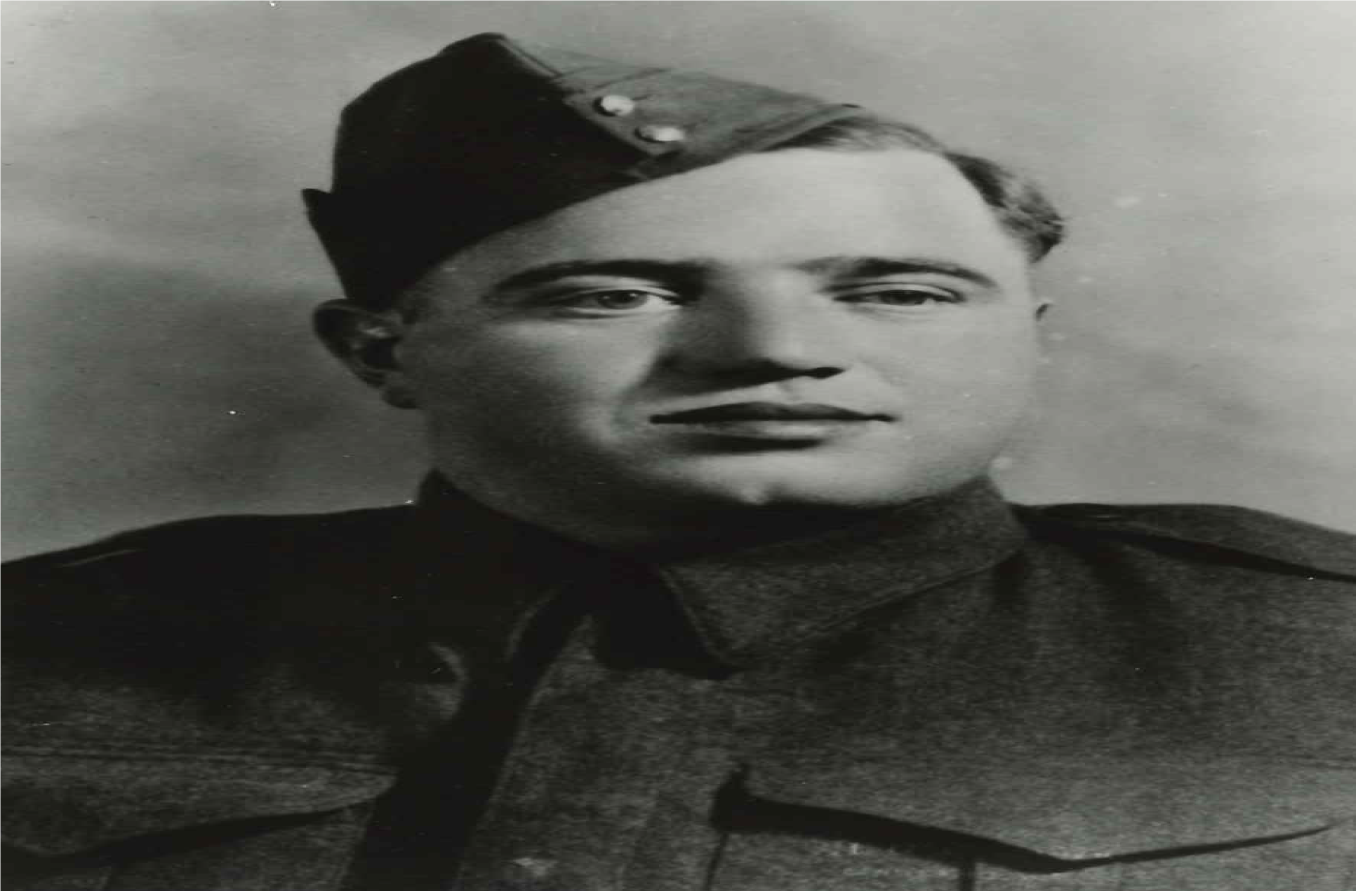
The war raged on, and the newspapers went distressingly quiet for this researcher. That is until an article on March 11, 1946, published in the Spokane Chronicle appeared. The story contains a large picture of the Benner clan all together in Pullman. Joseph, the doting grandfather holds his baby grandson, Melvin on his knee. Jennie who worked tirelessly to make this happen union happen balances little Karen on hers, and Peggy sits center frame. “FAMILY UNITED” reads the caption and continues “Mrs. Melvin Benner and two children . . . arrived at Pullman recently from Edinburgh Scotland, to make their home with her late husband’s parents, Mr. and Mrs. Joe Benner. Mrs. Benner’s husband, who was with the Canadian army in England, was killed there in a truck accident in April of 1944.”
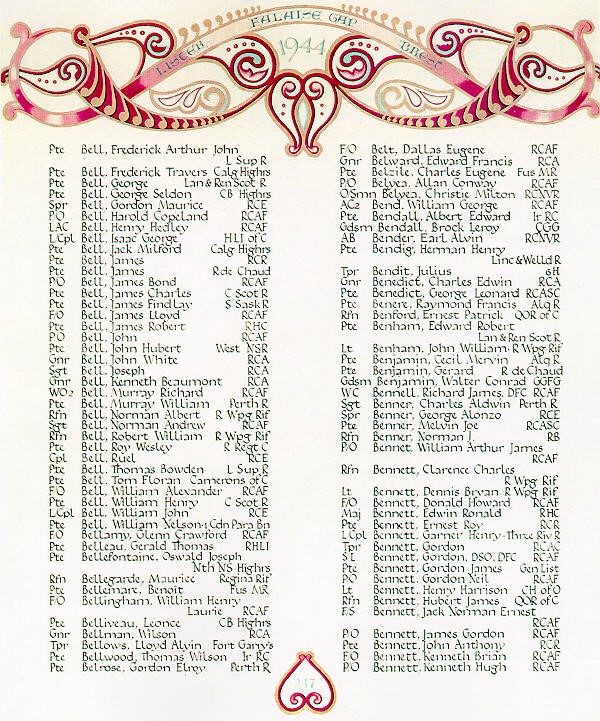
Clearly, Melvin’s family was his most important legacy and proof of a life well-lived and a sacrifice willingly made for those he cared for. But his family is not the only monument to that sacrifice. The Canadian government commissioned a lovely book called the Second World War Book of Remembrance, containing the names of all soldiers lost under the Maple Leaf banner. Melvin is listed on page 247. Melvin’s name is also carved into lovely white stone at his initial burial site in England, the Woodvale Cemetery and Crematorium. The Canadian government was right in telling Jennie that her son’s resting place was beautiful. And lastly, back home on the Palouse, where Melvin used to help his parents on the farm and the dairy, where he later drove trucks loaded with artisan meats or dairy products, took soil samples for government agencies, and attended classes in agronomy, another monument can be found. On the main campus of Melvin’s Alma Mater, today called Washington State University, in Pullman, Washington, his name is emblazoned in gold letters on the World War II memorial honoring WSU alumni that made the ultimate sacrifice to defeat Nazism and is listed alongside the names of his Fallen Cougar brethren.