
Jackson "Jack" Leonard Snyder

Early Life
Jackson “Jack” Leonard Snyder was born on September 30th, 1924, in Phoenix, Arizona to Lewis “Lew” and Mildred Snyder (nee. Newcomb). Jack’s parents met in Hazleton, Idaho after both relocating from the Midwest for work. Mildred worked as a schoolteacher and travelled between school districts, staying with host families, while Lew worked as a steel worker. Before meeting Mildred, Lew had served in the US Army as part of the 39th Field Artillery Battery in WWI, working at Camp Lewis in Washington State. Lew moved to Idaho after the war. The pair married in September in 1921 and gave birth to their first daughter Emma in February of 1922. By the time of Emma’s birth, Mildred and Lew were living in Utah. Emma and Jack also had younger brother: Donald, born in 1921. Mildred and Lew divorced in the early 1930s, and Mildred remarried Howell S. Payne in 1936. Jack, Emma, and Donald stayed with Mildred and Sherman in Phoenix, while Lew had moved to Trona, California by 1940. Lew stayed in California until his death in 1959. In 1938, Mildred and Sherman had son together, named Howell S. Payne Jr, who became Jack’s youngest sibling. Jack attended Phoenix Union High School between 1939 and 1943, graduating in Spring of 1943. While at Phoenix Union, Jack was involved in the Hi-Y Club, a youth club for young Christian men, throughout his sophomore, junior, and senior years. He also participated in Spanish Club in his freshman year, Masque (setting up social events) in his junior year, and the Mor Follies (in which students performed patriotic pantomimes) in his senior year. In his senior year, Jack also worked as an attendance collector. At the time of his graduation, Jack noted his interest in pursuing pre-Engineering after high school. This may have been one of the things that drove Jack to take the qualifying exam for the Army Specialized Training Program in 1943.
WSC Experience
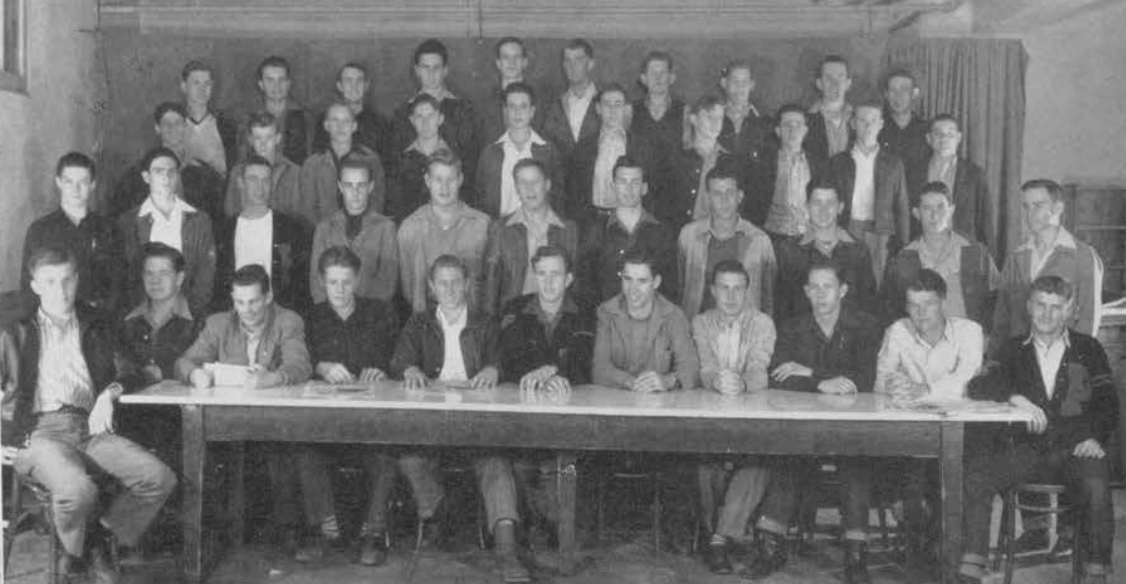
Jack attended Washington State College from 1943-1944 as part of the Army Specialized Training Program (ASTP). This program, designed to develop additional skills among enlisted infantrymen in the United States Army, invited 18–20-year-old high school graduates to attend university as a part of their military service. Students who participated in ASTP might receive training in a range of engineering or medical programs in addition to their basic training, however at the end of their designated time on a university campus (usually no more than two years), instead of commissioning as an officer as they would through an ROTC program, they would go on to serve alongside other enlisted soldiers. The program required young men to take a qualification exam to determine their aptitude and before they were matched to one of any 277 participating college campuses. On campus, the ASTP units and staff were a central part of campus life, making up the majority of intramural sports teams as well as participating in regular clubs, fraternities, and academic organizations. Although we do not have record of Jack’s social participation, we know that as an engineering student, he would have been in Company B on campus. Unfortunately, the ASTP program was discontinued before Jack and his classmates could finish the basic phase of his curricula training. Alongside the rest of his company, Jack was sent to the frontlines in Europe to join the 11th Armored Division of the United States Army.
Military Service & Death
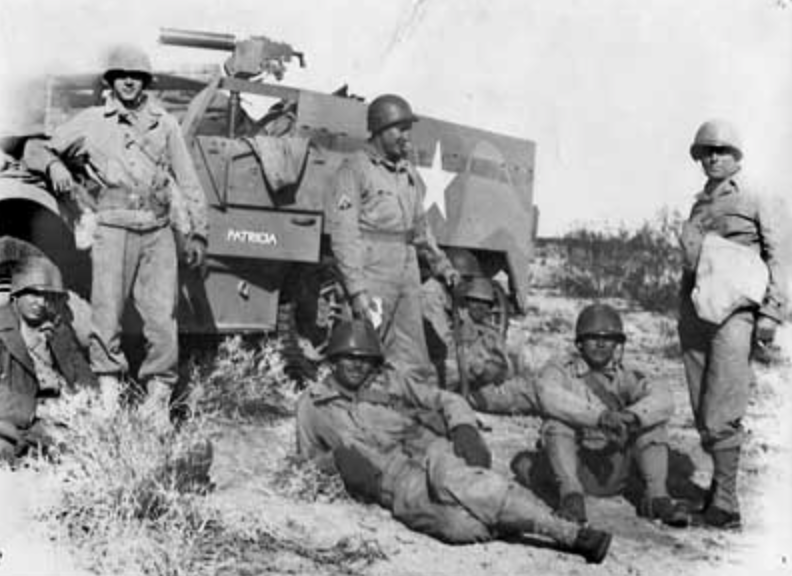
Within the 11th Armored Division, Jack served in the 55th Armored Infantry Battalion. The 55th Armored Infantry Battalion was created in August 1942 and Jack would have joined them while they were training either at Camp Ibis, in California or later at Camp Cooke in California. Jack’s division sailed for Europe in September of that same year and pushed forward to the Belgian frontlines around the wintertime. Throughout December the 55th served as part of the 11th Divisions’ Combat Command Reserve for the taking of Bastogne. In January of 1945, after pulling back to Magerotte at the end of 1943, the 55th Armored Infantry Battalion was assigned to assist in clearing the Bois de Nom de Falize, a forest in Belgium, of German forces. The soldiers faced severe weather during this time, with frequent snow flurries and poor visibility creating more obstacles to their mission. However, the Battalion was able to move through Cobru, Belgium, to Boer, Belgium, and establish defensive positions. On January 18th, 1944, the day of Jack’s death, the 55th was ordered to push up and offer relief to the 502nd Parachute Regiment of the 101st Airborne Division in Cobru. Instructed to create and reinforce a defensive line while also maintaining contact with the enemy, the 55th lost fifty-one soldiers during this mission, including Jack.
Burial, Recognition, and Legacy
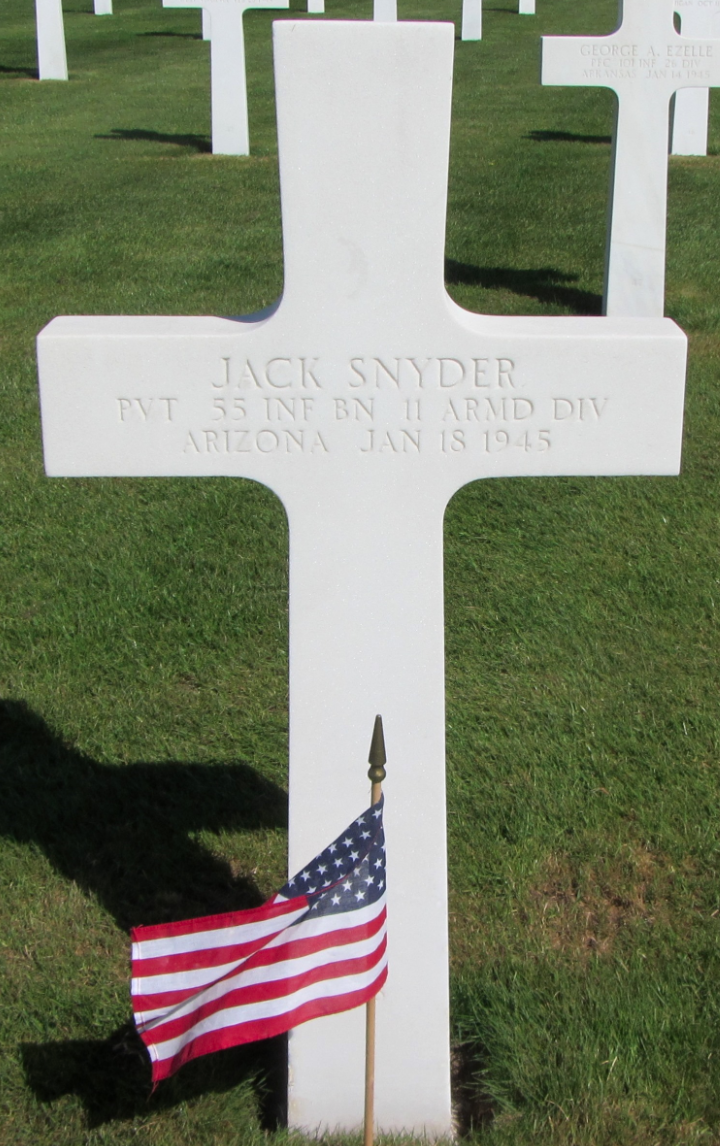
Private First-Class Jack Snyder received a Purple Heart for his sacrifice in Belgium. He was buried in Luxembourg American Cemetery and Memorial, a cemetery for American soldiers who were killed overseas. Within his military records, Jack is recorded as having died in Hardigny, near Bastogne. His mother, Mildred, was his listed next of kin. Though little information is available about Jack’s family, his brother, Donald, also served in the US Military in the Korean War. Donald, who apprenticed as a Merchant Marine after leaving secondary school, enlisted shortly after his 16th birthday in 1942. Returning to San Francisco after his service in 1952, Donald, like Jack, had also achieved the rank of Private First Class.